STYLING GUIDE · REVIEWED 20 JULY 2026
The short answer: choose a pair when you want symmetry and an easy visual anchor; choose a single earring when the design is sculptural, your haircut or piercings already create asymmetry, or you want one clear focal point. The best arrangement is decided by scale, visual weight, comfort and what else appears near the face—not by gender rules.
A practical decision table
| Your priority | Try a single | Try a pair |
|---|---|---|
| One strong focal point | Best when the motif has a clear direction or silhouette. | Can feel visually heavy if the design is large. |
| Balanced everyday look | Works if balanced by hair, glasses or another small stud. | The most straightforward option. |
| Multiple piercings | Useful as the anchor in an intentional ear stack. | Use the pair as anchors, then add smaller supporting studs. |
| Different left/right motifs | Wear the motif that best faces outward on that ear. | An asymmetric pair can create a coherent story without mirroring. |
| Formal clothing | A restrained single can modernise a clean neckline. | Pairs frame the face and read as more conventional. |
| Comfort testing | Lets you assess scale and weight on one ear. | Confirms whether both closures and lobes feel equally comfortable. |
Step 1: read the earring's visual weight
Visual weight is not the same as physical weight. A small black stud may appear stronger than a larger bright stud because contrast draws attention. A gold detail can become the focal point even when it covers only a small area. Textured hoops create more outline and movement than a flat stud of similar dimensions.
Start by holding the earring near your ear in neutral light. Look at the whole head-and-shoulders view, not only a close mirror. If the piece is immediately dominant, treat it as an anchor and simplify the other side. If it disappears, pair it or support it with a second small shape.
Step 2: choose an anchor
Every arrangement benefits from one element that reads first. It can be the largest earring, the darkest earring, the piece with the strongest silhouette or the only warm-coloured detail. When every earring competes equally, a multi-piercing arrangement looks accidental.
- One piercing per ear: use a matched pair for calm symmetry, or a single sculptural earring and let hairstyle/clothing balance the other side.
- Two piercings on one ear: place the anchor in the lower lobe and a smaller, simpler stud above it.
- Multiple piercings on both ears: repeat one feature—metal colour, dark finish, angular line or motif—but vary the scale.
Step 3: coordinate with what is already near your face
Hair
Short or swept-back hair gives the earring a clear outline, so small sculptural studs remain readable. Long loose hair creates movement and may catch on projections; compact studs or secure close-fitting hoops are easier to manage.
Glasses and headphones
Frames already add lines and metal near the ear. Repeat their shape deliberately or choose a contrasting organic motif. Check the earring from the side to ensure a hoop or post back does not collide with headphone cushions.
Necklines and collars
A high or detailed collar adds visual activity below the ear; a small pair or single stud keeps the area clear. An open neckline can support a more pronounced hoop or asymmetric arrangement.
Five reliable arrangements
- The quiet pair: two compact studs in the same design. It works with business clothing and layered necklaces because it does not compete.
- The single artifact: one sculptural stud or hoop, with the opposite ear left bare. Best when the motif has a recognisable silhouette.
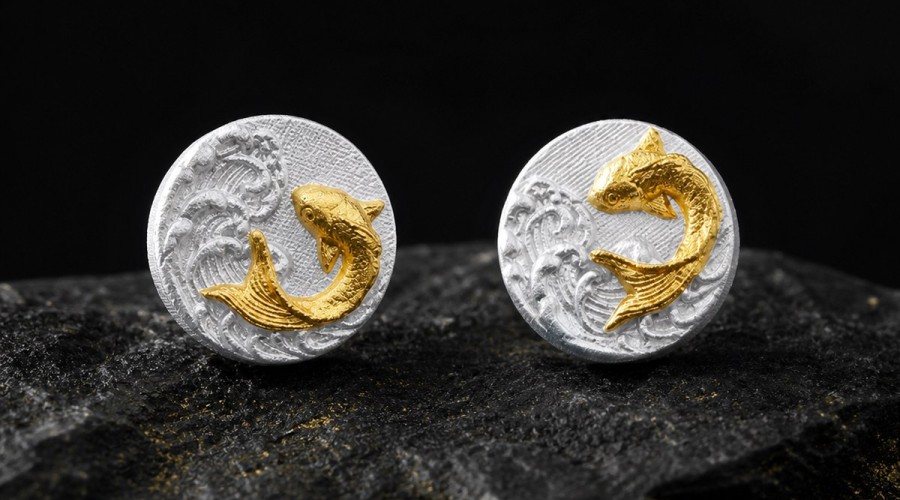
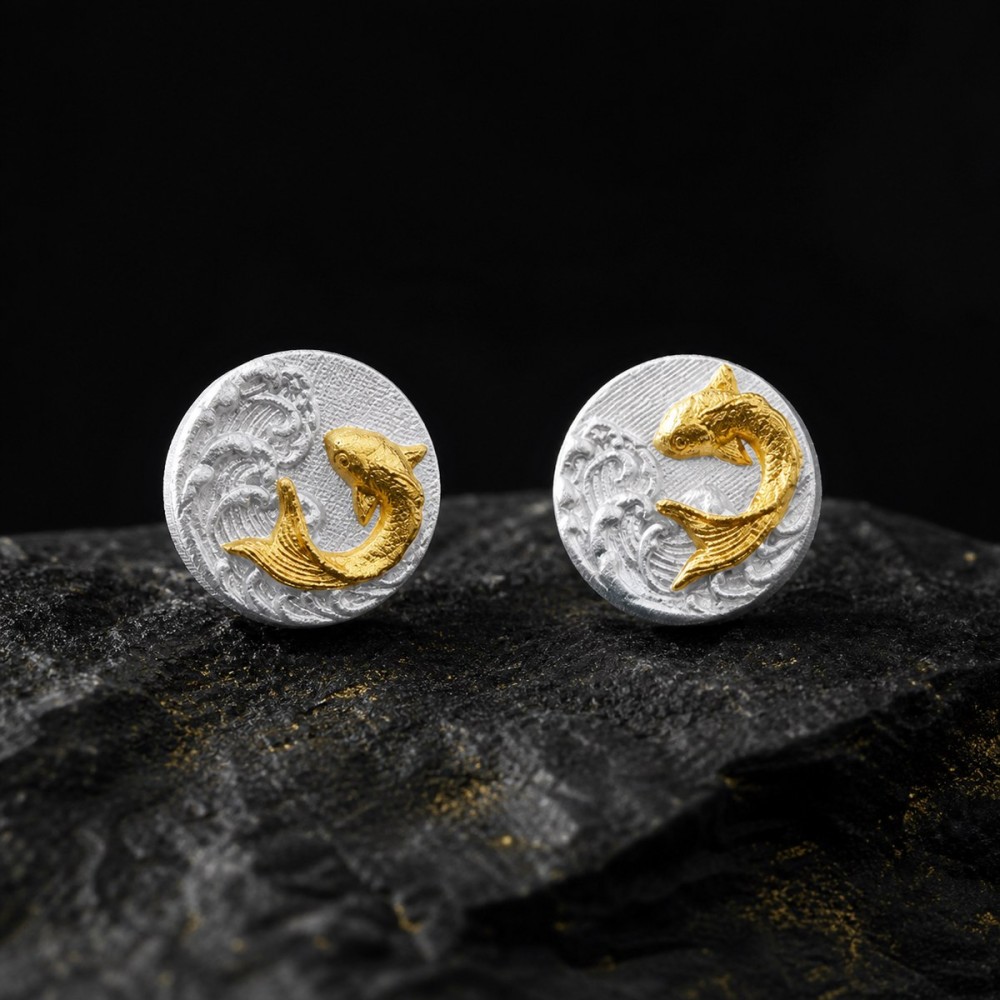
- The directional pair: two related earrings that face or move differently. Position them so the movement follows the jaw or points outward rather than appearing accidentally reversed.
- The anchor and echo: one dark or gold-detailed earring in the first piercing, plus a plain small silver stud above it.
- The controlled mismatch: different motifs sharing the same fine-silver finish, surface darkness or gold accent. Keep at least one repeated element so the mismatch looks intentional.
How to test a look before committing
- Confirm the product is supplied as a single or a pair.
- Try the arrangement at home for 15–30 minutes before a full day of wear.
- Take one front and one side photo in daylight. A photograph reveals imbalance that a close mirror can hide.
- Move your head, put on glasses or headphones, and check for contact.
- Inspect the lobe. The earring should not pull the piercing sharply downward or rotate continuously.
- Remove it immediately if you feel persistent pinching, heat or pain.
Material and piercing considerations
Our styling suggestions assume a fully healed piercing. For a new or healing piercing, decorative choice is secondary to appropriate implant-quality material, fit and professional aftercare. The Association of Professional Piercers states that sterling silver and gold-plated jewelry are not suitable for initial piercings. If you have known metal sensitivities, ask for the full alloy composition rather than relying on “silver-coloured” or “hypoallergenic” marketing language.
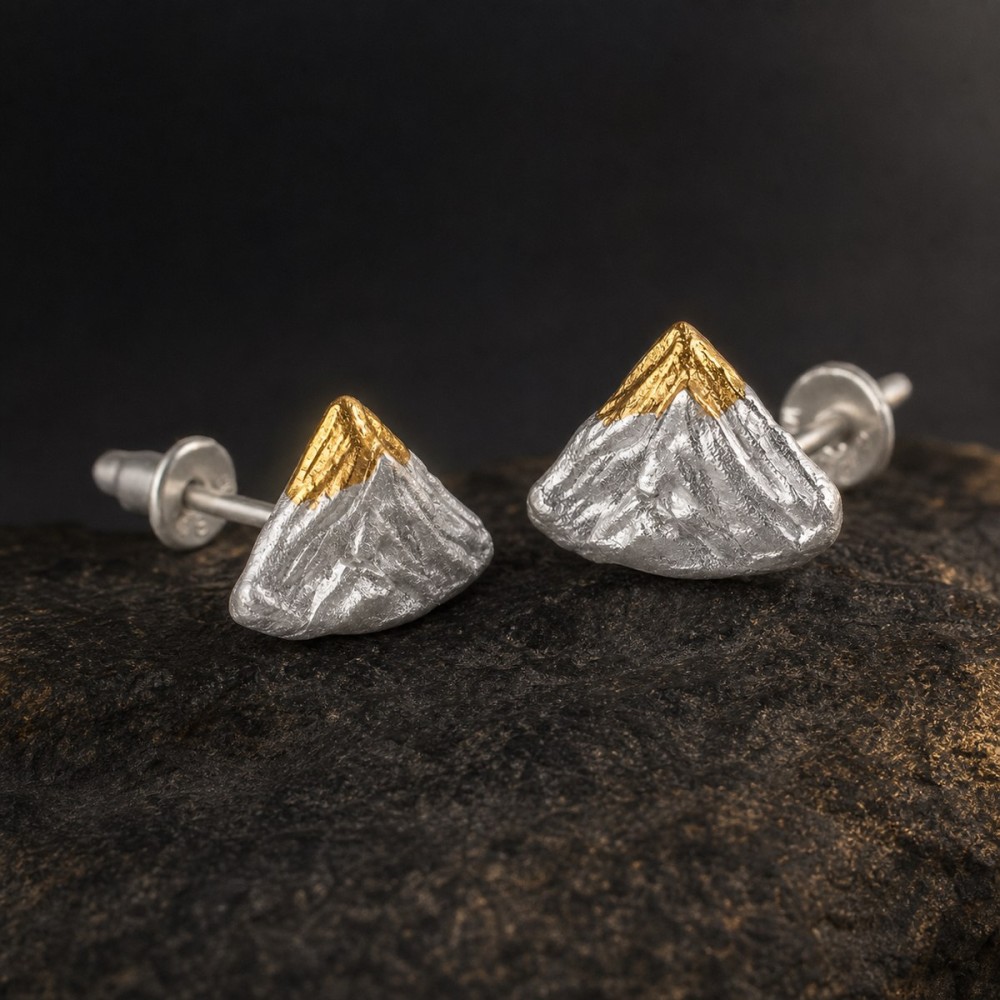
For a clearer material comparison, read 925 vs 999 silver earrings. To build an arrangement, browse all silver earrings, snake earrings, or the mountain stud pair.
Common styling questions
Must a single earring be large?
No. A small motif can work alone when it has strong contrast, a directional shape or a warm gold point against dark silver. Scale the choice to viewing distance: a quiet stud may be ideal in conversation even if it does not dominate a full-body photograph.
Can I split a supplied pair between two people?
Only if both wearers are comfortable with the same post, closure and material, and understand that a pair may include left- and right-facing pieces. Keep the order and material information with both earrings. For hygiene, do not casually share worn posts without appropriate cleaning.
How do I mix 925 and 999 silver?
They can be worn together. The difference in fineness is less visually important than surface finish. Repeat either bright polish, dark oxidation, texture or gold detail across the arrangement. Read the individual care instructions because the softer or mixed-finish piece may require gentler handling.
What if one lobe sits lower?
Perfect anatomical symmetry is uncommon. Use the mirror to adjust visual weight rather than trying to hide the ear: place the slightly smaller or brighter piece on the lower side, or use the same compact pair and let the natural difference remain. Comfort takes priority over forcing identical angles.