What Does “Black Zircon” Mean on an Earring Listing?
A stone label can be useful, but it is not a complete gem report. “Black zircon” is especially easy to misread because zircon and cubic zirconia are different materials with similar names. Before buying, separate what the listing actually says from what would need an origin, treatment or laboratory record to prove.
Start with the two names that sound alike
Zircon is a naturally occurring zirconium-silicate mineral. The U.S. Geological Survey identifies zircon as ZrSiO4. Cubic zirconia, often shortened to CZ, is a different material: a man-made zirconium-oxide simulant. GIA notes that CZ can be made in many colours, including colours used to imitate darker gems. The names share “zircon,” but one name alone does not turn one material into the other.
That distinction matters at checkout. A listing that says “zircon” is not automatically a statement that the stone is untreated, natural, laboratory tested, valuable, or suitable for every cleaning method. Conversely, a dark stone should not be relabelled CZ just because the listing does not provide a laboratory report. The accurate answer is the documented one.
What this Skullearring listing confirms
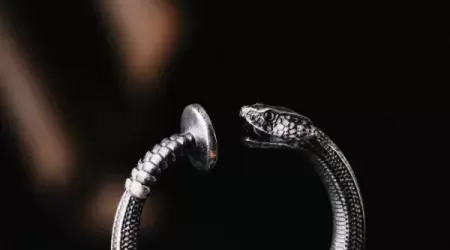
The current Rattlesnake Ear Cuff describes a black-zircon detail in a spring-opening S925 sterling-silver cuff. Its published product facts include an approximately 19 mm outer diameter, 14 mm inner opening, 3 mm width and 2.4 g weight per cuff. The required purchase selector lets the buyer choose one cuff or a pair of two.
Those are useful product facts. They do not establish whether the black zircon is natural or laboratory-grown, whether it has been treated, its carat weight, or a laboratory grade. The product page makes those limits explicit. A buyer who needs one of those answers should request product-specific documentation rather than treating the colour, a photograph or the word “zircon” as proof.
A practical reading checklist
- Read the noun precisely. Look for “zircon,” “cubic zirconia,” “glass,” or another stated material. Do not silently substitute one term for another.
- Separate stone facts from metal facts. “S925 sterling silver” describes the stated silver body; it does not identify the stone’s origin or treatment.
- Look for the missing details that matter to you. Origin, treatment, carat weight, grading report and setting method are separate disclosures. A listing can be honest about an unknown instead of guessing.
- Check the purchase unit before comparing cost. On this ear cuff, choose the required one-cuff or two-cuff option and read the selected total. Do not assume the shown starting price represents a pair.
- Use the product’s stated dimensions for fit. An approximately 14 mm inner opening is an item specification, not a guarantee that the cuff will fit every lobe or cartilage position comfortably.
Colour and treatment are separate questions
Colour does not disclose treatment by itself. GIA explains that heat treatment can alter some zircon colours, and its laboratory work discusses how treatment questions require testing and evidence rather than a visual guess. That is why “black zircon” should be read as the seller’s material description unless the listing also provides treatment and origin information.
This is not a defect in a listing. It is a disclosure boundary. When a stone’s origin or treatment affects your decision, ask before purchase and keep the reply with the order record. If the answer is unavailable, decide using the facts actually published rather than an assumed upgrade.
Care without overclaiming
For a verified natural zircon, GIA recommends warm soapy water and advises against ultrasonic and steam cleaners; it also notes that zircon can be brittle. This particular listing does not establish the black stone’s origin or treatment, so the cautious route is simpler: follow the product’s care guidance, wipe the cuff with a soft dry cloth after wear, avoid hard impacts and aggressive heat or chemical cleaning, and do not force the spring opening.
That advice does not diagnose the stone or promise a result. It keeps the care decision aligned with what is known about the item and what remains undisclosed.
Questions worth asking before you buy
Not every purchase needs every gemological detail. The useful question is whether a missing detail changes your decision. If it does, ask the seller a narrow, answerable question and keep the answer separate from general marketing language. For example:
- Is the stone represented as natural zircon, laboratory-grown material, cubic zirconia, glass, or another material?
- Is any colour treatment or clarity treatment disclosed?
- Is a carat weight stated for this particular piece, or is the stone described only by appearance?
- Is there a laboratory report, and if so, does it identify the stone in this item rather than a similar sample?
- Which care method does the seller recommend for the fitted stone and its setting?
Those questions do not imply that an answer must exist. They simply keep the buyer from converting a broad term into a specific claim the seller did not make. If a record is unavailable, the honest buying choice is to evaluate the design, price, metal and disclosed care on that basis rather than treating an unknown as confirmation.
Why photographs are not an identification test
A product photograph can show colour, shape, placement and overall style. It cannot reliably identify mineral species, origin, treatment, carat weight or laboratory grade. Lighting, display calibration, image processing and the scale of a small fitted stone can all change the appearance a buyer sees. This is why the Rattlesnake Ear Cuff’s photographs are useful for seeing the spring-opening cuff and dark detail, while the written product facts remain the appropriate source for its stated metal, dimensions, weight and purchase choices.
The same distinction protects the seller and the buyer. Do not use a photo to claim that a stone is untreated or natural; do not use an absence of a report to label it synthetic either. A term on a product page and a product-specific document answer different questions.
The buyer takeaway
“Black zircon” is a material label worth reading carefully, not a substitute for a gem report. Zircon and cubic zirconia are not interchangeable terms. For this Rattlesnake Ear Cuff, the listing verifies a black-zircon detail and the cuff’s stated metal, dimensions, weight, construction and one-or-pair choice; it does not verify origin, treatment, carat weight or grading. Use that line between fact and unknown to choose confidently and ask for product-specific evidence when your purchase requires more.
Leave a comment