Can 24K gold inlay wear off silver earrings? It can change through scratches, abrasion, impact or an unsuitable cleaning method, but “inlay” is not the same construction as ordinary gold plating and it has no universal wear-out date. How an inlaid detail ages depends on how the gold is set into the silver, the depth and location of the decorated area, how often it rubs against harder surfaces and how the piece is cleaned.
Pure 24K gold is chemically resistant, yet it is also physically soft and malleable. Those two facts are compatible: resistance to tarnish does not make a surface immune to dents, scratches or gradual mechanical wear. The safest answer is to identify the construction, avoid abrasive cleaning around mixed-metal detail, store the earrings separately and ask the maker about inspection or repair if the design visibly changes.
Inlay, plating and “gold colour” are not interchangeable
The first step is to ask what the seller means by inlay. The Metropolitan Museum of Art documents an electrolytic inlay process in which a recess is created in a metal object and another metal is deposited into that recess. It also notes that historical makers combined different techniques, including electrically applied and hammered inlays. That museum example proves that inlay can involve a prepared recess; it does not prove that every modern earring uses the same process or depth.
Gold plating is different. The U.S. Federal Trade Commission describes plating as a gold layer applied to a base material and says it eventually wears depending on thickness and use. The FTC identifies vermeil as a particular type of gold-plated product with a sterling-silver base. U.S. jewellery guidance also treats gold content, thickness, method of application and durability as material facts that should not be misrepresented.
Therefore, a page that says only “gold colour,” “gold tone,” “gold detail” or even “gold inlay” does not answer every construction question. A careful buyer should look for the stated gold fineness, base metal, application method and which part of the earring contains the gold.
Why 24K gold can mark even though it resists tarnish
The Royal Society of Chemistry identifies pure gold as 24 karat and describes gold as the most malleable metal and soft enough to be cut with a knife. The Canadian Conservation Institute likewise explains that relatively pure metals are soft, malleable and ductile because their atoms can slide when force is applied.
This is a mechanical limit, not a defect. A small gold detail may acquire fine marks when it rubs against other jewellery, hard storage surfaces, tools or abrasive particles. Raised high points and edges generally meet contact before recessed areas, but the actual pattern depends on the individual design. Without a measured cross-section or maker documentation, a retailer should not promise how many years a particular inlay will look unchanged.
What visible change might mean
| What you see | Possible explanation | Lower-risk next step |
|---|---|---|
| Fine lines or dullness on the gold | Surface scratching, residue or repeated rubbing | Stop polishing; photograph the area in diffuse light and ask the maker before further cleaning. |
| Silver darkening around bright gold | Silver tarnish creating more contrast; this is not automatically gold loss | Clean only by a method confirmed for the mixed-metal construction. |
| A gold edge appears thinner or interrupted | Wear, impact, incomplete original coverage or a photographic/lighting effect | Compare with earlier close-up photographs and request professional inspection. |
| A raised section is dented | Mechanical force on a soft metal or on the supporting silver | Do not push it back with household tools; ask whether the maker can repair it. |
| Colour changes after a dip or polish | Residue, over-cleaning or removal of surface material | Stop the treatment, rinse only if the product instructions make that safe, and seek qualified advice. |
These are diagnostic possibilities, not remote proof. Colour in a phone photograph changes with exposure, white balance, reflections and surrounding surfaces. An image can document a change, but it cannot measure the remaining depth or mass of gold.
Why aggressive silver polishing is risky around inlay
The Canadian Conservation Institute warns that every polishing or chemical tarnish-removal treatment takes away some underlying silver. It also explains that polishes are abrasive, leave fine scratch patterns and can damage gilding or surface inlays. General-purpose metal polishes are more abrasive than products designed for silver.
That guidance is written for conservation objects, so it is deliberately cautious. The useful consumer lesson is not to treat a mixed-metal earring as an undecorated block of silver. Toothpaste, scouring powders, stiff brushes and general metal polish can abrade high points and collect in recesses. A chemical dip can also behave differently across silver, gold, solder, patina, stones or other attached materials.
If the maker provides specific instructions, follow those instructions for that construction. If not, begin with the least aggressive step: remove loose dust with a very soft, clean brush or wipe gently with a dry, lint-free cloth. Do not scrub the gold-silver boundary. Stop if fibres catch on an edge or if colour transfers to the cloth.
A conservative care routine for gold-inlay silver earrings
- Inspect before cleaning. Check the gold detail, silver surface, post, backing, solder joins, stones and intentionally darkened finish. A loose part or lifted edge needs repair, not polishing.
- Limit friction. Put the earrings on over a soft surface and remove them before an activity likely to press or scrape the decorated front.
- Keep pieces separate. Store each stud in its own soft compartment or pouch so another earring, chain or backing cannot rub across the face.
- Control residues. Cosmetics, hair products and skin oils can change the appearance of the surface. Wipe gently after wear instead of waiting for a heavy build-up.
- Avoid unverified dips and abrasives. A cleaner labelled for silver is not automatically suitable for gold inlay, oxidation, gemstones, adhesive or mixed components.
- Document change. Take a sharp close-up in neutral, diffuse light when the item is new. Future photographs under the same conditions make a maker consultation more useful.
These steps reduce avoidable abrasion; they do not make an earring maintenance-free or guarantee that every finish will remain visually identical.
Does blackening around the gold mean the gold is failing?
Not necessarily. Silver commonly develops tarnish when it reacts with sulphur-containing compounds in the environment. On an oxidized design, a dark silver background may also be intentional. Either type of darkening can increase the visual contrast with gold and make the gold appear brighter or smaller without proving that gold has been lost.
Do not remove a dark finish until you know whether it is intentional. Our guide to cleaning oxidized silver earrings explains why preserving the recesses and high-low contrast requires a different goal from polishing every surface bright.
Can worn inlay be repaired at home?
Home repair is not a reliable default. Inlay may involve a recess, mechanical working, electrochemical deposition, heat, pressure or another shop-specific process. Filing, burnishing, gluing or adding metallic paint can change the original surface and make later professional work harder.
Ask the maker four questions: Is the change normal for this finish? Can the existing gold be inspected without aggressive polishing? Is replacement or re-inlay available? Will repair alter the oxidized or hammered silver around it? If the product description never identified the construction, request that information before authorizing a repair.
A real Skullearring example—and its evidence limits
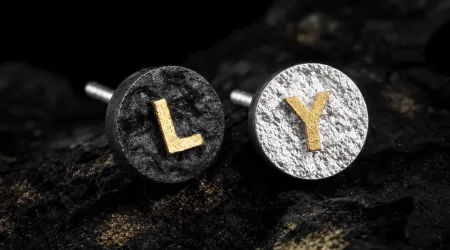
The current Personalized Initial Stud Earrings page states that the round disc is 999 fine silver and the uppercase letter is 24K gold inlay. It also describes a hammered handmade surface, black-oxidized or natural-silver finish, a straight post with butterfly backing, and single-stud or pair options. The listed letters are L, Z, N, W, M, Y, C, X, H, S, J, G, O and Q.
The same page does not publish the inlay depth, measured gold mass, exact bonding method, disc dimensions, per-stud weight, post metal, backing metal, wear lifespan or repair terms. Those fields must remain unknown until verified. This article therefore does not call the construction plating, vermeil, keum-boo or permanent.
For terminology, read what 24K gold inlay means. For the construction boundary, compare gold inlay, vermeil and gold-plated silver. Those pages answer different questions from the present care-and-wear guide.
Buyer checklist before ordering gold-inlay earrings
- Which component is gold, and is its fineness stated as 24K?
- Is the decoration in a recess, on the surface or described by another verified process?
- Is the base 999 fine silver, 925 sterling silver or a different metal?
- Are the post and backing materials stated separately from the decorative front?
- Is the dark area intentional oxidation, natural tarnish or another coating?
- What cleaning method does the maker recommend for this exact construction?
- Can the maker inspect or repair the gold detail if it changes?
- Are dimensions, weight and single-versus-pair quantity clearly listed?
A seller who cannot answer every question should label the missing field as unknown rather than replace it with a durability promise.
Evidence and limits
This guide combines material properties, conservation cautions and U.S. jewellery terminology. Museum guidance is intentionally more conservative than ordinary household care, while federal terminology does not test the service life of a specific earring. None of the sources predicts how quickly one Skullearring design will change.
Authoritative sources consulted:
- Canadian Conservation Institute: Silver—Care and Tarnish Removal
- Canadian Conservation Institute: Caring for Metal Objects
- Royal Society of Chemistry: Gold
- Federal Trade Commission: Buying Platinum, Gold, and Silver Jewelry
- eCFR: 16 CFR Part 23 Jewelry Guides
- The Metropolitan Museum of Art: Electrolytic Inlay
Conclusion
24K gold inlay can acquire marks or change at exposed areas because pure gold is soft and because mixed-metal surfaces respond to friction and cleaning. That does not make inlay identical to plating, and it does not establish a fixed wear-out date. Verify the construction, avoid abrasive polishing across the inlay, store pieces separately and contact the maker when a visible edge, dent or colour change needs diagnosis. The most trustworthy care claim is a bounded one: gentle handling reduces risk, but no decorated surface is immune to use.
Leave a comment