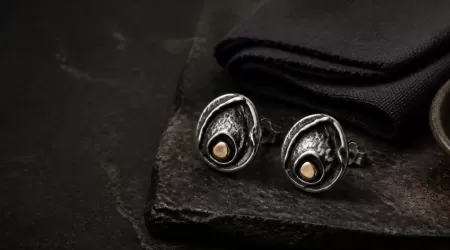
Short answer: clean intentionally oxidized silver earrings as a finished surface, not as ordinary bright silver. Start with a soft, dry cloth. If the earring has no porous stone, glued component or other water-sensitive part, use a small amount of mild soap in lukewarm water, clean briefly with a very soft cloth or brush, rinse quickly and dry completely. Do not use silver dip, toothpaste, baking-soda-and-aluminium methods, abrasive polish, steam or ultrasonic cleaning unless the maker has confirmed that the method is safe for that exact construction.
The black or charcoal colour in an oxidized earring is often deliberate. Aggressive polishing may brighten the high points, but it can also erase the dark contrast in recesses and change the design. The first care decision is therefore not “How do I remove the black?” It is “Which dark areas are the intended finish, and which deposits are dirt or unwanted change?”
Oxidized finish, patina and tarnish are related but not identical
Silver reacts with sulfur-containing gases and forms a surface layer dominated by silver sulfide. The Canadian Conservation Institute (CCI) explains that this layer can progress through yellow, red, blue and black tones. That is ordinary tarnishing chemistry.
An oxidized or antiqued jewelry finish uses controlled darkening as part of the design. The British Museum conservation glossary defines patina as a surface feature that can form naturally or through intentional intervention. On a sculptural earring, the maker may retain blackened recesses while polishing raised edges to create contrast.
The practical boundary is visual and documentary: compare the piece with its product photographs, care instructions and unworn areas. The Gemological Institute of America notes that a patina may or may not be something the owner wants removed. If the original finish is unknown—especially on vintage, plated or repaired jewelry—stop before polishing and ask a qualified jeweler or conservator.
For a fuller finish comparison, see our guide to satin, polished and oxidized silver earrings.
A finish-preserving cleaning sequence
1. Examine the whole earring before adding moisture
Check the metal, post, backing, soldered joints, stones, inlays, coatings and any hollow or glued parts. CCI recommends identifying whether an object is solid silver, plated, gilded or composite before cleaning. Its silver care guidance specifically warns that immersion and polish can damage gilding, surface inlays, plating and sealed hollow sections.
Remove a detachable backing and clean it separately when appropriate. A backing can have a different alloy or finish from the decorative front, so one method should not automatically be applied to both.
2. Begin dry
Use a clean, very soft lint-free cloth to lift skin oils from the surfaces that touch the ear. Support the earring rather than pulling on the post. On textured work, use a soft clean brush with almost no pressure to dislodge loose dust. Do not scrub across blackened recesses.
Avoid a pre-treated “silver polishing cloth” unless the maker explicitly recommends it. Some polishing cloths contain fine abrasives or chemicals. They can be useful on bright silver, but on an oxidized finish they may remove the contrast you are trying to preserve.
3. Use mild soap only when the construction allows it
For a solid-metal oxidized earring with no water-sensitive stone, coating, adhesive or trapped cavity, mix a drop of mild, fragrance-free dish soap with lukewarm water. Dampen—not saturate—a soft cloth or very soft brush. Clean only the areas that need it, briefly and without pressure. Rinse the cloth, remove soap residue, then dry the earring immediately and completely.
CCI describes detergent-and-water cleaning as suitable for many silver objects only when non-metallic parts are protected and residues are thoroughly removed. Museum instructions are intentionally conservative; home jewelry care should be even simpler. If you cannot verify the materials, stay with a dry wipe and professional advice.
4. Preserve the dark recesses deliberately
Clean raised edges and skin-contact surfaces without chasing every dark line. Black colour that is even, intentional and concentrated in carved or hammered recesses is often part of the finish. A new pale streak, sticky residue or local deposit is a different observation, but appearance alone cannot identify every coating or corrosion product.
5. Dry and store to reduce the next cleaning
Blot with a soft cloth and let the piece air-dry fully before storage. Keep earrings separated from harder jewelry to reduce scratches. Store them dry, away from rubber, household chemicals, perfume and sulfur-rich materials. CCI’s metal-care guidance emphasizes prevention because repeated tarnish removal gradually changes a silver surface.
Methods to avoid by default
| Method | Why it is risky for oxidized earrings |
|---|---|
| Toothpaste or abrasive paste | May scratch silver and polish away intentional blackening. Read the evidence limits in our toothpaste cleaning guide. |
| Silver dip | Can remove dark finish from recesses, over-clean textured detail and harm mixed materials. |
| Aluminium and baking soda | Electrochemical reduction targets sulfide; that is the same chemistry often used to create the intended dark appearance. |
| Ultrasonic or steam | May be unsuitable for natural stones, glued components, inlays, repaired joints or unknown construction. |
| Hard brush or vigorous rubbing | Can scratch soft metal, brighten high areas unpredictably and flatten hand-finished contrast. |
The U.S. National Park Service cautions that proprietary polishes may contain ammonia, harsh abrasives or corrosion inhibitors, and its Museum Handbook recommends material identification and controlled treatment rather than an all-purpose cleaner. Those sources concern collection objects, not ordinary daily wear, but the material-risk principle transfers: use the least aggressive method that solves the actual problem.
Mixed-material examples need separate decisions
Our Snake Stud Earrings with Natural Opal combine an oxidized silver setting with a natural opal cabochon. The workshop information does not verify the silver fineness, and opal adds a stone-specific care constraint. The safe default is a soft dry wipe; avoid soaking, steam, ultrasonic cleaning and aggressive polishing.
The Mobius Black Hoop Earrings use oxidized 999 fine silver, 24K gold inlay and an S925 push-back. Polishing across the piece can change both the blackened silver and the textured gold panel. For the material distinction, read what 24K gold inlay means. A brass-inlaid design has another care boundary explained in our brass-inlay care guide.
These examples do not create a universal rule. Stones, adhesives, solder, backs and surface treatments vary, even when two products are both described as oxidized silver.
When to stop and ask a professional
- The finish is flaking, powdery or changing rapidly.
- A stone is loose, cracked or appears glued.
- The post bends, the solder joint moves or the backing no longer holds.
- The piece may be plated, vintage, valuable or previously repaired.
- You cannot distinguish intentional patina from an unwanted deposit.
Cleaning cannot repair a failing joint or confirm metal purity. A jeweler can inspect wearable construction; a conservator is the better choice for historically important or fragile objects.
Practical conclusion
For oxidized silver earrings, “cleaner” should not automatically mean “brighter.” Preserve the intentional dark areas, remove only loose dust and surface residue with the gentlest verified method, and treat stones, inlays, backs and repairs as separate material questions. Prevention and careful storage usually protect the design better than repeated tarnish removal.
Browse the current silver earrings collection to compare verified materials and finishes, then follow the exact product page when its care instructions are more restrictive than this general guide.
Sources
- Canadian Conservation Institute: Silver — Care and Tarnish Removal
- Canadian Conservation Institute: Understanding How Silver Objects Tarnish
- Canadian Conservation Institute: Caring for Metal Objects
- National Park Service: Caring for Silver and Copper Alloy Objects
- National Park Service: Curatorial Care of Metal Objects
- British Museum: Conservation and Scientific Research Glossary
- Gemological Institute of America: How to Repurpose Heirloom Jewelry
Leave a comment