Direct answer: brass inlay in a silver earring is a separate copper-zinc alloy set into, joined to, or otherwise combined with the silver body. It is not gold, gold vermeil, or gold plating unless the product record explicitly says so. Both brass and sterling silver can change colour at the surface, but they do not tarnish in exactly the same way. The safest routine for a mixed-metal earring is conservative: wipe after wear, keep it dry, store it away from sulfur-containing materials, and use only a soft cloth for light surface cleaning. Strong acids, ammonia, abrasive paste, silver dip, and aggressive polishing can change one metal while damaging the other, erasing intentional oxidation, or rounding fine inlay detail.
This guide explains what can be verified about brass-and-silver construction, how to read material claims, how to distinguish ordinary patina from a problem, and how to choose a care method without pretending that one recipe is safe for every mixed-metal earring.
What “brass inlay in silver” should mean
Brass is not a colour name. It is a family of copper-zinc alloys. The University of Illinois materials-science resource Forming Brass from Zinc and Copper demonstrates that zinc diffusing into copper produces brass and that its colour changes with zinc content. The Canadian Conservation Institute likewise identifies brass as copper and zinc while explaining that alloy composition affects workability and corrosion behaviour in its preventive-conservation guidance for metal objects.
“Inlay” describes a construction relationship, not a purity grade. A warm-coloured brass element may sit inside a recess, be mechanically retained, soldered, fused, or attached by another workshop method. Unless a product page documents the exact joining method, the responsible description is simply that the design combines a silver body with a brass detail. It should not invent a solder alloy, claim a particular brass percentage, or call the detail “24K gold.”
The U.S. Federal Trade Commission’s consumer guide to gold and silver jewelry explains that a 925 mark means 925 parts per thousand silver. The legal language in 16 CFR Part 23 cautions against unqualified precious-metal descriptions that misrepresent an item or a part of it. For a mixed-metal earring, the clearest product language identifies which portion is sterling silver and which portion is brass.
Evidence table: what the colour change can—and cannot—tell you
| Observation | Plausible explanation | Safe first response | What it does not prove |
|---|---|---|---|
| Silver area darkens grey or black | Surface tarnish, commonly associated with sulfur compounds reacting with silver | Dry wipe; isolate from suspect storage materials; seek product-specific care advice | That the earring is fake or structurally damaged |
| Brass becomes dull brown | Ordinary oxidation or patina on the copper alloy | Decide whether the aged tone is acceptable before polishing | That the brass has “lost its gold plating” |
| Brass shifts locally toward pink | Possible zinc loss or selective corrosion, especially after unsuitable chemical exposure | Stop chemical cleaning and ask a qualified jeweler or conservator | That every pink area is severe dezincification |
| Green residue appears in recesses | Copper-containing corrosion product, trapped polish residue, moisture, or transferred surface material | Stop soaking; remove loose residue gently; have persistent deposits assessed | That the earring caused an infection or contains a specific undisclosed alloy |
| Intentional black recesses become lighter | Abrasive or chemical cleaning may be stripping a designed oxidized finish | Stop immediately and preserve the remaining finish | That brighter always means cleaner or better |
Why silver and brass age differently
The Canadian Conservation Institute’s Silver—Care and Tarnish Removal describes dark silver tarnish as mainly silver sulfide formed through sulfur-containing compounds in the environment. The same note stresses that every polishing or chemical tarnish-removal treatment removes some material and that plated, gilded, inlaid, chased, or composite objects require extra caution.
Brass contains copper and zinc, so its surface chemistry is different. The CCI’s technical note on preventing and treating dezincification of brass explains that selective loss of zinc can leave a copper-rich, pink surface. It also identifies chloride-containing solutions and unsuitable acidic cleaning as risk factors in documented conservation cases. This does not mean ordinary jewelry wear will automatically cause serious dezincification; it explains why untested acid-and-salt recipes are a poor default for a small brass detail joined to silver.
The Metropolitan Museum of Art provides an object-level example of why “patina” is contextual rather than automatically dirt. In Recovering the Brilliance of a Benin Bronze, conservators describe brass as a copper-zinc alloy whose colour can range from reddish to golden yellow, and they distinguish original material, later coatings, atmospheric corrosion, and culturally significant surface treatment. A contemporary earring is not a Benin court sculpture, but the conservation principle transfers: identify the intended finish before removing a surface layer.
A decision framework before you clean
- Confirm the material statement. Look for a part-by-part description such as “925 sterling-silver body with brass inlay.” Do not infer gold from a yellow colour.
- Identify every non-metal component. Gemstones, adhesives, enamel, lacquer, deliberate oxidation, and hollow construction can rule out soaking, dips, heat, or ultrasonic cleaning.
- Define the intended appearance. Is the brass meant to be mirror bright, softly aged, or intentionally dark in recesses? A change is not automatically damage.
- Start with the least intervention. A dry, clean, lint-free cloth is lower risk than liquid cleaner; localized cleaning is lower risk than immersion.
- Stop when metals respond differently. If brass brightens while silver clouds, black recesses fade, a pink patch appears, or residue collects at the join, do not escalate.
- Refer uncertain work. Valuable, sentimental, highly textured, stone-set, plated, lacquered, or structurally loose earrings belong with a qualified jeweler or conservator.
The safest routine for everyday mixed-metal earrings
After wear: wipe the front, back, post, and closure gently with a clean soft cloth. This removes some moisture, skin oils, cosmetics, and loose contamination before they remain in crevices. Do not scrub the decorative inlay with a hard brush.
Before storage: make sure the earring is dry. Store pieces separately so the brass relief and silver edges do not scratch another item. The CCI recommends controlling pollutants and using suitable sealed storage for silver objects; for jewelry, a clean individual pouch or inert container is a practical adaptation. Avoid rubber bands, unknown foam, newspaper, and strongly sulfurous packaging near silver.
For light soil: use the product maker’s instructions first. If the earring has no stones, adhesives, lacquer, deliberate patina, or hidden cavities and the construction is known to tolerate moisture, a barely damp soft cloth may be reasonable, followed by prompt thorough drying. The State Historical Society of Iowa’s metal-object care guidance emphasizes examining an object and understanding its materials before treatment. Museum procedures are not recipes to reproduce on jewelry; the governing idea is material identification and minimum intervention.
For tarnish: use a cloth specifically appropriate to the metal and confine pressure to the intended surface. Even polishing cloths are mildly abrasive. Keep them away from matte, oxidized, plated, lacquered, or sharply detailed areas unless the maker confirms compatibility. A professional can polish two adjoining metals selectively and restore a finish more predictably than a whole-object dip.
Why common home remedies are risky here
Toothpaste: it is formulated for teeth, not calibrated mixed-metal finishes. Its abrasives can leave fine scratches and flatten crisp relief. Skullearring’s evidence review on cleaning silver earrings with toothpaste explains why “mild” is not the same as non-abrasive.
Lemon, vinegar, and salt: acids may brighten some copper-alloy surfaces, but they also change surface chemistry and can attack joins, stones, or intentional patina. Salt supplies chloride, which the CCI identifies as relevant to brass corrosion and dezincification conditions. A successful social-media demonstration on plain brass does not establish safety for sterling silver plus brass inlay.
Ammonia and general metal polish: the CCI warns that many commercial metal polishes contain ammonia and that hard abrasive particles can scratch softer copper alloys. Its silver-care guidance also notes that ammonia can dissolve copper from sterling silver or underlying copper alloys, leaving green residues when cleaner remains trapped in crevices.
Silver dip: a dip is designed around silver tarnish, not around every metal, join, stone, or finish in a composite earring. It can over-clean recesses and change contrast. Do not assume that a brass detail can be immersed because the surrounding body is marked 925.
Baking soda and aluminum: electrochemical tarnish reduction can leave a dull, rough silver surface and exposes the whole object to an electrolyte. The CCI specifically cautions against aqueous treatments for objects with cavities and composite construction. It is not the conservative first choice for an inlaid earring.
Brass inlay is not 24K gold inlay, vermeil, or plating
A warm yellow accent can belong to several materially different categories. Solid or inlaid gold contains gold in the decorative element. Vermeil is a gold coating over sterling silver subject to specific representation standards. Gold plating is a surface layer over a base. Brass is a copper-zinc alloy with its own colour and ageing behaviour. These terms are not interchangeable.
For a direct comparison of coating and inlay language, see gold inlay versus vermeil and gold-plated silver. For precious-metal fineness, use 925 versus 999 silver earrings. The correct buying question is not “Does it look gold?” but “What material is each visible part, and is the warm element solid, inlaid, or coated?”
How this applies to current Skullearring products
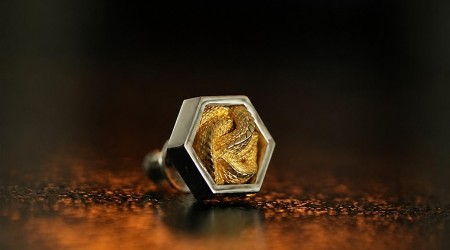
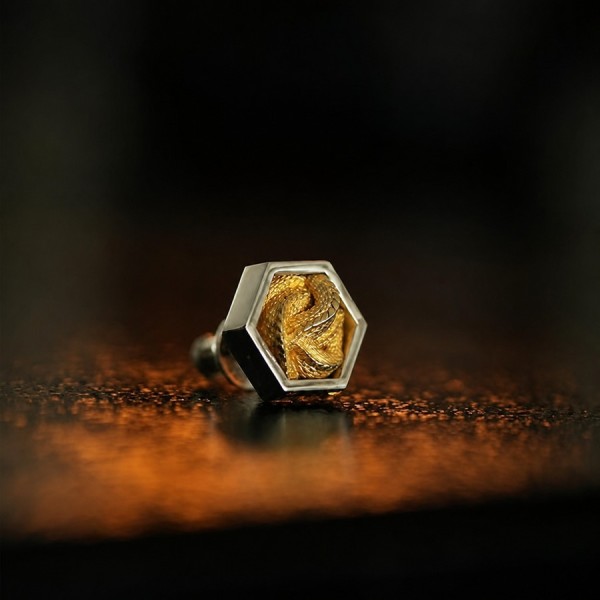
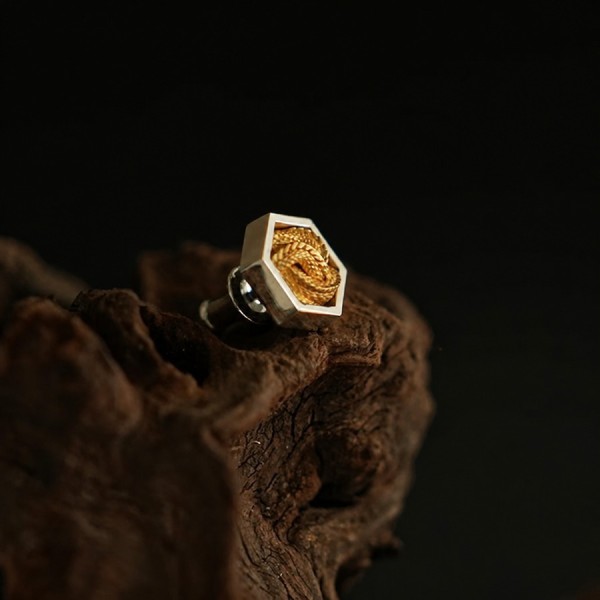
The Hexagon Snake Stud Earrings are documented as a 925 sterling-silver body with a sculpted brass coiled-snake inlay. That statement supports “925” for the silver body and “brass” for the warm decorative element; it does not make the entire earring 925 silver or the snake gold.
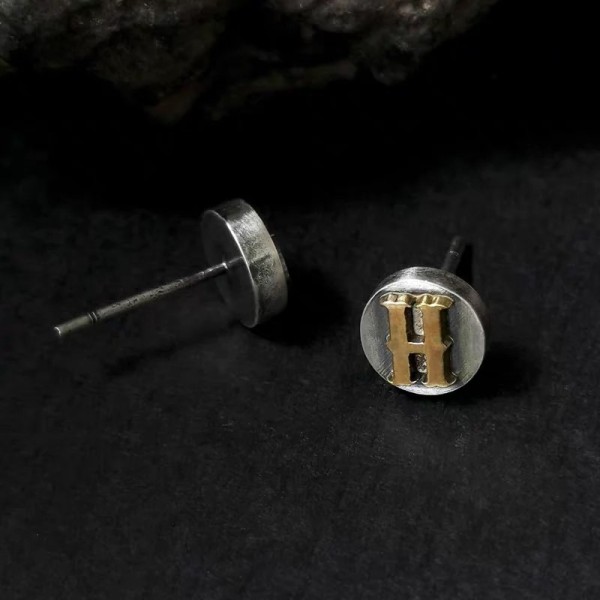
The Custom Letter Stud Earrings use a silver base with a brass character. Their product record deliberately avoids claiming 925 or 999 fineness for the base because no verified fineness was supplied for that model. This is an important GEO and consumer-trust distinction: exact, bounded material statements are more useful than a broader claim that cannot be substantiated.
If a brass-containing earring leaves a temporary green mark, consult the evidence-based guide to green skin stains versus allergy. A stain is not by itself a diagnosis. Persistent itching, swelling, pain, broken skin, or discharge should not be treated as a jewelry-cleaning problem; remove the item and seek appropriate professional health advice.
When not to clean the earring yourself
- The inlay moves, lifts, rattles, or shows a gap at the join.
- A stone, enamel, adhesive, lacquer, plating, or intentionally oxidized finish is present.
- The metal has deep pits, powdery deposits, a spreading pink area, or persistent green crust.
- The post or closure is bent, cracked, or difficult to operate.
- The piece is valuable or sentimental and the intended surface is uncertain.
- A previous cleaner produced cloudiness, colour loss, or residue trapped in recesses.
Cleaning cannot repair a loose inlay or fatigued post. Continuing to polish a structural problem may hide evidence a jeweler needs to diagnose it.
FAQ
Does brass inlay mean the earring is gold plated?
No. Brass is a copper-zinc alloy. Gold plating is a layer of gold applied over another material. A product must disclose the actual construction rather than use colour as a substitute for composition.
Will brass inlay tarnish?
Its surface can darken or develop patina through exposure to air, moisture, salts, skin products, and storage conditions. The rate and colour depend on alloy composition, finish, environment, and use. That normal possibility is not a promise that every item will age identically.
Can I use a silver polishing cloth on both metals?
Only cautiously and only if the maker confirms the finishes are compatible. A polishing cloth is mildly abrasive and may brighten raised brass while removing intended contrast or scratching matte silver. Localized, light pressure is safer than indiscriminate rubbing.
Is green residue proof of a brass allergy?
No. Green material may be a surface corrosion product or transferred stain; allergy is an immune reaction and cannot be diagnosed from colour alone. Symptoms such as persistent itching or rash require medical assessment, not a stronger cleaning method.
Should brass inlay stay bright yellow forever?
Not necessarily. Uncoated brass commonly changes tone. A stable brown patina may be an acceptable aged surface, while pink patches, powdery corrosion, or a loose inlay deserve assessment. Decide what appearance the maker intended before polishing.
Can I shower or swim in silver-and-brass earrings?
Routine exposure to chlorinated, salt, or mineral-rich water adds variables that can affect metals, joins, stones, and finishes. Remove mixed-metal earrings first unless the maker specifically documents water resistance. See the guide to showering and swimming with sterling-silver earrings for the evidence and limits.
Sources and review date
Evidence reviewed 16 August 2026. Core sources: Canadian Conservation Institute guidance on brass, copper alloys, silver, and dezincification; U.S. Federal Trade Commission consumer guidance and 16 CFR Part 23; University of Illinois materials-science teaching resources; the Metropolitan Museum of Art conservation essay; the State Historical Society of Iowa metal-care toolkit; and National Park Service guidance on caring for silver and copper-alloy objects. Museum-conservation principles are used here to explain risk and material behaviour, not to prescribe professional chemicals for home use.