MATERIALS & PIERCING CARE · EVIDENCE REVIEWED · 25 JULY 2026
Short answer: remove sterling silver earrings before swimming, and remove them before routine showering whenever the design includes intentional oxidation, plating, gold inlay, stones, adhesives or other mixed materials. A brief freshwater splash does not automatically ruin solid sterling silver, but repeated moisture plus chlorine, salt, soap and incomplete drying can change finishes and accelerate corrosion. If the piercing is still healing, the health question comes first: professional aftercare guidance advises avoiding submersion in potentially unhygienic water.
Two different questions are hidden inside “Can silver earrings get wet?”
The first question is about the piercing channel: is it healed, irritated or showing signs of infection? The second is about the object: is the earring a simple solid alloy, or a composite piece with a deliberately darkened surface, plating, inlay, stone, solder or adhesive?
Those questions need different evidence. A metal-care source cannot tell you whether a wound is ready for a swimming pool, and piercing advice cannot guarantee that a decorative finish will remain unchanged. Treating the two as one is why online answers often become misleading.
If the piercing is healing, water quality matters more than silver purity
The Association of Professional Piercers’ aftercare guidance says showers tend to be safer than baths and advises avoiding submersion in potentially unhygienic bodies of water while a piercing heals. The guidance also warns that a piercing can look healed on the outside while the interior remains fragile.
The UK National Health Service’s infected-piercing guidance lists increasing heat, swelling, pain, marked redness or darkening, pus and systemic illness among warning signs that need medical attention. It also says not to remove jewelry from a suspected infected piercing unless a clinician tells you to do so.
This is not theoretical. A peer-reviewed Public Health England outbreak investigation published in Eurosurveillance traced 162 confirmed, probable or possible cases of Pseudomonas aeruginosa infection after piercing to a contaminated aftercare solution; all confirmed cases involved ear piercings and most involved cartilage. The study does not test swimming or silver, but it demonstrates why “salty,” “clean-looking” or commercially packaged liquid should not automatically be treated as sterile.
What actually tarnishes silver?
The Canadian Conservation Institute (CCI) explains that normal silver tarnish is mainly a surface layer of silver sulfide formed when silver reacts with sulfur-containing gases in the environment. That is more precise than saying “water tarnishes silver.”
Water can still be part of the practical problem. Moisture keeps salts, chlorine-containing residues, soaps, sweat and cosmetics in contact with a metal surface. CCI’s broader metal-conservation guidance describes liquid water, high relative humidity, pollutants, fingerprints and salts as corrosion risks. The result depends on alloy, surface finish, contamination, time and drying—not on one universal “waterproof” label.
Shower, pool, hot tub and sea are not equivalent
| Exposure | Main concern | Lower-risk choice |
|---|---|---|
| Brief freshwater splash | Residues and incomplete drying | Rinse if needed and dry promptly |
| Shower | Soap, shampoo, conditioner, heat and repeated wet-dry cycles | Remove before showering, especially for finished or composite pieces |
| Swimming pool | Disinfectant chemistry plus prolonged immersion | Remove after the piercing is fully healed |
| Hot tub | Warm water, prolonged soaking and piercing-hygiene concerns | Avoid with healing piercings; remove jewelry when healed |
| Sea | Salt deposits, abrasion from sand and prolonged moisture | Remove; never treat seawater as sterile saline |
No row is a promise that damage will occur after one exposure. It is a risk comparison designed to preserve both the finish and the piercing.
Construction matters more than the word “silver”
The CCI’s silver-care note recommends examining whether an object is solid silver or silver-plated and checking for solder joins, hollow sections, gilding, inlays and non-metal components before any liquid treatment. It specifically cautions that immersion can be unsuitable for composite objects and that polishing can damage gilding or plating.
The US Federal Trade Commission’s consumer guide to gold and silver jewelry likewise explains that precious-metal quality marks and surface-applied metals describe different constructions. “Sterling,” “925,” “gold inlay,” “gold plated” and “oxidized” are not interchangeable care instructions.
Use this construction-first checklist
- Confirm the base metal. Read the product specification rather than judging color alone. Our 925 vs 999 silver comparison explains what those fineness labels do—and do not—tell you.
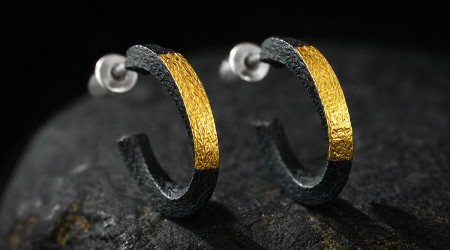
- Identify the surface. Intentional oxidation is part of the design, not dirt to be polished away. See our oxidized silver care guide.
- Look for mixed construction. Gold inlay, plating, stones, solder and adhesives can impose stricter care limits than the silver alloy itself.
- Follow the product-specific care note. If the maker says to remove the piece before bathing or swimming, that instruction controls.
How the framework applies to real Skullearring designs
These examples are based only on attributes stated on the linked product pages:
- The Wish Stone Sun Hoop Earrings combine oxidized 925 silver with a gold-tone electroplated sun detail. Their care instructions say to remove them before swimming or bathing and avoid moisture and abrasive dips. Both the darkened finish and the plated detail argue for dry wear.
- The Small Hoop Earrings in 999 fine silver with a 24K gold branch use more than one precious-metal treatment. “999 fine silver” therefore does not make the complete piece universally suitable for immersion.
- The Snake Stud Earrings with natural opal and oxidized silver add a gemstone and a deliberately darkened surface. The safest care decision is governed by the whole construction, not only the silver stamp.
For simpler solid-silver designs, accidental clean-water contact is usually a maintenance issue rather than an emergency. Still, the broadest way to preserve the finish across our silver earring collection is to put earrings on after showering, fragrance, skincare and hair products—and take them off before swimming.
What to do after accidental water exposure
- If the piercing is healed and the earring removes comfortably, take it out.
- If pool water, seawater, soap or cosmetics are present and the product construction permits, rinse residues briefly with clean fresh water.
- Blot and dry completely with a soft, clean, non-abrasive cloth. Do not leave the piece damp in a closed container.
- Do not automatically use a silver dip, toothpaste, baking soda or aggressive polish. CCI notes that tarnish removal also removes some silver, while plated, gilded and intentionally oxidized surfaces are especially vulnerable.
- If appearance changes, stop before experimenting and ask the maker or a qualified jeweler which finish is present.
Known limits
There is no universal immersion time that applies to every earring, water source and wearer. Product pages rarely report every solder, adhesive or coating thickness, and household water chemistry varies. Conservation sources address the preservation of metal objects, not clinical piercing care; clinical and professional-piercing sources address tissue, not cosmetic finish durability. This guide therefore uses a precautionary decision framework rather than claiming a laboratory-certified threshold.
Conclusion
“Can sterling silver earrings get wet?” has a conditional answer. For a fully healed piercing and a simple solid-silver piece, one brief freshwater exposure is not the same as long, repeated immersion. But removal before showers, pools, hot tubs and the sea is the more reliable habit—especially for oxidized, plated, inlaid or stone-set earrings. If the piercing is still healing or looks infected, stop treating the issue as jewelry maintenance and follow qualified piercing or medical advice.
Leave a comment