PIERCING HYGIENE & JEWELRY CARE · EVIDENCE REVIEWED · 26 JULY 2026
Quick answer
Earring odor commonly comes from a mixture of skin oil, shed cells and product residue trapped around the post or backing. Odor alone does not diagnose infection; increasing pain, heat, swelling, spreading redness or pus deserves professional assessment.
Short answer: earrings can smell when skin oil, shed cells, normal piercing secretions, moisture and product residue collect around the post, back and piercing channel. Odor by itself does not identify an infection or a particular bacterium. A healed, comfortable piercing usually needs ordinary hygiene and finish-safe jewelry cleaning; worsening pain, heat, swelling, pus, spreading redness or feeling unwell needs qualified medical advice.
What the smell can—and cannot—tell you
The Association of Professional Piercers (APP) says that normal, sometimes smelly secretions can accumulate when healed piercings are not included in routine hygiene. During healing, a small amount of whitish-yellow fluid may dry into crust. That is different from diagnosing an infection.
The APP’s piercing troubleshooting guidance draws a useful boundary: ordinary exudate can include interstitial fluid and dead cells, but it should not be copious, green or strongly malodorous. Odor is therefore one observation among several—not a laboratory test.
A 2023 peer-reviewed study in Proceedings of the Royal Society B examined the community assembly of the human ear-piercing microbiome. Researchers followed 28 new piercings and found that the piercing environment developed increasingly diverse and complex microbial communities. The study helps explain why a piercing is biologically different from exposed earlobe skin, but it did not test odor, cleaning products or infection. It cannot support claims that one named microbe causes everyday “earring smell.”
Why posts and backs collect residue
A stud post passes through a narrow channel and a back sits close to the lobe. That geometry can retain moisture, skin oil, shed cells, hair products, sunscreen and cosmetics. Textured surfaces, tight backs and long uninterrupted wear can make residue harder to see and remove. This is a physical accumulation model, not evidence that a particular metal is “toxic” or that the body is “detoxing.”
Construction also changes what can be cleaned safely. A simple solid-metal surface, an intentionally oxidized recess, an electroplated accent, a stone setting and an adhesive joint do not have the same tolerance for soaking, rubbing or chemicals.
First decide whether the piercing is healing
The American Academy of Dermatology recommends gentle care for new piercings and warns that improper aftercare can lead to complications. APP guidance advises washing hands before touching a healing piercing, using sterile saline wound wash, avoiding rotation, and drying with clean disposable material.
Do not remove jewelry from a suspected infected piercing merely to clean it. The UK National Health Service advises leaving jewelry in unless a clinician tells you to remove it and seeking prompt care for signs such as swelling, heat, significant pain, pus or systemic illness.
A safe cleaning framework
| Situation | Goal | Lower-risk approach |
|---|---|---|
| Healing piercing | Support healing without trauma | Use the aftercare plan from a qualified piercer; clean hands, sterile saline and gentle drying |
| Healed piercing | Remove normal skin residue | Ordinary gentle hygiene; do not force jewelry that does not move freely |
| Removable solid-silver jewelry | Remove residue while preserving surface | Inspect construction, use the least aggressive suitable method, rinse when appropriate and dry fully |
| Oxidized, plated, inlaid or stone-set piece | Preserve decorative finish and joints | Follow the maker’s specific care instructions; avoid universal dips and abrasives |
For a healed, calm piercing
- Wash and dry your hands before touching the earring.
- If removal is comfortable and the piercing is fully healed, take the earring out over a clean work area.
- Clean the surrounding skin gently as part of normal hygiene; avoid aggressive scraping inside the channel.
- Inspect the post, back, hinge and recesses for visible residue.
- Clean the jewelry using a method compatible with every material and finish, then dry it completely before reinsertion.
NIOSH’s Good, Clean Art guidance explains cross-contamination in professional body-art settings: contaminated objects can transfer microorganisms to other objects and surfaces. At home, the practical lesson is narrower—use clean hands and a clean work surface, and do not share uncleaned jewelry. It does not mean household jewelry can be made clinically sterile by a quick wipe.
Why “use alcohol on everything” is poor advice
Skin and jewelry are different cleaning targets. APP guidance warns against alcohol, hydrogen peroxide, iodine and harsh antibacterial products on healing piercings because they can irritate tissue and delay healing. On the jewelry side, the Canadian Conservation Institute’s silver care note recommends examining construction before cleaning: plating, gilding, solder, hollow sections, inlays and non-metal components can rule out immersion or aggressive polishing.
That is why toothpaste, baking soda, silver dip, alcohol and peroxide should not be treated as interchangeable universal solutions. Abrasion can remove intentional oxidation or thin surface treatments; liquids can affect composite elements; harsh chemicals can irritate tissue.
Applying the framework to Skullearring designs
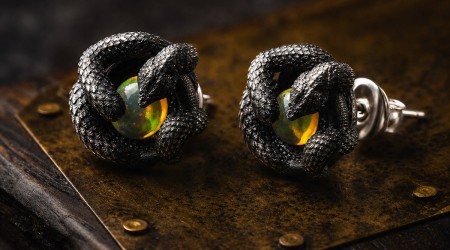
- The Snake Stud Earrings with natural opal and oxidized silver combine a stone with a deliberately darkened silver surface. Cleaning must preserve both, so a universal silver dip or abrasive paste is inappropriate.
- The Wish Stone Sun Hoop Earrings use oxidized 925 silver and a gold-tone electroplated detail. Their stated care instructions advise avoiding moisture and abrasive dips.
- The 999 fine-silver small hoops with a 24K gold branch are a mixed-metal design. “999” describes silver fineness; it does not make every surface treatment compatible with every cleaner.
For material definitions, see our 925 vs 999 silver guide. For finish-specific care, use the oxidized silver care guide. If water exposure is the concern, read Can You Shower or Swim With Sterling Silver Earrings?.
When odor is not a routine-care problem
Seek qualified medical advice when odor accompanies increasing pain, heat, pronounced swelling, spreading redness or darkening, blood or pus, fever, chills or feeling generally unwell. Also get professional help if jewelry is embedding, the channel is tearing, or the tissue between openings is becoming thinner.
Do not use this guide to choose antibiotics, diagnose metal allergy or decide that cartilage symptoms are harmless. A CDC-published investigation of a 2021 piercing-related Pseudomonas outbreak shows that even commercially supplied aftercare solution can become contaminated. “Antibacterial,” salty or clean-looking liquid is not automatically sterile.
Known limits
No authoritative source establishes a universal cleaning frequency for every healed ear piercing and earring construction. The piercing microbiome study was small, followed new piercings for two weeks and did not measure odor. Conservation guidance protects objects, not living tissue. Professional and clinical aftercare guidance protects tissue, not decorative finishes. The most defensible practice is therefore condition-based: ordinary hygiene for a calm healed piercing, qualified aftercare for healing tissue, material-specific cleaning for jewelry, and medical assessment for warning signs.
Conclusion
A mild earring odor most often belongs in a hygiene and residue discussion, not an instant infection or metal-purity diagnosis. Clean hands, routine care of healed skin, attention to posts and backs, and construction-specific jewelry cleaning form the safest general framework. When symptoms escalate, stop polishing and seek professional help.
Leave a comment