Direct answer: If your piercing is fully healed, taking ordinary fashion earrings out before sleep is usually the lower-risk choice because it removes pressure, snagging and backing-related irritation. A new piercing is different: dermatologists advise leaving starter jewelry in, including at night, so the channel does not close. During healing, the priority is not removal but avoiding direct pressure and following the instructions of your piercer or clinician.
Quick answer
Leave professionally fitted starter jewelry in during the healing period unless a qualified piercer or clinician advises otherwise. Once a piercing is healed, removing bulky, sharp, dangling or poorly fitted fashion earrings before sleep usually reduces pressure and snagging.
That distinction matters. “Can you sleep in earrings?” sounds like one question, but it contains several: Is the piercing new or healed? Is it in the soft lobe or cartilage? Is the jewelry a small, smooth stud or a hoop, climber, dangle or heavy ornament? Does its backing press into the skin? Are redness, swelling, discharge or itching already present?
This guide separates what professional sources actually support from reasonable risk-reduction advice. It is not a diagnosis, and it does not label any fashion earring universally “sleep-safe.”
Quick decision table
| Situation | Practical default | Why |
|---|---|---|
| New or actively healing piercing | Keep the starter jewelry in unless your piercer or clinician tells you otherwise; avoid sleeping directly on it. | Removing starter jewelry too early can allow the channel to close, while pressure can irritate a healing piercing. |
| Healed lobe piercing with ordinary fashion earrings | Remove the earrings before sleep when removal is easy and comfortable. | This eliminates overnight pressure, catching and backing contact. |
| Healed piercing with a small, smooth, well-fitted stud | Some people tolerate it, but check the post and backing and stop if there is pressure or irritation. | Small size reduces some hazards but does not prove a universal safety guarantee. |
| Hoop, dangle, climber, sharp projection or heavy design | Remove before sleep. | More exposed geometry creates more opportunity to catch, twist or load the piercing. |
| Red, hot, swollen, painful, draining or embedded jewelry | Do not treat it as a styling question; seek qualified medical or piercing help. | These can be signs of infection, trauma or embedding. |
New piercings and healed piercings need opposite advice
For a new piercing, do not casually remove the starter jewelry
The American Academy of Dermatology recommends leaving new-piercing jewelry in for six weeks or more and keeping it in even at night. The exact healing period varies by site and person, so the “six weeks” statement should not be treated as a promise that every piercing is healed on day 43. Cartilage commonly requires a longer and more cautious process than a simple lobe piercing.
For a healing cartilage piercing, the Association of Professional Piercers warns that sleeping directly on it can cause irritation and may even shift the piercing angle. Its practical suggestion is to offload the ear—one option is placing a travel pillow on the regular pillow and positioning the ear in the opening. Clean pillowcases also reduce unnecessary contamination around a healing site.
The useful rule is therefore: keep required starter jewelry in, but keep your body weight off it. Do not replace professional starter jewelry with a decorative silver fashion earring simply because the design is small. Initial jewelry has requirements involving material, surface, dimensions and room for swelling that cannot be inferred from a product photograph.
For a fully healed piercing, removal is usually simpler
Once a piercing is genuinely healed and jewelry can be removed and reinserted without force, taking ordinary earrings out at bedtime removes several avoidable variables at once. There is no post or backing against the pillow, no hoop available to catch in hair or bedding, and no overnight exposure if a component triggers contact dermatitis.
This is risk reduction, not a claim that one night in a small stud inevitably causes harm. Good evidence does not define a universal earring, ear shape or sleeping position that is safe for everyone. Side sleepers, people with thin or stretched lobes, and anyone who already feels pressure may have a different experience from a back sleeper wearing a low-profile design.
What can go wrong when you sleep in earrings?
1. Local pressure and friction
A pillow can push the ornament, post or backing into the skin for hours. A stud that feels fine while upright may become uncomfortable when the ear is compressed sideways. Pressure is particularly important in healing cartilage because the tissue is less forgiving than the soft lobe and direct sleeping pressure can prolong irritation.
Pressure problems are not determined by the visible front alone. A compact stud may still have a long post or a backing that sits tightly. If you wake with a clear pressure mark, tenderness or a backing indentation, that is useful evidence that the setup is not working for your ear.
2. Snagging and twisting
Hair, pillow seams, blankets and sleepwear can catch exposed jewelry. Hoops, dangling elements, open hooks and directional ear climbers provide more opportunities to snag than a smooth, low-profile form. A sudden tug can load the piercing channel even when the earring itself is light.
Clinical literature on split and elongated lobes associates long-term heavy jewelry and traumatic tugs with earlobe damage. That does not calculate the probability of a tear during sleep, but it supports avoiding unnecessary pulling forces—especially on a lobe that is already stretched or thin.
3. Backings that are too tight
An earring back should not clamp the lobe. Embedded earring backs are a recognized complication in the medical literature, particularly in relation to piercing-gun studs and young wearers. The available study does not show that sleep alone causes embedding, so the accurate conclusion is narrower: swelling plus a tight or poorly monitored backing can become a serious problem, and prolonged pressure is not helpful.
If the backing is disappearing into the skin, the front is sinking, or removal would require digging or force, do not keep manipulating it at home. Seek professional medical help.
4. Contact dermatitis from any component
Itching and rash may be a material problem rather than a cleanliness problem. The American Academy of Dermatology identifies earrings and earring backs as common nickel-exposure sources. That means the post and backing matter as much as the decorative front.
“Sterling silver” describes a silver alloy, not a universal biological response and not necessarily every component in an assembled earring. If you are evaluating material comfort, read our evidence-focused guide to sterling silver earrings and sensitive ears. Persistent or recurring rash deserves assessment rather than repeated overnight exposure.
5. Infection warning signs can be missed
Sleeping in jewelry does not automatically create an infection. However, a painful, increasingly red, swollen or draining piercing should not be dismissed as ordinary pillow pressure. MedlinePlus notes that pain and redness after trauma or piercing of the stiff cartilage can require prompt medical attention because perichondritis can damage cartilage if it progresses.
Seek medical advice for spreading redness, heat, substantial swelling, worsening pain, pus-like discharge, fever, a change in ear shape or jewelry becoming embedded. Do not use an article to delay care.
Does earring style change the answer?
Stud earrings
A small stud has less exposed geometry than a hoop or dangle, but “stud” does not specify the backing, post length, weight or surface. For a healed piercing, inspect all sides. The front should not have sharp projections; the post should not extend far enough to press into the neck; and the backing should be secure without compressing the lobe.
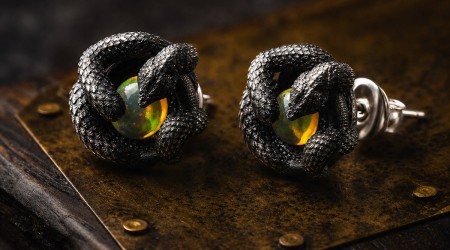
Skullearring’s sterling silver cat stud earrings and opal snake stud earrings illustrate how “stud” covers very different shapes and materials. Their inclusion here is stylistic, not a claim that either is designed for sleep or for a healing piercing. Confirm product specifications and remove decorative studs at night if the shape or backing creates pressure.
Hoops and dangling earrings
Hoops and dangles create a larger capture area for bedding and hair. Even a light hoop can twist when trapped. For healed piercings, removal before bed is the straightforward default. Explore silver earring styles for daytime wear, then store them dry and separated using our conservation-informed storage guide.
Heavy earrings
There is no clinically validated gram threshold that separates “safe” from “unsafe” for every ear. Weight per ear, duration, design leverage, lobe anatomy and existing stretching all matter. Our measurement-based earring weight guide explains how to evaluate those factors without inventing a universal cutoff. Heavy or levered designs should come out before sleep.
Flat-back and threadless jewelry
A low-profile back may reduce the sharp-post problem, but no backing erases material sensitivity, fit, hygiene, swelling or pressure from lying directly on the ear. “Flat-back” is a construction description, not a medical certification. A qualified piercer should select jewelry for a healing piercing; for healed piercings, comfort still needs to be assessed on your own ear.
A practical bedtime check for healed piercings
- Confirm that the piercing is healed. If it is new, tender, crusting, swollen or still under aftercare instructions, follow the piercer or clinician rather than removing the starter jewelry.
- Look at the entire earring. Check the front, post, backing, joins and any projecting decoration.
- Check pressure while awake. Gently place the side of your head against a clean pillow. Any immediate poke or pinch will not improve after hours of sleep.
- Check for snag points. Hoops, hooks, chains, climbers and prongs should be removed.
- Inspect the skin. Do not sleep through redness, heat, swelling, discharge, itching or a backing that is sinking into the lobe.
- When in doubt, remove fashion earrings. Clean them appropriately and store them separately. Never force jewelry out of a healing or swollen piercing.
Common questions
Can I sleep in earrings immediately after piercing?
Keep the professional starter jewelry in unless your piercer or clinician tells you otherwise, but avoid sleeping directly on the piercing. The AAD advises keeping new-piercing jewelry in even at night; the APP specifically warns against direct pressure on healing cartilage.
Are small studs safe to sleep in?
Small size can reduce snagging, but it does not prove safety. The post, backing, material, fit, piercing location and healing status all matter. For a healed piercing, removal remains the lower-variable choice.
Can sleeping in earrings stretch the hole?
One night in a light stud has not been shown to produce a predictable amount of stretching. Long-term heavy jewelry and traumatic tugs are associated with elongated or split lobes, so avoid heavy, levered or snag-prone earrings during sleep.
Why does my earring hurt only when I sleep?
The pillow may be pressing the front, post or backing into the tissue, or the jewelry may be twisting. Remove fashion jewelry from a healed piercing and reassess. For a healing piercing, offload the ear and consult your piercer. Worsening redness, swelling, heat, discharge or cartilage pain needs medical attention.
Should children sleep in newly pierced earrings?
Starter jewelry is generally kept in during initial healing, including at night, but children need close adult monitoring for tight backs, swelling, embedding and infection signs. Follow the child’s clinician or qualified piercer; do not substitute decorative fashion earrings during healing.
Does sterling silver make an earring safe for overnight wear?
No material label guarantees comfort or safety for every person. Alloy composition, posts, backs, fit, surface condition, piercing status and individual sensitivity all matter. Sterling-silver fashion earrings should not be assumed suitable as initial piercing jewelry.
Bottom line
For a healed piercing, removing ordinary fashion earrings before sleep is the simplest way to eliminate overnight pressure, snagging and backing contact. For a new piercing, do not casually remove required starter jewelry; instead, keep pressure off the site and follow qualified aftercare advice. Treat low-profile designs as a comfort feature, not a safety guarantee, and seek help for infection signs, embedding or significant trauma.
References and evidence scope
- American Academy of Dermatology: How to care for a new piercing
- Association of Professional Piercers: Aftercare
- American Academy of Dermatology: Nickel allergy
- MedlinePlus: Perichondritis
- Cleveland Clinic: Earlobe repair
- Muntz et al.: Embedded earrings
- Kumar et al.: Post-traumatic split earlobe repair study
Evidence reviewed: 31 July 2026. This guide distinguishes professional aftercare recommendations from practical risk-reduction advice. It does not diagnose infection or certify a specific fashion earring for sleep or for a healing piercing.
Leave a comment