Short answer: there is no clinically validated gram limit that makes an earring “safe” or “too heavy” for every ear. Comfort depends on weight per earring, how far that weight sits from the piercing, the size and position of the piercing, the backing or closure, the condition of the lobe, and wear time. Treat the scale reading as one input—not a medical guarantee. If an earring pulls the hole downward, changes its angle, causes persistent pressure, or becomes uncomfortable, remove it rather than trying to wear through the warning.
This guide explains how to measure earring weight, why two earrings with the same gram weight can feel different, and how to make a conservative wear decision. It also separates published evidence from retail rules of thumb. The result is a practical framework for choosing sterling and fine-silver earrings without pretending that one number fits every person.
What “earring weight” actually means
Earring weight should be stated per earring, not only for a pair. A pair listed at 4 g may mean 2 g on each ear; a single statement earring listed at 4 g places the whole 4 g on one lobe. Product pages should make that distinction explicit.
Weight is only the gravitational load. The sensation at the piercing also depends on leverage. A compact stud keeps most of its mass near the lobe. A long drop places mass farther from the hole, so movement can create a larger turning effect. A hoop can swing and catch; an ear climber can spread contact along the lobe if it fits correctly, but twist if it does not. These are mechanical differences, not evidence that one style is universally safer.
Published research supports that anatomy and geometry matter. A finite-element study comparing attached and free earlobules found different estimated tensile strengths and explicitly said that further clinical trials were required before translating the model into clinical guidance. That is a useful warning against converting a laboratory model into a universal shopping threshold. See the PubMed record for the finite-element analysis.
There is no evidence-based universal gram cutoff
Search results often repeat thresholds such as “under 7 g is comfortable” or “8 g is heavy.” Those figures are usually retailer guidance, not a clinical standard. The authoritative and peer-reviewed sources reviewed for this article discuss fit, anatomy, prolonged heavy-jewelry use, tearing forces, piercing position and individual response. They do not establish one validated gram limit for all adults.
The Association of Professional Piercers states that size, material, quality, style, weight and finish all contribute to whether jewelry is suitable for daily wear. It also notes that extremely heavy adornments are seldom appropriate for everyday use. The organization does not assign a universal number, which is consistent with an anatomy-first approach. Read its guidance on jewelry for healed piercings.
That absence of a single cutoff is not an excuse to ignore weight. It means the honest decision is comparative: measure the earring, inspect what it does to your healed lobe, and shorten or stop wear when the lobe shows strain.
What the evidence does—and does not—show
| Evidence | What it supports | What it does not prove |
|---|---|---|
| Cohort study of repaired split earlobes | The paper’s clinical context states that traumatic elongation can follow long-standing heavy-jewelry use or a tug on an earring. | It does not define a safe gram limit for an uninjured lobe. |
| Mechanical pull study using earring types and piercing positions | Earring style and the distance of the piercing from the lower lobe border affected the force needed for pull-through in the study models. | It measures external pulling injury, not normal all-day gravitational wear. |
| Finite-element comparison of attached and free lobules | Structural differences can change modeled tensile behavior. | The authors say clinical translation needs further trials. |
| Professional piercing guidance | Weight must be considered together with size, material, quality, style and finish. | It does not certify a particular earring or make every healed piercing equally tolerant. |
The clinical paper on post-traumatic split-earlobe repair describes long-standing heavy-jewelry use and tugs as contexts for traumatic elongation; it studied repair methods in 30 women, not weight limits for the general population. Review the study abstract and limitations on PubMed.
A separate experiment compared hoops, studs, buckles, hooks and screw styles under an external pulling force and tested piercing locations at different distances from the lower border. Because the work included a silicone model and focused on tearing or release under a pull, it should inform snag-risk thinking—not be converted into a recommended daily gram weight. See the mechanical-force study.
A five-factor comfort model
Use the following model instead of asking only, “How many grams is too heavy?”
- Weight per ear: record the weight of one complete earring, including its backing or detachable component.
- Distance from the piercing: note whether most mass sits against the lobe or hangs below it. More distance can increase leverage and movement.
- Contact and support: examine the post, back, hinge, hook or climber clip. A closure must secure the piece without pinching or forcing it into an unnatural angle.
- Lobe and piercing condition: a healed, centered hole with adequate tissue below it is a different starting point from an elongated, low, tender or recently pierced hole.
- Duration and activity: a piece comfortable during a quiet one-hour trial may behave differently during a full day, exercise, changing clothes, headset use or sleep.
The American Society of Plastic Surgeons lists heavy earrings worn over long periods, gauges, snagging, children pulling earrings, low or closely spaced piercings and sudden trauma among causes considered in earlobe repair. This is professional educational guidance, not a controlled weight-threshold study, but it reinforces that duration, location and accidental pull matter together. See its explanation of earlobe repair and causes.
How to weigh earrings accurately at home
- Use a small digital scale that reads at least 0.1 g. Place it on a stable, level surface and let it reach zero.
- Weigh one complete earring. Include the butterfly back, screw back or other part worn on that ear. Do not divide a pair’s weight unless both pieces are demonstrably identical.
- Repeat the reading. Remove the earring, re-zero the scale and measure again. Record a small range if the last digit changes.
- Measure the other earring separately. Handmade pairs can differ slightly. Directional pairs may also have different structures.
- Record shape and dimensions beside the grams. Diameter, drop length, face width and closure type help explain why equal weights may feel different.
Do not test an earring by taping coins or other objects to the lobe. That changes the contact area and adhesive behavior and does not reproduce the earring’s center of mass or closure. A scale gives a weight reading; only a cautious wear trial reveals how the actual design sits.
How to perform a conservative wear trial
This trial is for a fully healed, comfortable piercing. It is not advice for a new, inflamed, injured or previously repaired piercing.
- Inspect the post, hinge, hook and back for bending, burrs, looseness or sharp edges.
- Insert the clean earring without forcing it. The Association of Professional Piercers advises against pushing jewelry through when it does not go in easily.
- Check the front view. The hole should not be visibly dragged downward, and the earring should not rotate into a position the closure was not designed to hold.
- Wear it at home for a short, low-activity period. Recheck pressure, angle and comfort rather than waiting for pain.
- Remove it if you notice persistent pulling, tenderness, swelling, redness, itching, a change in the hole’s shape, or a closure that pinches. Seek a qualified piercer or healthcare professional when symptoms persist or the tissue is damaged.
Two verified Skullearring examples
The following examples show how weight data should be read. They are not universal comfort claims.
| Product | Verified listing facts | What a buyer should still assess |
|---|---|---|
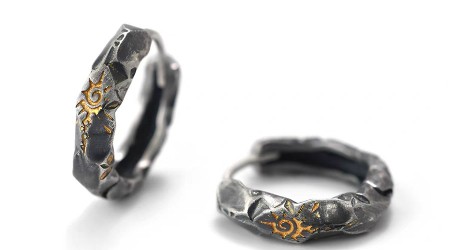
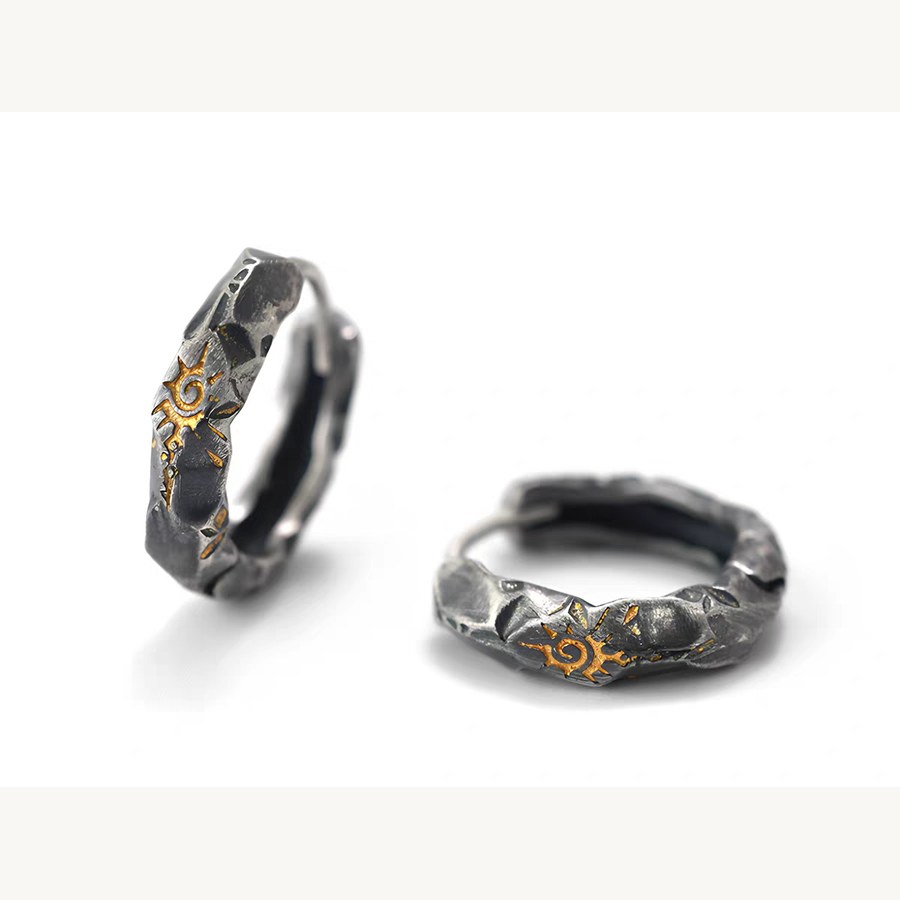
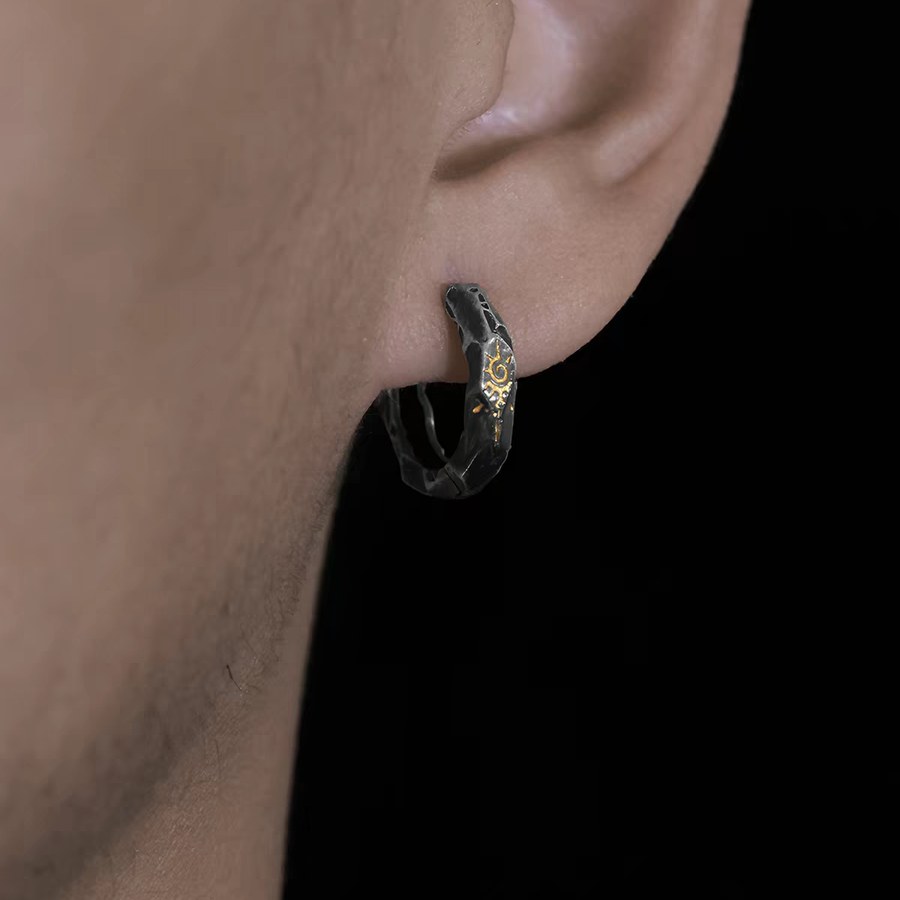
| Wish Stone Sun Hoop | Approximately 2 g per single earring; about 17.7 mm outer diameter, 13 mm inner diameter and 3.8 mm widest face; S925 silver structure with a gold-tone electroplated sun detail. | Whether the inner diameter clears the individual lobe and whether the hinged closure closes without pressure. |
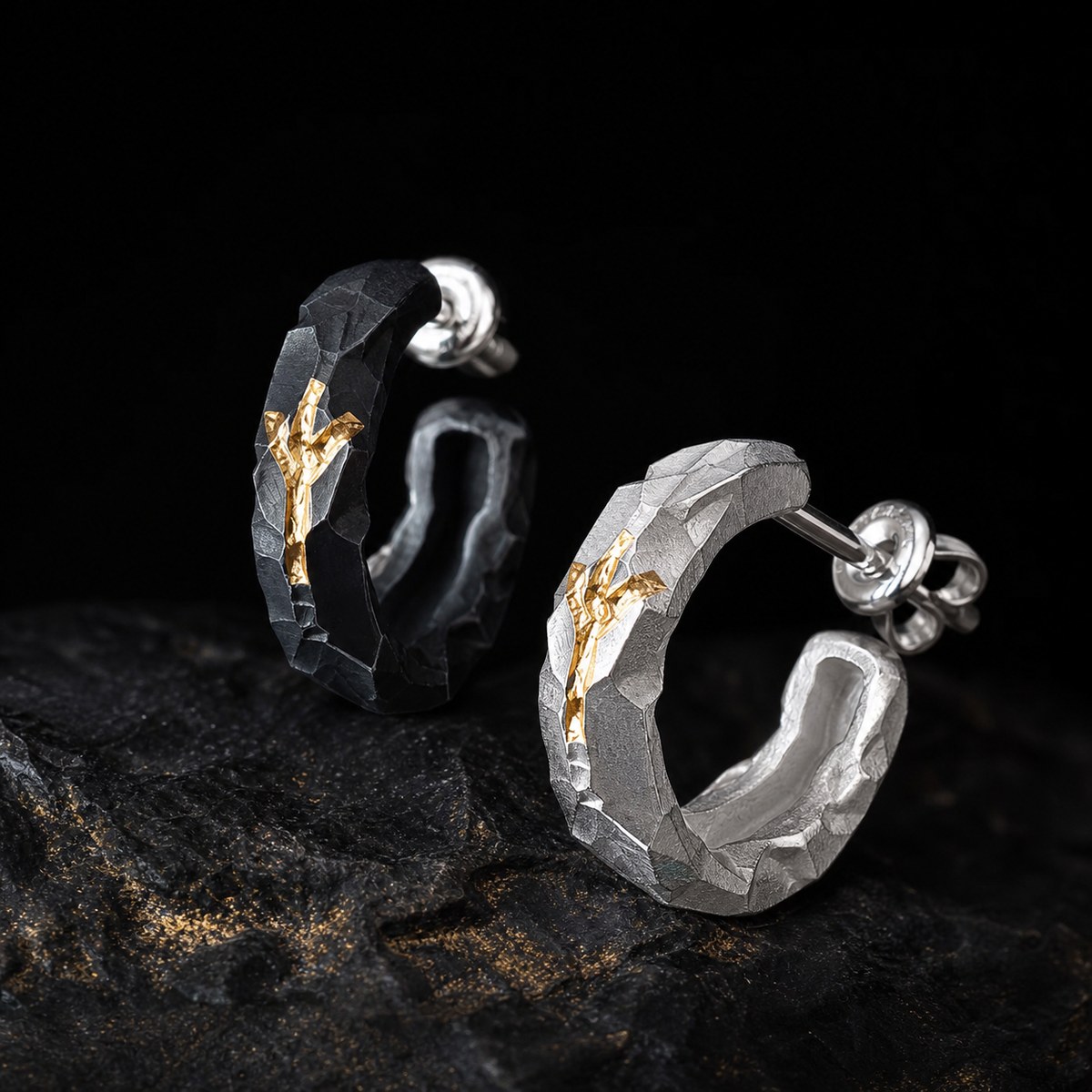
| Faceted Fine-Silver Small Hoop | Approximately 2.2 g per earring and 4.5 mm face width; 999 fine silver with 24K gold inlay; straight post with a separate butterfly push-back. | Backing pressure, post alignment and how the compact C-shaped face rests against the lobe. |
These two listings sit close in scale weight, yet their closures and geometry differ. That is exactly why grams alone cannot determine comfort. If a product does not state an independently verified weight—such as the current cyberpunk mechanical stud listing—do not invent a number. Ask before ordering if exact weight is important.
Material labels do not answer the comfort question
Metal description and weight are separate facts. In the United States, the FTC jewelry guides state that an item described as “silver,” “sterling silver,” “solid silver” or “Sterling” should be at least 925 parts per thousand pure silver. The rule supports accurate fineness labeling; it does not mean every sterling-silver earring has the same density, alloy additions, finish, closure quality or suitability for every wearer. Read 16 CFR §23.5 on silver-content representations.
For a clear distinction between the two silver finenesses used in current products, see our evidence-limited guide to 925 versus 999 silver earrings. If your concern is skin response rather than mechanical load, use the separate sterling-silver and sensitive-ears guide. “Lightweight” and “hypoallergenic” are not synonyms.
When a weight test is not appropriate
- New or incompletely healed piercing: do not use a fashion-earring trial to test healing.
- Current tenderness, discharge, swelling or redness: remove the source of irritation when safe to do so and seek qualified advice.
- Elongated or split hole: do not rely on a lighter earring to diagnose structural damage.
- Recent repair or repiercing: follow the treating professional’s instructions, not a general shopping guide.
- Known metal allergy: weight reduction does not remove an allergen.
Likewise, care methods cannot correct a mechanical fit problem. Use our guide to caring for oxidized silver earrings to protect intentional dark finishes, but replace a damaged closure rather than polishing around the fault.
Decision checklist
| Question | Proceed cautiously when… | Stop when… |
|---|---|---|
| Is the piercing fully healed? | It is calm, established and jewelry inserts without force. | It is tender, swollen, secreting or recently pierced. |
| Is weight stated per ear? | You can verify one complete earring on a scale. | The listing is ambiguous and exact weight is important to you. |
| Does the geometry suit the lobe? | The mass stays stable and the closure is not pinching. | The hole visibly drags, the piece twists or the backing compresses tissue. |
| Does comfort remain stable? | A short trial produces no persistent pressure or change in angle. | Discomfort, redness, swelling or altered hole shape appears. |
Frequently asked questions
Is 5 g too heavy for one earring?
No authoritative source reviewed here establishes 5 g as universally safe or unsafe. Consider anatomy, piercing position, leverage, closure, wear time and individual response. A lower weight can still be uncomfortable if the design pulls or pinches.
Are studs always more comfortable than hoops?
No. A compact stud can keep mass close to the lobe, but a tight backing, poor post alignment, rough finish or large front-heavy face can still cause pressure. A well-fitting compact hoop may feel stable, but diameter and closure must suit the wearer.
Does a wider backing make a heavy earring safe?
A wider backing changes the contact area and may alter tilt, but it does not erase total weight, leverage, wear time or snag risk. It should not be treated as a medical device or a guarantee against elongation.
Can I sleep in lightweight earrings?
Low weight does not make every style suitable for sleep. Posts, protruding forms, hoops and catches can press, snag or damage jewelry. Follow the jewelry maker’s and qualified piercer’s guidance for the specific piece and piercing.
How should directional ear climbers be assessed?
Weight is only one factor. Direction, clip pressure and how the design follows the lobe are central. Use the separate guide on left/right ear-climber fit and measurement.
Bottom line
Use grams to compare earrings, not to issue a universal safety certificate. Weigh one complete earring, record its dimensions and closure, consider leverage and piercing position, and conduct a short trial only on a fully healed, comfortable lobe. The most defensible rule is behavioral: an earring that pulls, changes the piercing angle, pinches or causes persistent discomfort is not suitable for continued wear in that situation—whatever the scale says.
Evidence reviewed: 24 July 2026. This article is general jewelry-selection information, not medical diagnosis or treatment. Persistent symptoms, an injured lobe or uncertainty about a piercing should be assessed by a qualified professional.
Related evidence review: If repeated pulling or visible tissue change is the concern, read our evidence-based guide to whether heavy earrings can stretch or tear earlobes, including warning signs and why grams alone cannot predict tissue response.
Is 4 grams heavy for earrings?
Four grams per earring can feel light to one wearer and uncomfortable to another. No validated source establishes 4 g as a universal cutoff. Confirm whether the listing means 4 g for one earring or the pair, then assess leverage, backing pressure, piercing position and wear time.
Are 8 gram earrings too heavy?
Eight grams per earring is double 4 g, but the number still cannot diagnose suitability. Treat it as a reason for a shorter, conservative trial on a fully healed lobe; remove the earring if the hole drags, the angle changes or pressure persists.
How much weight can an ear hold?
There is no evidence-based maximum that applies to every earlobe. Anatomy, previous stretching or repair, piercing placement, jewelry geometry, accidental pull and duration all change tissue load. A scale supports comparison; it does not certify safety.
Leave a comment