Short answer: yes. Repeated traction from heavy or pendulous earrings can gradually widen a piercing, thin the tissue below it and contribute to an incomplete or complete earlobe split. A sudden snag can also tear a lobe. But there is no clinically validated gram limit that makes every earring safe or unsafe for every person. Weight per earring matters alongside wear time, how far the mass sits from the piercing, movement, closure, piercing position, lobe anatomy and any previous stretching.
This is an evidence review and buyer guide, not a diagnosis. If an earlobe is bleeding, acutely torn, increasingly painful, hot, very swollen, producing pus or changing quickly, stop treating the issue as a jewelry-comparison problem and obtain appropriate professional care.
What the Evidence Supports
| Question | Best supported answer | Important limit |
|---|---|---|
| Can heavy earrings stretch a piercing? | Clinical and professional sources consistently describe heavy or pendulous jewelry as a contributor to widening and stretched lobes. | Most sources do not quantify dose by grams, hours or years. |
| Can an earring tear the lobe? | Yes. A split can develop progressively, and a sudden pull or snag can cause an acute tear. | Risk depends on tissue, hole position, geometry and trauma, not weight alone. |
| Is there a universal safe weight? | No clinically validated universal cutoff was found. | Retail rules of thumb are not medical thresholds. |
| Does a large backing make a heavy front safe? | A backing can change support and angle. | It cannot erase total load, movement, poor fit or a thin tissue bridge. |
Stretching, Elongation and Splitting Are Not the Same
A normal pierced channel can become visibly longer or wider without being fully torn. Clinical papers call early enlargement an incomplete split or cleft; more advanced cases can leave only a thin bridge of tissue, and a complete split divides the lower lobe. A 2020 surgical paper in PubMed Central describes classifications based on how far the cleft extends toward the lower edge. That classification helps clinicians plan repair; it is not a self-diagnosis tool.
A 2023 pilot study of enlarged piercing holes reports that chronic traction may cause tissue atrophy, gradual widening and progression toward a split. The study involved only six patients receiving a particular repair, so it cannot tell an individual buyer exactly how many grams or hours will cause damage. Its value here is the documented direction of the process, not a consumer threshold.
Why Grams Alone Cannot Predict What an Ear Will Do
1. Duration changes exposure
A heavier earring worn briefly and removed at the first sign of pulling is not the same exposure as repeated all-day wear. The American Society of Plastic Surgeons describes long-term wear of heavy earrings as one route to gradual stretching. This supports a cumulative-risk interpretation, but it still does not produce a universal schedule.
2. Geometry changes leverage and movement
Two earrings can have the same scale reading yet feel different. A compact stud keeps more mass close to the hole; a long dangle or wide climber can place material farther away and move more as the head turns. That is a mechanical comparison, not a clinical formula. Buyers should therefore check dimensions and form as well as weight. Our separate guide explains how to read earring height, width, diameter and scale online.
3. Piercing position and remaining tissue matter
A hole close to the lower edge has less tissue beneath it. ASPS notes that low placement can leave less soft tissue to support later earring loads. Existing enlargement, scarring, accidental injury and individual anatomy can further change the situation. A product listing cannot verify those personal factors.
4. Intentional stretching is a different process
Intentional enlargement with gauges should not be confused with an ordinary fashion earring accidentally pulling a small pierced channel. The Association of Professional Piercers defines stretching as gradual enlargement and warns that results vary, permanent change is possible and going too far or too fast can thin or tear tissue. Anyone intentionally stretching a piercing should work with a qualified professional rather than using heavy fashion earrings as an improvised tool.
Observable Warning Signs
These signs do not identify a diagnosis, but they are reasons to stop loading a healed lobe and reassess:
- the hole looks longer vertically than it used to;
- the front of the earring tilts downward even when the backing fits correctly;
- the bridge of tissue below the hole appears thinner;
- wear causes persistent pulling, pressure, burning or pain;
- there is new bleeding, a visible notch or a sudden tear;
- redness, swelling, warmth or discharge persists after the earring is removed from a healed piercing.
The Cleveland Clinic advises contacting a healthcare provider for persistent pain or swelling, nodules, allergic rash or signs of infection. The NHS lists swelling, pain, heat, marked redness or darkening, blood or pus, and feeling unwell as infection warning signs. Infection and a mechanical tear are different problems, although they can coexist.
Fresh Piercing Versus Healed Piercing
Do not apply ordinary fashion-earring advice to a fresh piercing. The American Academy of Dermatology advises leaving starter jewelry in for six weeks or more and following appropriate aftercare, because early removal can allow the channel to close. Initial jewelry also needs suitable material, dimensions, surface and room for swelling. A decorative silver earring should not replace professionally fitted starter jewelry merely because it looks small.
For a healed piercing, remove a fashion earring when it persistently pulls, pinches or changes the hole's angle. Read the separate evidence review on backing pressure, post fit and warning signs when tightness rather than downward traction is the main complaint. If you are unsure whether a piercing is fully healed or whether jewelry should stay in, ask a qualified piercer or clinician.
A Conservative Buyer Checklist
- Find weight per earring. A pair weight cannot be compared directly with a single-ear load.
- Confirm dimensions. Height, width, diameter and projection help explain where mass and movement may sit.
- Identify the format. Stud, hoop, climber and dangle designs distribute load and movement differently.
- Check the closure. The matching post and back affect angle and retention, but no back makes an unsuitable load universally safe. Compare the main earring-back families.
- Start with a shorter wear test on a healed piercing. Do not wear through persistent pulling or pain.
- Remove snag-prone jewelry before sleep, exercise, hair care or changing tight clothing. See the guide to sleeping in earrings safely.
- Do not hide missing data. If a seller does not state weight, dimensions, quantity or closure, treat them as unknown rather than estimating from photos.
Two Catalog Examples — Specifications, Not Safety Ratings
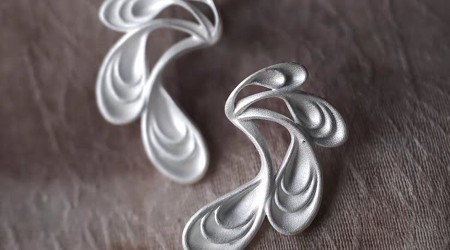
The Yin Yang stud earring in 999 fine silver with 24K gold inlay is listed at approximately 1.2 g per earring. The Peacock Feather ear climber in satin 925 sterling silver is listed at approximately 4 g per earring and approximately 30 × 20 mm.
Those numbers make comparison possible, but they do not declare the stud safe for every wearer or the climber unsafe for every wearer. The pages do not know the buyer's anatomy, piercing position, previous stretching, wear duration or activity. Use the figures with the measurement-based earring weight and comfort guide, and stop if a healed lobe shows persistent pulling or change.
What This Review Cannot Prove
The available sources support an association between heavy or pendulous earrings, chronic traction, enlarged holes and split lobes. They do not establish a single gram cutoff, a guaranteed safe wear time, a home test that predicts tissue failure or a product that prevents it. Much of the clinical literature begins with people already seeking repair, which limits how confidently it can estimate risk for all earring wearers.
The most defensible conclusion is therefore simple: weight is a necessary disclosure, not a complete safety verdict. Compare weight per ear with dimensions and design, limit exposure when a healed lobe pulls, avoid snagging, and seek professional assessment for progressive thinning, a tear, persistent inflammation or suspected infection.
Sources
- Cleveland Clinic: Earlobe Repair
- American Society of Plastic Surgeons: Torn and Stretched Earlobes
- Sadasivan & Kochunarayanan: Acquired Split Earlobe Classification and Repair
- Bhooshan & Madhavi: Hole-retaining Lobeplasty for Type I Deformities
- Association of Professional Piercers: Stretching
- NHS: Infected Piercings
- American Academy of Dermatology: Caring for New Piercings
Leave a comment