Direct answer: read an online earring listing as a set of separate measurements, not as one generic "size." Height and width describe the visible outline; face size describes the front of a stud; inner and outer diameter answer different questions for a hoop; post length describes the straight wearable shaft only when the seller actually measures it; and weight is mass, not a dimension or a guarantee of comfort. Compare like with like in millimeters, check which endpoints were used, and treat every omitted value as unknown rather than estimating it from a photograph.
The safest method is to reproduce the stated outline on paper at full scale, compare it with an earring you already own, and then account for your own piercing position and ear shape. An on-ear photograph can show orientation and approximate visual proportion, but it is not a calibrated ruler. Peer-reviewed studies of external-ear anatomy document variation with age, sex and population; one model's ear cannot predict another person's fit.
The seven measurements shoppers should keep separate
| Listing term | What should be measured | What it helps answer | Common mistake |
|---|---|---|---|
| Overall height | Topmost to bottommost point in the intended wearing orientation | How much vertical space the design occupies | Assuming it means drop below the piercing |
| Overall width | Widest horizontal span of the visible design | Coverage and lateral presence on the lobe | Confusing it with metal thickness |
| Stud face size | Width or diameter of the decorative front, excluding post and back | How much of the lobe the face may cover | Reading a round diameter as total earring depth |
| Outer hoop diameter | Outside edge to outside edge through the center | Total visual footprint | Using it to predict clearance around the lobe |
| Inner hoop diameter | Inside edge to inside edge through the center | Available opening and approximate lobe clearance | Assuming the same inner diameter from an outer value |
| Post or wearable length | The usable straight section between the decorative front and closure, defined by the seller | Whether the closure has enough room for the intended placement | Guessing it from a side photograph |
| Weight | Mass per earring or per pair, with backs included or excluded stated clearly | A comparison input for load | Treating mass as a comfort threshold |
These terms are not interchangeable. The Getty Conservation Institute describes height, width and depth as standard overall dimensions in object documentation and stresses reporting measurements with appropriate accuracy. Museum catalogues demonstrate the same discipline. One Metropolitan Museum of Art earring record, for example, separately reports height, width and depth. Another Met earring record reports millimeter dimensions, mass and a separate interior measurement. Neither approach turns every number into a promise about fit; it identifies what was measured.
Why millimeters work better for small jewelry
The International System of Units defines the meter as the base unit of length. The U.S. National Institute of Standards and Technology explains SI length and its prefixes, while its metric-ruler resource explicitly teaches millimeter and centimeter scales for small everyday objects. For earring listings, millimeters avoid the awkward fractions created by inches and make small differences visible.
Conversion is simple: 10 mm equals 1 cm, and 25.4 mm equals 1 inch. Do not round too early. A 13 mm inner hoop diameter and a 17.7 mm outer diameter are not meaningfully described as "about half an inch" and "about seven-tenths of an inch" if the purpose is to compare available space. Keep the original millimeter value for decisions; add inches only as a secondary convenience.
Precision also needs context. "Approximately 30 mm" tells you the maker expects small variation. "30.00 mm" implies a level of precision that may not match a hand-finished object or an ordinary ruler. The Getty's guidelines on dimensional measurement warn that processes, deformation and measurement method can affect reported dimensions. A responsible product page states approximate values honestly rather than displaying false decimal precision.
How to read stud face size
For a round stud, face diameter is the straight line across the widest part of the decorative front, passing through its center. For a non-round stud, height by width is clearer. Measure the visible face only unless the listing explicitly includes a frame, setting or projection. Post length and backing size should be separate fields.
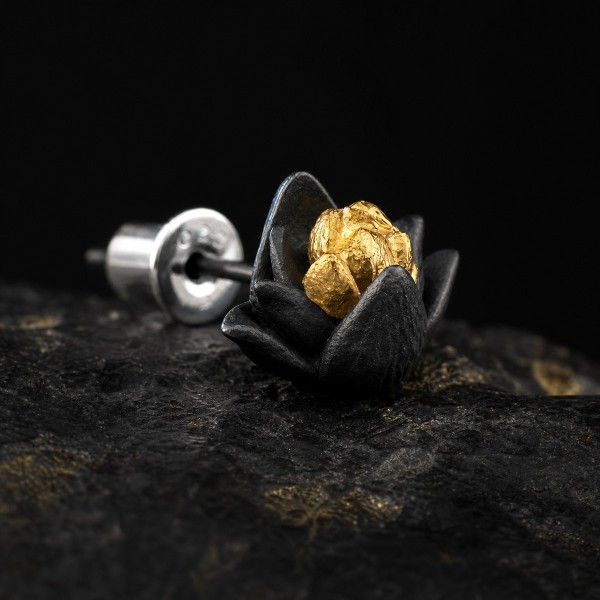
The Lotus Flower Stud Earrings provide a bounded example: the three-dimensional face is approximately 9-10 mm across. That statement supports a front-face comparison. It does not establish post length, total depth, weight, universal comfort or how much of every person's lobe will be covered.
To test that scale, draw a 10 mm circle on paper, cut it out, and place it beside the lobe in a mirror without attaching it to the skin. The paper test reproduces the nominal front footprint, not the final look. A sculpted face can appear smaller or larger depending on contrast, depth, edge shape and light.
Inner versus outer hoop diameter
Outer diameter describes the hoop's complete visual span. Inner diameter describes the open space inside it. Metal thickness, faceting and an irregular silhouette mean you cannot reliably calculate one from the other unless the cross-section is known and uniform. Listings should publish both when clearance matters.
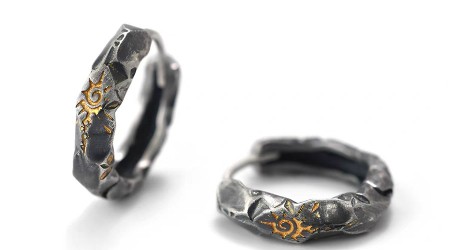
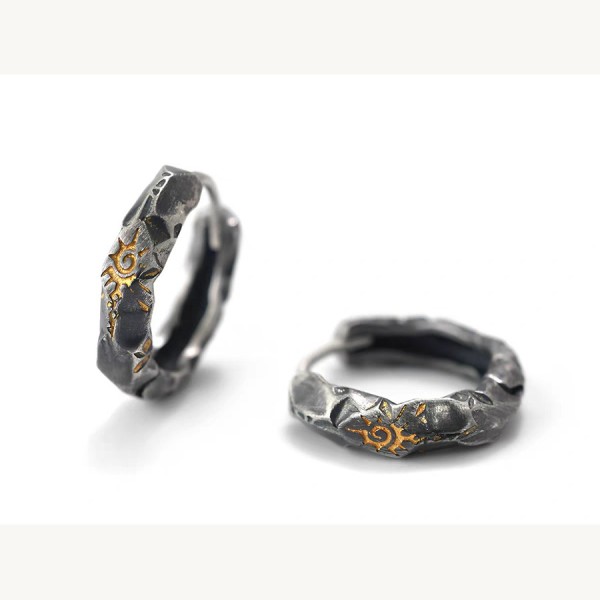
The Wish Stone Sun Hoop is documented at approximately 17.7 mm outside diameter, 13 mm inside diameter and 3.8 mm at the widest face, with an approximate weight of 2 g per single earring. Read the four values independently:
- 17.7 mm describes the total outside footprint.
- 13 mm describes the central opening, not guaranteed lobe clearance.
- 3.8 mm describes the widest visible face, not the post thickness.
- 2 g is mass per earring, not a dimension and not a universal comfort limit.
Whether 13 mm closes around a particular lobe depends on the distance from piercing channel to lobe edge, tissue thickness, closure geometry and how the hoop is oriented. If that distance is close to the stated inner radius or opening, ask the seller for a closure diagram or additional measurements rather than assuming the model photograph settles the question.
Height and width for ear climbers
Directional ear climbers need height, width and orientation. The measurement should follow the intended upright orientation, not whichever angle makes the product look longest. The listing should also distinguish left and right versions because a mirrored outline changes how the design follows the ear.
The Bamboo Leaf Ear Climber is approximately 30 mm high by 15 mm wide and approximately 3 g per earring. Those values describe a long, narrow outline. They do not prove that the top leaf will reach the same anatomical point on every ear. The product is offered as left, right or mirrored pair precisely because orientation is part of fit.
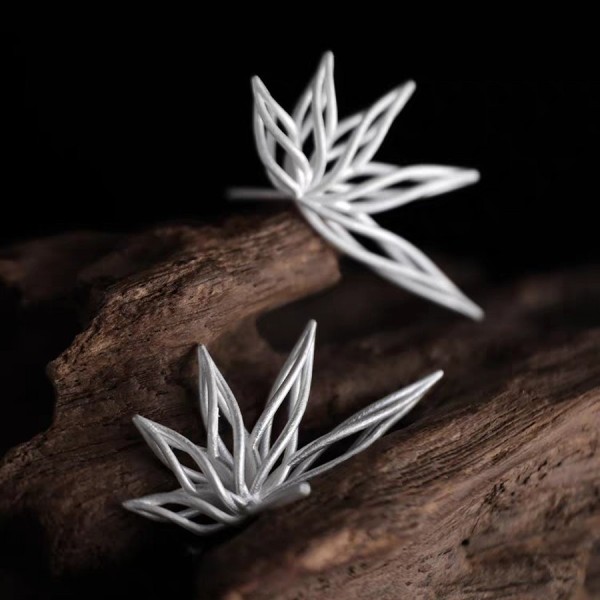
If two climbers are both 30 mm high, they can still look different. One may concentrate most metal near the lobe; another may use open lines or a narrow upper tip. Overall dimensions define a bounding box, not the distribution of visual mass. Use the dimensions first, then examine a straight-on product image to see how much of that box is empty space.
Why an on-ear photo is not a calibrated scale
External ears vary. A 2022 peer-reviewed photogrammetric study of adult auricles reported differences across measured parameters and discussed age, sex and ethnic influences on ear shape and size. A larger 2025 multicenter Korean study measured 631 adults and found associations with age and sex across several external-ear dimensions, while comparisons with other populations also differed.
These clinical and anthropometric studies were not conducted to choose earrings, and this guide does not convert their group averages into a jewelry size chart. Their relevant lesson is narrower: human ears are not one fixed template. Camera distance, focal length, head angle and retouching add more uncertainty. Therefore a model photo is useful for orientation and styling, but a shopper should not use it to calculate missing millimeters.
A product-only photograph without a ruler has the same limitation. Pixels do not become millimeters unless the image contains a reliable scale in the same plane as the object and has not been resized or distorted. Even a coin can mislead if it is closer to the lens. Written measurements should control the decision.
A five-step comparison method at home
- Copy the exact labels. Write down height, width, inner diameter, outer diameter, face size, post length and weight in separate rows. Leave omitted fields blank.
- Compare with a known earring. Measure an earring you already wear using the same endpoints. Do not compare a new item's outer diameter with your old item's inner diameter.
- Make a full-scale paper outline. Draw the stated height and width as a rectangle, circle or simplified silhouette. This tests footprint without pretending to reproduce depth or weight.
- Measure your placement, not an average ear. For a hoop, note the distance from the center of the healed piercing to the lobe edge. For a climber, note the available direction and whether the design is left- or right-specific. Do not insert measuring tools into a piercing.
- Ask one precise question. If the decision depends on an omitted field, ask for that field and its endpoints: "What is the usable straight post length from the back of the face to the closure position?" is better than "Is it small?"
Unknown means unknown: if a page does not state post length, face width or weight, do not infer it from a photo, another product, a model number or a familiar style name. Contact the seller before ordering when that missing value determines fit.
Measurements that do not guarantee comfort
Dimensions and weight help comparison, but neither guarantees comfort. Comfort can change with closure pressure, post angle, edge finish, movement, wear time, piercing position and individual sensitivity. The site's earring weight and comfort guide explains why there is no defensible universal gram threshold for every wearer.
Likewise, post length alone does not establish material compatibility or suitability for a healing piercing. Read the separate sterling silver and new piercing evidence guide for that question. This article makes no claim that a measurement prevents allergy, treats infection, improves healing or makes an earring safe for every person.
Stop wearing a piece that causes persistent pressure, pain, bleeding, swelling or tissue damage. Seek advice from a qualified medical professional for symptoms and from an experienced piercer or jeweler for fit and hardware questions. A product-size chart is not a diagnosis.
What a high-quality listing should disclose
For studs
- Face height and width or diameter
- Post material and closure type
- Usable post length if verified
- Weight per earring, with back inclusion stated
For hoops
- Outer and inner diameter
- Face or tube width
- Closure geometry
- Weight per earring
For climbers
- Height and widest span
- Left/right orientation
- Front and rear retention structure
- Weight per earring
For every style
- Approximate versus exact values
- Single versus pair basis
- Materials stated by component
- No estimates disguised as specifications
Frequently asked questions
Is earring size the same as face width?
No. Face width is one dimension of the decorative front. Overall height, depth, post length, inner diameter and weight may also matter depending on the style.
Should hoop size mean inner or outer diameter?
The listing should say which. Outer diameter describes total visual span; inner diameter describes the opening. If it only says "diameter," ask for clarification before using it to judge clearance.
Can I estimate post length from a side photo?
No reliable estimate is possible without a calibrated scale in the same plane and a clear definition of the endpoints. Treat unstated post length as unknown.
Does a 10 mm stud cover a 10 mm area of every lobe?
It has an approximately 10 mm front span, but visible coverage depends on lobe dimensions, piercing location, the stud's outline and viewing angle.
Does a lighter earring always feel more comfortable?
No. Mass is only one input. Closure pressure, balance, movement, post angle, surface finish, anatomy and wear time can change the experience.
What should I do when a product has no measurements?
Ask the seller for the specific measurement needed and how it was taken. Do not replace a missing specification with a photo estimate or a generic size chart.
Sources and review date
- National Institute of Standards and Technology, SI Units - Length.
- National Institute of Standards and Technology, Metric Ruler (SP 376).
- Getty Conservation Institute, Measurements of Dimension.
- Metropolitan Museum of Art, Earring object record with height, width and depth.
- Metropolitan Museum of Art, Gold earring record with millimeter, mass and interior measurements.
- Boesoirie et al., 2022, adult auricle anthropometry using photogrammetry.
- Cho et al., 2025, Anthropometry of the External Ear in Korean Adults: A Multicenter Study.
Editorial review date: August 19, 2026. Product measurements were checked against current Skullearring product records. This guide provides a measurement framework, not a universal fit or health guarantee.