Does an Ear Cuff Need a Piercing? Read the Listing Before You Buy
No: an ear cuff does not necessarily use a piercing. The useful next question is how that particular cuff opens, which measurements the seller gives, and whether the order is for one piece or two. A close-up photo can show the style, but the listing is where a buyer should find the construction and purchase facts.
Start with the construction
An ear cuff is an earring-like format that can sit on the outer ear rather than use a post through a piercing. That broad name is not enough to describe every product. A cuff may have a fixed opening, a clip-style mechanism, or a spring-opening construction. Read the actual product description instead of assuming that every item called a cuff works the same way.
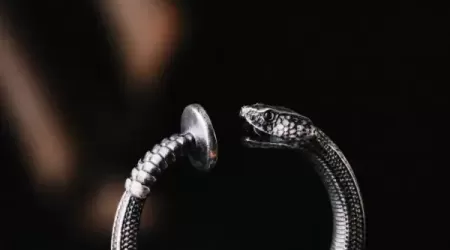
The current Rattlesnake Ear Cuff is described by the seller as a spring-opening S925 sterling-silver cuff. Its product page says that it can be positioned without using a piercing, while noting that fit varies by individual ear shape. That is the product-specific answer for this listing; it is not a promise about every cuff on the market.
What “no piercing” does and does not tell you
“No piercing” identifies the stated wearing format. It does not guarantee that one design will fit every lobe or cartilage position, feel comfortable for every wearer, or remain secure in every activity. Those are individual-fit questions, not claims supplied by the phrase itself.
Keep two decisions separate. First, check whether the design uses a post through a piercing. Then check the seller's measurements, opening mechanism, material disclosures and purchase terms. If a fit or health question matters to you, use an appropriate individual source of advice rather than treating a retail listing as a universal sizing or medical recommendation.
Read the opening mechanism with the measurements
The Rattlesnake Ear Cuff page lists an approximately 19 mm outer diameter, a 14 mm inner opening, 3 mm width and approximately 2.4 g per cuff. These are product measurements, not a universal-fit result. Outer diameter describes overall scale; the inner opening describes the space inside the cuff. They answer different questions and should not be substituted for one another.
A spring-opening mechanism is also a construction fact, not permission to force a piece into place. The seller's instructions say to open this cuff only as needed, position it carefully and release it. If the item feels tight, unstable or uncomfortable, that is a reason to stop rather than to treat a listed measurement as a guarantee.
Do not confuse a cuff with an ear climber
An ear climber and an ear cuff can create a similar sweeping silhouette, but they are different purchase formats. An ear climber can use a pierced-ear post and may have left/right orientation. A cuff buyer should instead look for the named cuff or clip construction and its stated opening. The site's ear-climber guide covers the directional format; it is not evidence that a cuff needs a piercing.
Check the order unit after the construction
Construction and quantity are separate choices. The Rattlesnake listing asks the shopper to choose one cuff or a pair of two. That selector changes the order unit, not the spring-opening construction. Confirm the selected unit and resulting total before adding the item to the cart; do not infer a pair from a photograph or a starting price.
Use product facts without adding unverified claims
For this specific cuff, the product page identifies an S925 sterling-silver body and a black-zircon detail, alongside its dimensions, weight, finish choices and spring-opening format. It does not establish universal fit, skin suitability, medical safety, stone origin, treatment, carat weight or a laboratory grade. Those limits matter: a careful product explanation should separate what the listing says from what it does not prove.
Likewise, a model image can help show the sculptural snake design and relative scale, but it cannot identify how the piece will sit on another person's ear. Use the written measurements and mechanism for the seller's stated facts, and ask a narrow question before purchase if a missing detail would change your decision.
A quick pre-purchase checklist
- Does the listing call the item a cuff, clip, hoop, stud or ear climber?
- Does it identify a spring opening, fixed opening, clip or pierced-ear back?
- Which measurements are outer size, inner opening, width and weight?
- Is the item sold as one cuff or as a pair?
- Which metal, finish and stone details are actually stated?
The buyer takeaway
An ear cuff can be a no-piercing choice when the product listing says so, but the product name alone is not a fit guarantee. For the Rattlesnake Ear Cuff, the current seller disclosure identifies a spring-opening S925 cuff, stated dimensions and a one-cuff or pair selector. Read those facts together, keep individual-fit assumptions separate, and choose the purchase unit you intend to receive.
Leave a comment