Short answer: an ear climber should follow the outer line of the lobe without twisting, pinching or pulling the piercing. Directional designs need a left- or right-ear version; the correct side is the one that lets the decorative form rise naturally from the piercing. Before buying, compare the earring's height, width, fastening position and weight with the usable area of your own lobe. Wear fashion ear climbers only in a fully healed piercing, stop if they cause tenderness or redness, and never force a post or support into place.
“Ear climber” and “ear crawler” are retail terms rather than regulated engineering categories. Both usually describe an earring that travels upward or outward across the lobe instead of hanging vertically. The useful question is therefore not which label a seller uses, but how the piece is oriented, fastened and sized.
Start with the four facts that determine fit
A product photograph can show the design, but it cannot prove how the piece will sit on every ear. Earlobes differ in height, width, attachment and soft-tissue mechanics. A finite-element study comparing free and attached ear lobules found different stress and deformation patterns under simulated load. That research does not establish a consumer fit rule, but it does support a cautious conclusion: identical jewelry can behave differently on different anatomy. See the peer-reviewed study indexed by PubMed.
Use these four product facts before judging appearance:
| Fit fact | What to check | Why it matters |
|---|---|---|
| Orientation | Left, right or reversible | A directional curve may point away from the lobe or rotate when used on the wrong side. |
| Height and width | Millimetres, not “small” or “large” | The decorative form needs enough lobe area without reaching an uncomfortable edge. |
| Fastening geometry | Where the post and rear support sit | The visible outline alone does not show the points where pressure is applied. |
| Weight | Per earring, not per pair | Weight changes leverage and determines whether a design is suitable for extended wear. |
How to choose the left or right version
Stand in front of a mirror and identify the direction in which the design should travel from your piercing. If it rises toward the outside edge of the left ear, select the left-oriented piece. If it is meant to rise along the right ear, select the right-oriented version. A pair should contain mirrored pieces rather than two copies of the same orientation.
- Find the anchor point. This is the piercing hole, not the bottom edge of the lobe.
- Trace the intended path. Imagine a line from the piercing toward the outer contour of the ear.
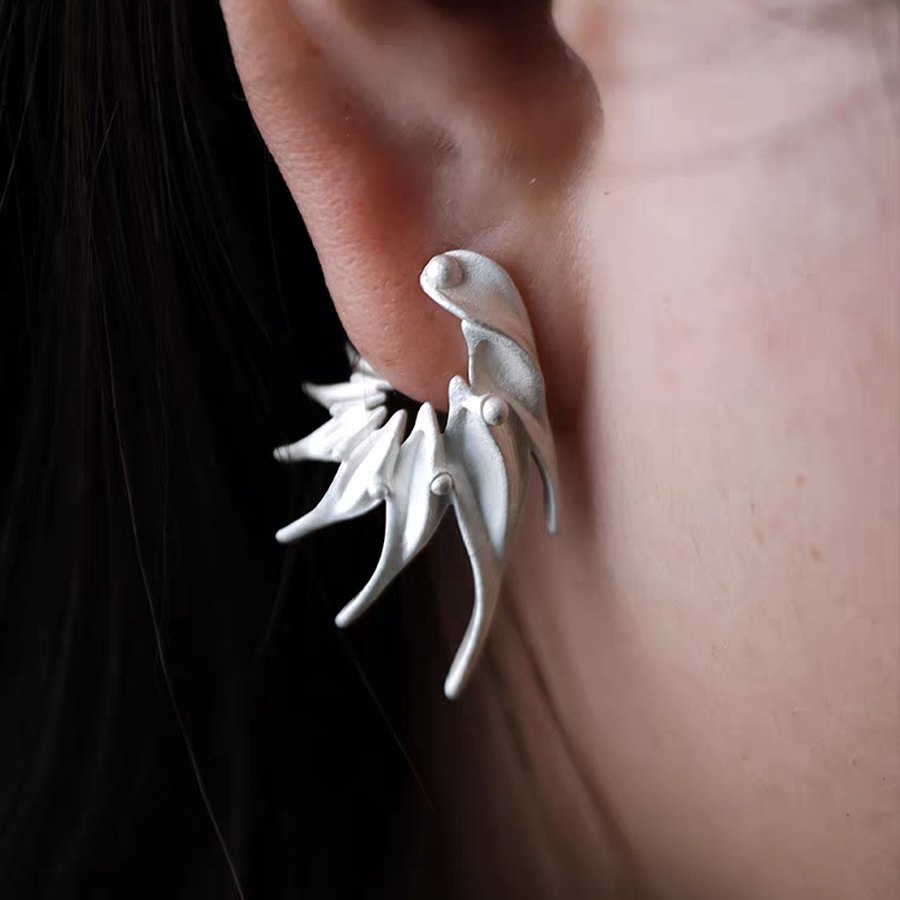
- Compare the product photograph. Use an on-ear photograph only for direction and approximate scale; do not assume the model's anatomy matches yours.
- Check the option label. Select “Left Ear — Single,” “Right Ear — Single,” or a clearly described mirrored pair.
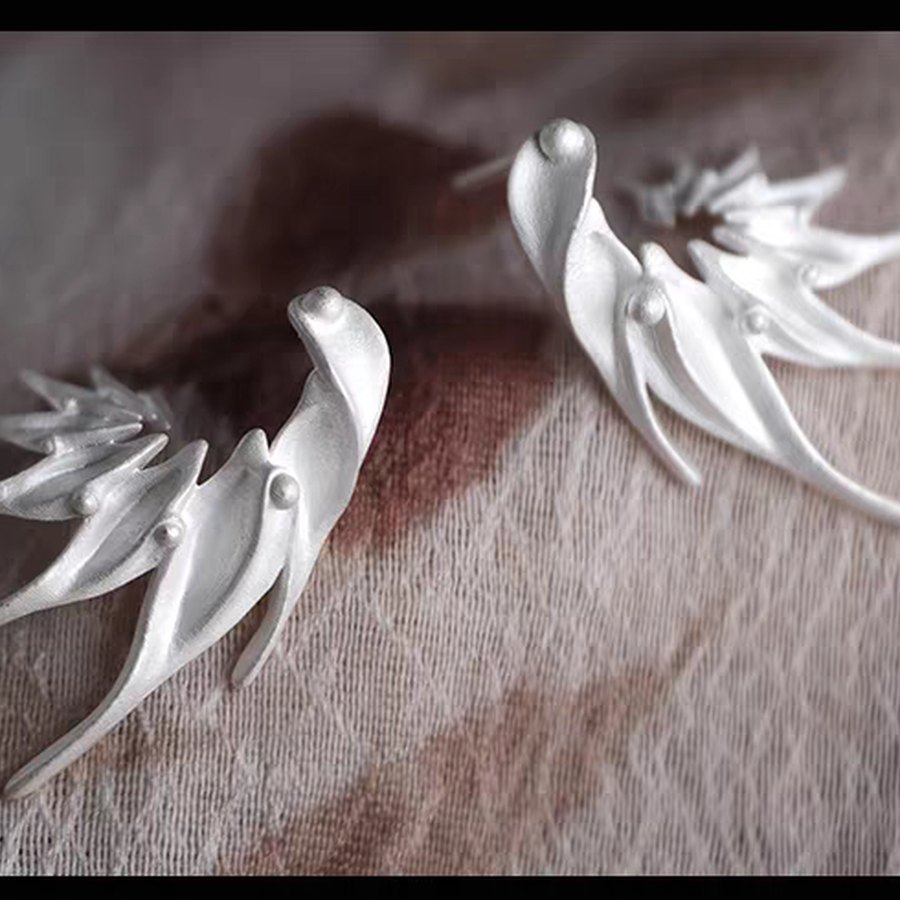
Skullearring's four current directional designs use separate left and right options. The Silver Bird Ear Climber and Spiral Shell Ear Climber are approximately 30 × 20 mm and about 5 g per earring. The Bamboo Leaf Ear Climber is approximately 30 × 15 mm and about 3 g; the Peacock Feather Ear Climber is approximately 30 × 20 mm and about 4 g. These are product measurements, not promises that a style will fit every lobe.
A practical measurement method before ordering
You do not need specialist equipment. Use a mirror, a flexible paper strip, a fine pen and a millimetre ruler. Do not place sharp measuring tools against the ear.
- Wash and dry your hands, then identify the centre of the healed piercing.
- Hold a narrow paper strip beside the lobe and mark the distance from the piercing to the highest point where you want the design to end.
- Measure the widest usable area across the intended path.
- Compare those two numbers with the product's stated height and width.
- Allow visual clearance at the lobe edge. A product equal to the entire measured area leaves no room for differences in curve, fastening position or movement.
This method is a screening tool, not a fit guarantee. It is most useful for rejecting obviously oversized or incorrectly directed choices. If your piercing is unusually high, low or angled, ask the seller for the post-to-tip measurement or consult a qualified piercer with the product specifications.
How to put on an ear climber without forcing it
The Association of Professional Piercers advises that jewelry for a healed piercing should not be forced through the channel and that hands, jewelry and the work area should be clean. Its guidance also says size, material, finish, style and weight all affect suitability for wear. Read the APP's full guidance on jewelry for healed piercings.
- Confirm the piercing is healed. It should no longer be tender, secreting or crusting. If you are uncertain, ask a qualified piercer rather than changing jewelry yourself.
- Clean your hands and the fastening. Work over a clear surface so a small backing is not lost.
- Insert the post gently. Follow the existing piercing channel. Stop if resistance requires pressure.
- Rotate only as the design requires. Guide the decorative section upward while supporting the centre; do not pull narrow leaf, feather or wing tips.
- Secure the backing or support. It should hold the piece in place without compressing the lobe.
- Check from two angles. Look from the front and side. The piece should not twist the piercing or lift sharply away from the ear.
- Perform a short first wear. Recheck comfort and position before extending wear time.
Fashion ear climbers are not initial-piercing jewelry. The APP explains that new piercings have anatomy-, placement- and material-specific requirements, and that jewelry that is too tight or too large can create complications. Its initial-jewelry standards should be used with professional piercing advice, not replaced by a retail style guide.
Fit signals: secure, questionable or stop
| Signal | Interpretation | Action |
|---|---|---|
| Stable position, no pinching, no visible pull | Reasonable initial fit | Continue a short trial and recheck later. |
| Frequent rotation or sliding | Orientation, backing tension or geometry may be wrong | Remove it and recheck the side and fastening; do not overtighten. |
| Pressure mark that persists, tenderness or throbbing | Excess pressure or unsuitable fit | Remove the earring and do not “wear it in.” |
| Itching, swelling, redness or discharge | Possible irritation, allergy or another problem; appearance alone cannot diagnose the cause | Stop wearing it and seek appropriate professional advice if symptoms persist or are significant. |
Metal disclosure also matters. In the United States, the Federal Trade Commission's Jewelry Guides state that “sterling silver” should not be used for an item that is less than 925 parts per thousand pure silver. See 16 CFR § 23.5. A 925 mark describes silver fineness; it does not by itself disclose every alloying metal, solder, post component or nickel-release result.
Nickel is specifically regulated in the European Union for articles such as earrings that contact the skin. The European Chemicals Agency's technical explanation of prolonged skin contact documents the regulatory context and the role of nickel release. That does not prove a reaction will or will not occur with a particular product. Buyers with known metal sensitivity should request component and testing information rather than relying only on “925” or the word “hypoallergenic.” Our separate sterling silver earrings and sensitive ears guide explains this distinction in detail.
Which shape is likely to be easiest to fit?
No design is universally easiest, but product dimensions let you compare trade-offs:
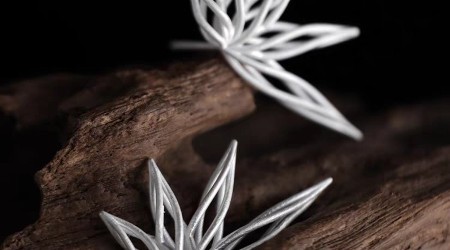
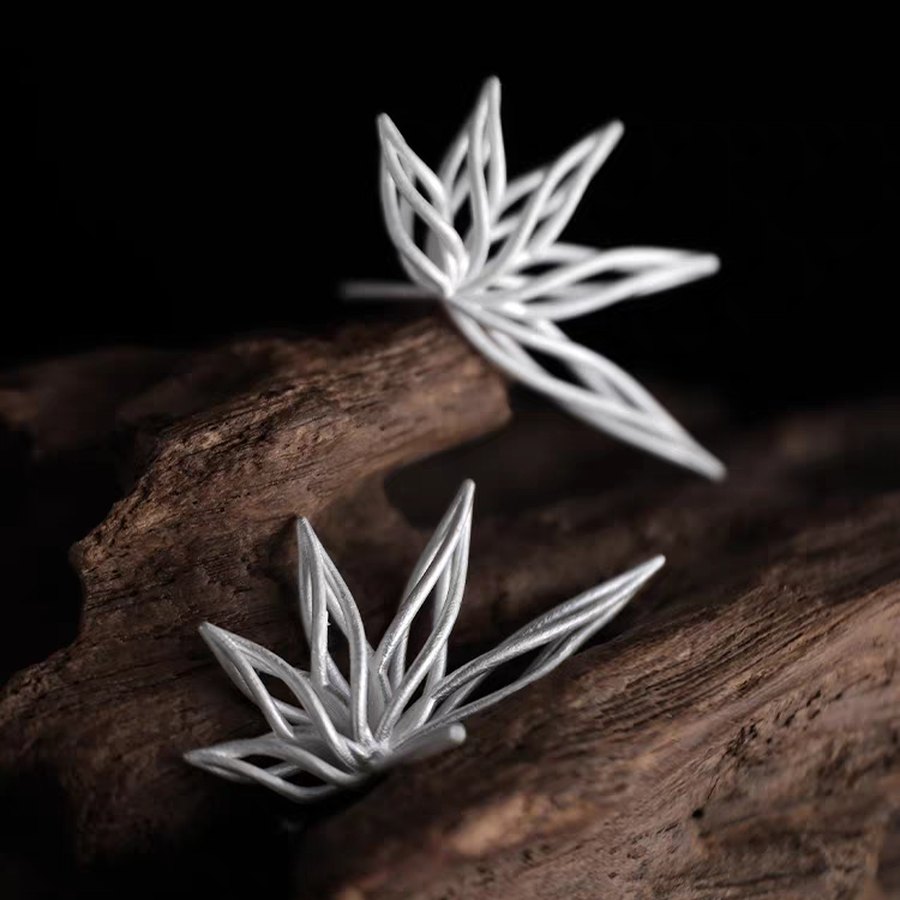
- Narrow openwork climbers: the 30 × 15 mm bamboo design has the lowest listed weight of the four, but its pointed openwork leaves should be handled at the centre rather than the tips.
- Broad sculptural climbers: the bird and spiral designs occupy a wider 30 × 20 mm area and weigh approximately 5 g each. They offer a stronger silhouette but demand more usable lobe area.
- Layered medium-weight forms: the peacock design is approximately 4 g and 30 × 20 mm, placing it between the lighter bamboo and the heavier bird/spiral pieces by listed weight.
Weight alone is not enough. Distribution matters: a compact 5 g form and a long 5 g form can create different leverage. This is why both measurements and on-ear orientation should be reviewed together.
The spiral example is a shell-inspired sterling-silver form, not evidence that natural shell is present or that the motif has one universal symbolism. For the material and historical distinction, read our evidence review of what shell earrings mean.
Care without damaging a satin or oxidized finish
Sterling silver can tarnish as silver reacts with sulfur-containing gases and forms a surface layer of silver sulfide. The Canadian Conservation Institute explains the mechanism and warns that repeated abrasive polishing removes some underlying silver. Its silver care and tarnish-removal note is written for conservation contexts, so jewelry owners should use it as a materials reference rather than as a command to apply museum treatments at home.
For these satin-finished climbers, use a conservative routine:
- Wipe moisture and cosmetics away with a soft, dry cloth after wear.
- Store each piece separately so harder jewelry cannot scratch the surface or bend fine elements.
- Do not polish aggressively across satin texture, intentional darkening or mixed finishes.
- Hold the fastening or solid centre when removing the earring.
- If deeper cleaning is necessary, choose a product intended for the stated finish and test cautiously.
For intentionally darkened designs, use the more specific oxidized silver earring care guide. For material terminology, compare 925 versus 999 silver earrings.
Single, matched pair or mixed pair?
A single directional climber makes sense when you know which ear will carry the design. A mirrored pair is the most predictable choice when you want the same motif to rise correctly on both ears. A mixed pair can work, but compare length, visual weight and fastening position rather than matching only the metal colour. The single earring or pair styling guide covers composition; this article is the fit and orientation companion.
For the historical and personal-meaning boundary behind the bird example, see our evidence review of what bird earrings mean. It compares species-specific museum records with the product facts a buyer can verify.
Frequently asked questions
Can the same ear climber be worn on either ear?
Only if the product is designed and labelled as reversible. A directional bird, leaf, feather or spiral should have separate left and right versions. Using the wrong orientation can change the curve, balance and fastening position.
Should an ear climber feel tight?
It should feel stable, not compressed. Persistent pressure marks, tenderness or throbbing are reasons to remove it. Tightening a backing is not a safe solution for a design whose geometry does not suit the ear.
Can I wear an ear climber in a new piercing?
Fashion ear climbers should be reserved for fully healed piercings. Initial jewelry must be selected for anatomy, placement, swelling and material suitability with professional guidance.
How do I know whether 30 mm is too long?
Measure from the piercing along the intended upward path with a flexible paper strip. Compare the usable distance and width with the product measurements, leaving clearance for the lobe edge and the fastening geometry.
Does 925 sterling silver guarantee nickel-free jewelry?
No. The fineness designation identifies the minimum proportion of silver; it does not disclose every other component or prove nickel-release testing. Request detailed component information if this matters to you.
Why does my ear climber rotate?
Possible causes include choosing the wrong side, a fastening that does not match the design, an unsuitable post position or anatomy that does not support the intended curve. Remove it and reassess rather than increasing pressure.
Can I sleep or exercise in an ear climber?
These activities can add pressure, snagging and movement, especially with openwork or projecting forms. Removing sculptural fashion earrings before sleep, sports, bathing and swimming reduces avoidable mechanical stress.
Decision checklist
- The piercing is fully healed and comfortable.
- The product clearly states left, right or reversible orientation.
- Height, width and weight are stated per earring.
- The on-ear photograph confirms direction but is not treated as a fit guarantee.
- The fastening is visible or adequately described.
- The material claim distinguishes silver fineness from full component disclosure.
- The return terms allow you to manage a genuine fit mismatch before wear where hygiene rules permit.
Editorial conclusion: the best ear climber is not simply the most dramatic silhouette. It is the correctly oriented piece whose measured footprint, weight and fastening geometry suit the wearer's healed piercing and usable lobe area. Measurements can narrow the choice; a gentle first wear confirms it.
Reviewed by the Skullearring Editorial Team on July 23, 2026. This guide provides product-selection and care information, not medical diagnosis or treatment.
Leave a comment