A hammered silver finish is a deliberately uneven surface made to show small facets, dimples or tool-like marks. The phrase describes what the surface looks like, but it does not, by itself, prove that every mark was struck by hand. A silversmith may hammer metal while forming it, refine it with lighter planishing blows, add texture by chasing, or use a die, stamp or mould that repeats a similar pattern. To judge the claim fairly, separate the visible finish from the documented process and the silver fineness.
This distinction matters when comparing artisan earrings online. A photograph can show scale, rhythm, reflections and repeated marks. It cannot establish the alloy, identify every tool, or prove that two pieces were made by exactly the same sequence. The most useful product page pairs clear close-ups with specific material and process statements.
What does “hammered” mean on silver earrings?
In retail language, “hammered” usually means that the visible face has many shallow depressions or facets rather than a perfectly flat polish. Light catches each plane at a slightly different angle, so the surface may appear lively even when the earring does not move. The pattern can be regular and repeated, or varied enough to show the maker’s changing angle and pressure.
The word is not a fineness mark. It does not mean “sterling,” “999 fine silver,” “solid silver” or “silver plated.” Those are separate material questions. The Royal Society of Chemistry describes silver as a soft, pliable metal that can be hammered and moulded, while also noting that sterling silver is an alloy containing 92.5% silver. A hammered appearance therefore tells you about surface character, not the percentage of silver.
Hammering can form, refine or decorate metal
Hammering is not one single operation. It can move metal into shape, smooth an already formed surface, or create decoration. A documented tupu in the Metropolitan Museum of Art was hammered to shape from a blank, with hammering alternated with annealing. That record is useful because it shows that hammer blows may be structural, not merely cosmetic.
At the finishing end of the spectrum, the Getty Art & Architecture Thesaurus defines planishing as producing a smooth finish on metal by light hammer blows or rollers. Chasing works differently: tools are driven from the front to refine or raise surface details. The Met’s Martelé silver record describes silver that was chased and sculpted with hammers while preserving visible hand-hammer marks as part of its character.
These examples explain the vocabulary; they do not authenticate an unrelated pair of earrings. For a current product, the maker or seller should state which terms apply.
Hammered, planished, chased, stamped and cast: what changes?
| Term | What happens | What you may see | What a photo cannot prove |
|---|---|---|---|
| Hammered / forged | Blows move, thin, curve or texture the metal. | Facets, dimples, directional marks and small variation. | Whether every mark was made by hand or which hammer was used. |
| Planished | Lighter blows or rollers refine and smooth a formed surface. | Fine overlapping facets with a more controlled rhythm. | The number of passes or the exact finishing sequence. |
| Chased | Tools work the front surface to define relief or detail. | Lines, recesses or modelled ornament. | Whether the design was entirely freehand. |
| Stamped / die-struck | A die or stamp transfers force and pattern, sometimes with a drop hammer. | Highly repeatable impressions and consistent spacing. | Whether later hand finishing was added. |
| Cast | Molten metal takes the form of a mould. | A repeatable texture that may imitate tool marks. | Whether the original master was hand hammered. |
| Engraved | Material is cut from the surface to create lines or recesses. | Crisp grooves rather than broad impact facets. | Whether cutting was done by hand, machine or both. |
The Victoria and Albert Museum’s overview of metalworking describes both hand forging and industrial methods such as drop-hammer and roll stamping. That is the key caution: a hammer may be part of a hand process or a mechanised one, and a repeated texture may also originate in a mould. “Hammered look” and “hand hammered” are not interchangeable evidence claims.
How can you evaluate a hand-hammered claim online?
1. Read the process statement, not only the title
Look for a plain description of what was hammered: the whole blank, the visible face, an edge, or a master pattern. Broad phrases such as “artisan style” do not identify a process. A precise statement does not need to reveal workshop secrets; it should simply avoid making the photograph carry more proof than it can.
2. Compare more than one example
If several photographed pieces are available, compare the placement and depth of marks. Small differences can be consistent with individual finishing, while exact repetition may suggest a die or cast texture. Neither observation is conclusive. Lighting, retouching and viewing angle can conceal or exaggerate differences.
3. Check material evidence separately
A textured surface can make tiny stamps harder to see, but the texture cannot substitute for a material declaration. Use the seller’s stated fineness, legally meaningful marks where applicable, and supporting documentation. Our guide to what “hand-finished” means provides a broader verification checklist.
4. Ask for scale and side views
A straight-on macro image can make shallow texture look deep. Side views, on-ear scale and neutral lighting help distinguish surface relief from photographic contrast. The same evidence discipline is covered in our guide to photographing 24K gold inlay earrings honestly.
Does hammering make silver stronger?
Hammering and other cold working can make metal harder through work-hardening, but that fact should not be turned into a blanket durability promise. The Canadian Conservation Institute explains that shaping processes can work-harden metal and that annealing can soften it again. A finished earring may pass through several cycles, and its real performance also depends on alloy, thickness, geometry, joints, post construction and later handling.
Therefore, a hammered face does not guarantee that an earring is bend-proof, scratch-proof or suitable for every use. It also does not tell you the weight. For comfort, use an actual product weight when supplied and the wearer’s experience; do not infer weight from texture.
How hammered texture changes light and wear
A flat mirror polish produces broad, direct reflections. A hammered surface breaks those reflections into many smaller highlights, so minor handling marks may be less visually dominant. That is an appearance effect, not immunity from wear. Raised facets can still rub against clothing or storage surfaces, and deeper recesses can retain polishing residue.
Oxidation adds another variable. Darkened recesses can increase contrast around bright high points, but aggressive polishing may remove that deliberate contrast. For a wider visual comparison, see satin, polished and oxidized silver finishes.
How should hammered silver earrings be cleaned?
Begin with the maker’s instructions because mixed materials and intentional oxidation may need different care. For routine handling, use a clean, soft, dry cloth with light pressure. Avoid toothpaste, abrasive powders and stiff brushes. Conservation guidance warns that polishing is abrasive, can remove metal, and can leave residues in recesses. Repeated heavy polishing can gradually soften crisp texture and alter darkened details.
- Store earrings separately so posts and harder jewellery do not scratch the face.
- Keep household cleaners, chlorine and cosmetics away unless the maker confirms compatibility.
- Do not force polishing cloths into deep recesses or across a gold inlay.
- If a surface is intentionally oxidized, ask before using any silver-polish product.
- For loose posts, lifted inlay or a deep dent, stop wearing the piece and seek professional assessment.
A real product example: textured silver with a gold initial
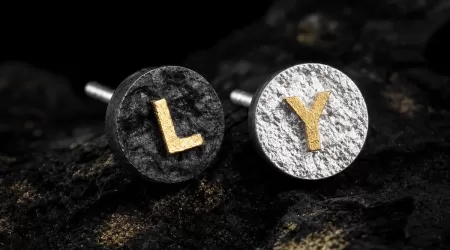
The Personalized Initial Stud Earring is currently described as a hand-textured 999 fine silver disc with an uppercase 24K gold inlay. The live page offers a black oxidized or natural silver finish and a single stud or pair. Its photography shows a visibly irregular surface around the gold letter, making it a useful example of texture working with contrast rather than competing with it.
That example must stay within the published evidence. The current page does not state the dimensions, per-stud weight, or a separate metal specification for the post and butterfly back. Those details should be confirmed before purchase if they affect fit, sensitivity or comfort. Browse the wider 24K gold inlay silver earring collection for other verified designs.
The practical conclusion
Choose a hammered finish because you like its broken reflections, tactile character and ability to make small variations visible. Verify a hand-process claim through the written process description, multiple photographs and material information. Treat alloy fineness, weight, post construction and durability as separate questions. The strongest listing tells you what was done, what the piece is made from, and which details remain naturally variable.
Leave a comment