Direct answer: satin, polished and oxidized are descriptions of a silver earring's surface, not its silver purity. A polished finish reflects light in clear highlights; a satin finish scatters light through fine, directional or diffuse texture; an oxidized finish deliberately darkens selected silver surfaces or recesses to create contrast. None is automatically “better,” more genuine, hypoallergenic or more durable. The right choice depends on the look you want, how visible you are comfortable with everyday marks becoming, and whether you can preserve intentional dark or textured areas instead of polishing every surface the same way.
This guide provides a visual vocabulary, a decision table and a conservative care workflow. It does not infer an exact abrasive grit, polishing compound, patination chemical, coating or workshop sequence unless a product record documents it. “Hand-finished” means a human contributed to the final surface, but by itself it does not prove a specific technique or amount of labour.
Finish is not fineness: define the two separately
“Sterling,” “925” and “999” concern metal composition. The U.S. Federal Trade Commission's consumer guide to silver jewelry explains that 925 identifies 925 parts per thousand silver, while the federal jewelry guides in 16 CFR Part 23 address how precious-metal content should be represented. “Satin,” “polished,” “oxidized,” “hammered” and “blackened” do not replace those composition statements.
A 925 sterling-silver earring may be polished, satin, intentionally oxidized, or combine several finishes. A 999 fine-silver design can also carry texture, dark contrast or gold detail. Conversely, a bright mirror finish is not proof that an item is sterling silver. When shopping, read material and finish as two separate fields: what the object is made from and how its visible surface was treated.
For a composition-focused comparison, see 925 versus 999 silver earrings. That distinction matters because alloy and construction can influence working behaviour, but appearance alone cannot establish fineness.
Comparison table: how the finishes look and change
| Finish | How light behaves | What normal wear may reveal | Care priority |
|---|---|---|---|
| Polished | Clear, bright highlights; may approach a mirror on broad flat areas | Fine hairline marks and fingerprints can be conspicuous because they interrupt reflection | Avoid abrasive improvisation; wipe with a clean, soft cloth using light pressure |
| Satin / matte | Soft, diffuse highlights produced by fine surface texture | Repeated rubbing can locally burnish high points, making them brighter than surrounding areas | Do not “shine” the texture with polish unless restoration of gloss is intended |
| Oxidized / blackened | Dark tone absorbs light or deepens recesses; bright edges may create contrast | Raised areas can lighten through contact while protected recesses remain dark | Keep silver dip and polishing cloth away from deliberate dark areas |
| Hammered / faceted | Multiple planes break highlights into flashes | Edges and high points receive the most contact; recesses may collect residue | Clean crevices gently and avoid rounding crisp facets with aggressive polishing |
| Mixed finish | Combines diffuse, bright and dark zones to make relief readable | Contrast can soften unevenly because each zone responds differently | Treat each zone according to its intended finish, not as one uniform surface |
What “polished” actually tells you
Polishing reduces or refines surface irregularities so light reflects more coherently. It is not a permanent shield. Surface roughness can be measured through topography and optical methods, as reviewed in the measurement paper Recent developments in surface roughness characterization, but a product photograph does not supply a roughness value. Responsible product language should therefore describe the visible result rather than invent a technical measurement.
Bright silver shows fingerprints and hairline marks readily because a small disruption is visible against an orderly reflection. That does not necessarily mean more metal has been lost than on a satin surface; it means the mark is optically obvious. Polishing can also remove material. The Canadian Conservation Institute's care guidance for silver states that polish is abrasive, removes silver along with tarnish and can leave fine scratches. Repeated pursuit of a flawless mirror can therefore create the damage it is intended to fix.
What “satin” or “matte” tells you
A satin finish contains fine surface texture that spreads reflected light. “Matte” is often used more broadly for a low-gloss appearance; the terms are not governed here as exact roughness grades. Different workshops can create a visually similar result by different controlled methods. Unless the maker documents the process, do not assume sandblasting, brushing, tumbling, a particular abrasive or a coating.
Satin can make sculptural curves easier to read in soft light and may make isolated fine marks less visually dominant than on a mirror surface. It is not scratch-proof. Repeated contact with clothing, another earring or a polishing cloth may smooth high points and create brighter patches. Attempting to correct those patches with household abrasive can make the texture patchier. A jeweler can re-establish a consistent satin direction or density more predictably than spot treatment at home.
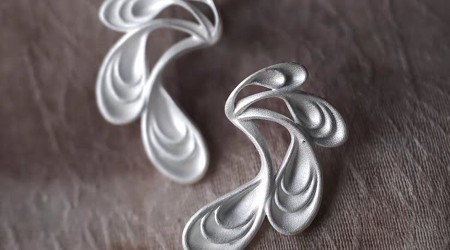
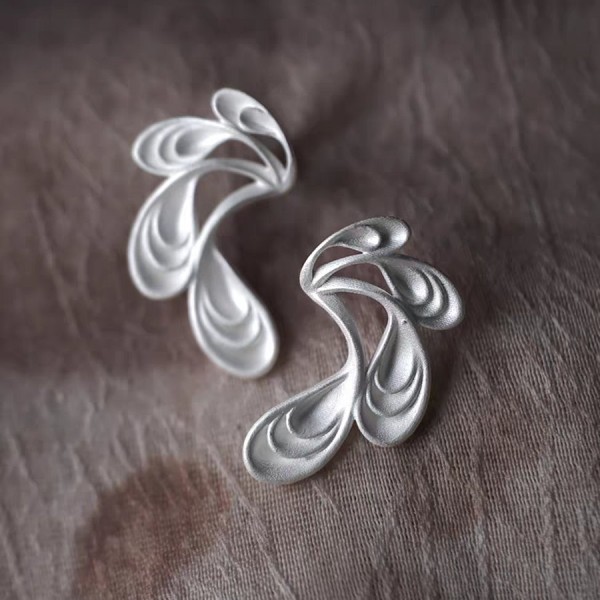
The Peacock Feather Ear Climber is a current 925 sterling-silver example described with a satin surface. Its layered teardrop forms and open spaces provide a useful observation: diffuse reflection emphasizes the overall silhouette, while edges catch enough light to separate the layers. This is a product observation, not a claim that every satin finish is made by the same process.
What “oxidized” or “blackened” tells you
Oxidized silver jewelry uses a deliberately darkened surface as part of the design. It may cover a broad area or remain mainly in recesses after raised areas are finished brighter. It should not be confused with uncontrolled tarnish, dirt or evidence that the silver is fake. The National Park Service's curatorial guidance for metal objects lists patination among surface treatments and warns that over-cleaning can remove original surface material.
The Victoria and Albert Museum's treatment account for the Milton Shield makes the distinction concrete: conservators treated deliberately oxidized areas differently and avoided chemicals that could remove the intended colour. Museum treatment is not a home-jewelry recipe, but the decision principle transfers directly: first decide whether darkness is intentional.
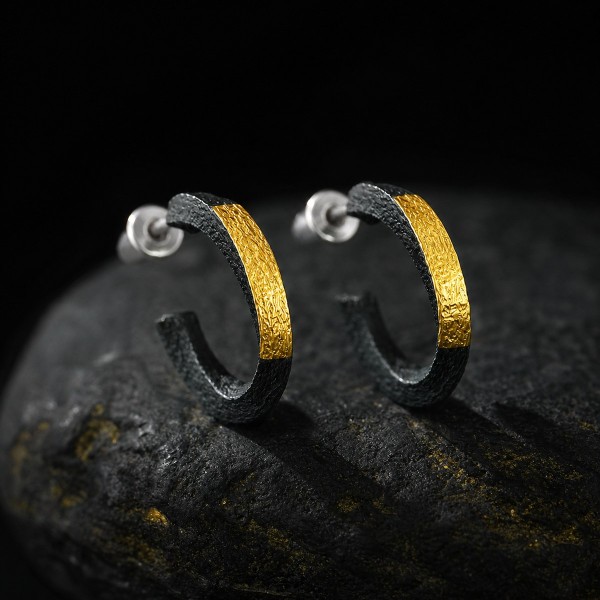
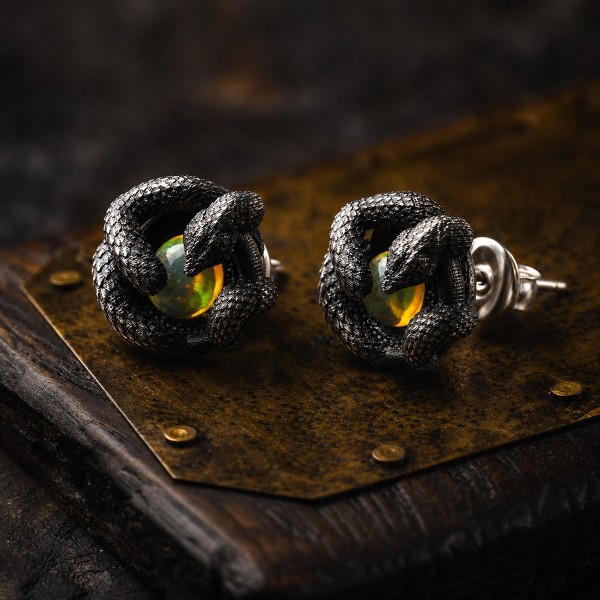
The Black Mobius Hoop Earrings show a blackened fine-silver surface with contrasting warm detail. The surface should not be treated like a plain polished silver hoop. Similarly, the Natural Opal Snake Stud Earrings use oxidized silver around a stone and sculptural recesses. Stone setting adds another reason to avoid immersion or unverified chemical cleaners.
Normal wear versus a problem
Normal wear is gradual and concentrated where the earring contacts skin, fingers, closures, clothing or storage surfaces. A polished high point may acquire fine lines. A satin ridge may become slightly brighter. An oxidized raised edge may lighten while protected recesses stay dark. These changes can document use without compromising function.
Stop and obtain professional assessment if a post bends or cracks, a stone moves, a join opens, a coating peels, powdery corrosion appears, deep pits develop, or a dark surface changes rapidly after chemical exposure. Cleaning cannot repair a fatigued post or loose setting. Continuing to rub may remove clues and make a structural repair more difficult.
Evidence boundary: finish cannot diagnose skin sensitivity. Persistent itching, swelling, pain, broken skin or discharge is a health issue, not proof that a surface is “dirty.” Remove the jewelry and seek advice from an appropriate qualified professional. No silver finish is claimed here to treat infection, improve circulation or provide another clinical benefit.
A six-step finish-safe care workflow
- Read the product description. Record the metal, finish, stones, inlay, plating, lacquer and closure. If these are unknown, do less rather than more.
- Inspect in neutral light. Compare raised areas with recesses. Deliberately even darkness or dark relief may be intentional oxidation; random deposits or a recent chemical change require caution.
- Remove loose material first. Use a clean, dry, very soft cloth. Dust can scratch: the CCI's silver-polish guidance specifically notes that particles trapped during polishing can mark silver.
- Match pressure to the finish. Minimal wiping is appropriate for ordinary handling residue. Do not use a polishing cloth on satin or oxidized zones merely because it is marketed for silver.
- Avoid whole-object chemistry. Dips, toothpaste, baking-soda pastes, acids, ammonia and general metal polish can affect texture, stones, joins and intentional colour differently.
- Dry and separate. Store each earring dry in its own clean compartment or pouch to reduce metal-on-metal contact and pollutant exposure. The detailed silver earring storage guide explains the material limits of common packaging.
Decision framework: which finish fits your priorities?
- Choose polished when crisp brightness and reflected highlights are the main aesthetic goal and you accept that fingerprints and fine lines can be visible.
- Choose satin when you prefer diffuse light and sculptural form over mirror reflection, and you are prepared to avoid routine brightening with polish.
- Choose oxidized when dark contrast is central to the design and you can treat that darkness as an intentional finish rather than something to remove.
- Choose hammered or faceted when changing highlights and visible tool-like texture are important; expect raised edges and recesses to age differently.
- Choose mixed finish when contrast is the point, but verify the care instructions because one cleaner may not suit every zone.
None of these choices establishes allergy safety. Material disclosure, post composition, fit, piercing condition and individual exposure history matter separately. Finish also does not guarantee longevity: design thickness, construction, closure, impact and care are different variables.
Common mistakes that flatten or erase a finish
Polishing every dark area: this can remove designed oxidation. Spot-scrubbing satin patches: this can create a bright island that no longer matches the surrounding texture. Using toothpaste: uncontrolled abrasives can add scratches rather than restore a calibrated finish. Soaking stone-set oxidized earrings: liquid can affect stones, adhesives, cavities and surface colour. Chasing every hairline mark: each abrasive correction removes some material and may change edges or relief.
For conservative routine care, follow the oxidized silver earring care guide. For designs that combine silver with a warm base-metal detail, use the separate brass-inlay and sterling-silver care framework; mixed metals should not be treated as a single uniform surface.
Limitations and uncertainty
Photographs can suggest gloss, texture and contrast but cannot establish alloy purity, coating thickness, roughness values, patination chemistry or whether a surface is sealed. Screen brightness and editing also change perceived colour. Product terms are most reliable when they are paired with real material statements and multiple views.
Wear is individual. Two earrings with the same finish can age differently because of contact, storage, cosmetics, humidity, pollutants and cleaning history. This guide therefore offers bounded observations and low-risk first steps rather than a promise that one finish will hide scratches, resist tarnish or remain unchanged for a fixed period.
FAQ
Is satin silver the same as brushed silver?
They can overlap in appearance, but the words do not prove the same process. “Brushed” often suggests directional lines; “satin” describes a soft low-gloss result more generally. Ask the maker if the exact technique matters.
Does oxidized silver mean damaged silver?
No. Oxidation may be applied intentionally for dark contrast. Damage is more likely when the change is unintended, unstable, associated with structural problems or caused by unsuitable treatment.
Which finish hides scratches best?
No finish is scratch-proof. Fine isolated marks may be less visually obvious on some textured surfaces than on a mirror polish, but satin high points can burnish and blackened high points can lighten. Visibility depends on texture, lighting and location.
Can I polish satin silver until it is shiny?
You can change a satin surface by abrasion, but that is a finish alteration, not routine cleaning. An uneven home result may be difficult to reverse. Ask a jeweler if a permanent conversion to a polished finish is intended.
Will a polishing cloth remove oxidation?
Yes, it can lighten or remove intentional dark colour, especially on raised areas. Keep it off oxidized zones unless selective brightening is part of the design and the maker confirms the method.
Is “hand-finished” a guarantee of quality?
No single quality level follows from that phrase. It says a human participated in finishing, but does not document skill, time, inspection, grit, chemistry or performance. Evaluate the disclosed material, construction, photographs and care instructions.
Sources and review date
Evidence reviewed 17 August 2026. Core sources: the Canadian Conservation Institute's silver-care and polishing guidance; National Park Service curatorial care for metal objects; Victoria and Albert Museum metal-conservation reporting; American Institute for Conservation's Conservation Wiki entries on patina and metals; U.S. Federal Trade Commission consumer guidance and 16 CFR Part 23; and the peer-reviewed surface-roughness measurement review linked above. Conservation sources establish principles of surface identification and minimum intervention; they are not instructions to reproduce museum chemicals or workshop finishing processes at home.