Direct answer: in U.S. jewelry guidance, “hand-finished” is not merely a poetic synonym for attractive or premium. The Federal Trade Commission says a jewelry product should not be represented as hand-finished unless the described finishing operation was performed by hand labor and manually controlled methods that let the maker control and vary the type, amount and effect of that operation on each part of each individual product. The phrase concerns a stage of work. It does not, by itself, establish the silver fineness, the country of origin, the identity of the maker, the number of hours worked, the tools used, or a universal level of quality.
A useful buying decision therefore separates four questions: What is the metal? What finishing operation is claimed? What evidence supports that operation? Which facts remain undocumented? This guide provides a claim-by-claim evidence ladder rather than treating “hand-finished,” “handmade,” “925” and “Made in” as interchangeable labels.
The regulatory meaning of “hand-finished”
The most direct U.S. reference is 16 CFR 23.2, part of the FTC Guides for the Jewelry, Precious Metals, and Pewter Industries. It distinguishes the broad “handmade” claim from narrower claims such as hand-forged, hand-engraved, hand-finished and hand-polished. For the narrower terms, the operation named must be accomplished by hand labor and manually controlled methods that allow variation and control on each part of each product.
That wording matters. An earring may use casting, prefabricated findings, mechanical cutting or other processes before a person performs a manually controlled final-surface operation. In that situation, “hand-finished” describes the finishing stage; it does not automatically describe the complete manufacture of every component. Conversely, pressing a button on a fully automatic finishing cycle would not provide the kind of part-by-part manual control described in the guide.
The FTC’s 2018 final Jewelry Guides notice explains the consumer-protection basis: jewelry claims should not mislead a reasonable consumer about a material aspect of production. This is guidance for avoiding deceptive claims, not a certificate attached to every object. A seller still needs records appropriate to the claim it makes.
Evidence table: what each claim can establish
| Claim or evidence | What it can support | What it does not prove by itself |
|---|---|---|
| “Hand-finished” | A named finishing operation used hand labor and manually controlled methods, if the claim is substantiated | That the entire earring was handmade from raw material; exact tools, time, quality grade or country of origin |
| “Handmade” | A broader production claim subject to stricter conditions in the FTC Jewelry Guides | 925 or 999 silver content; a particular artisan; ethical sourcing; one-of-a-kind status |
| 925 / sterling silver | A metal-composition claim: 925 parts per thousand silver when accurately marked and represented | Surface finish, production method, origin, comfort or skin compatibility |
| 999 / fine silver | A higher silver-fineness claim when supported | That the piece was forged, cast, polished or finished by hand |
| Hallmark or responsible-party mark | Information defined by the applicable marking system, commonly including fineness and responsibility | A universal craftsmanship score or a complete workshop history |
| Product photograph | Visible form, relative scale if shown, surface appearance and some construction details | Invisible alloy composition, exact abrasive grit, chemical treatment, labor time or origin |
| “Made in USA” | A U.S.-origin claim when it meets the FTC’s applicable standard | That every operation was performed by hand or that the material is sterling silver |
Finish is different from fineness
Fineness describes composition. The FTC’s consumer guide to buying silver jewelry explains that “silver,” “sterling” and “sterling silver” describe products containing 92.5 percent pure silver, and that 925 means 925 parts per thousand are pure silver. The guide also distinguishes solid silver claims from silver plate, where a silver layer is applied to a base metal.
Finish describes a surface result or operation. Polished, satin, brushed, hammered, oxidized, blackened and hand-finished belong in this second category. A 925 earring can be polished by hand, finished by a controlled machine process, or combine several surface treatments. A 999 fine-silver earring can also have bright, satin and darkened zones. Neither a glossy photo nor the phrase “hand-finished” is a substitute for a clear material statement.
For a detailed composition comparison, read 925 versus 999 silver earrings. For visual surface differences, see our guide to satin, polished and oxidized silver finishes. Those two questions should be evaluated independently before price or style enters the decision.
There is no single universal “hand-finishing sequence”
Metal objects can be shaped, joined, decorated and surfaced through many distinct operations. The American Institute for Conservation’s Metals Conservation Wiki lists casting, forging, sawing, hammering, filing, sanding and polishing among common metalworking techniques; it separately lists joining methods and decorative processes such as engraving, plating, inlay and patination. A finished earring may combine several of them, but a product page should not imply an undocumented sequence.
For example, a maker might manually refine edges after casting, selectively polish high points, apply or preserve dark contrast in recesses, or restore a directional satin texture after assembly. Each is a plausible finishing task. Plausible is not the same as verified. Unless the maker’s record names the operation, buyers and editors should describe only what the record and object support.
The National Park Service’s curatorial guide to metal objects also treats surface treatments, coatings, corrosion and cleaning as separate matters. That distinction is valuable for jewelry: a dark recess may be intentional patination, later tarnish, soil, or a coating. Appearance alone may not identify which. Overconfident cleaning can erase the intended surface as easily as overconfident marketing can invent its origin.
A six-question verification framework
- Is the metal stated separately? Look for a direct statement such as 925 sterling silver or 999 fine silver. Do not infer composition from color, price or the words “artisan” and “hand-finished.”
- Which operation is actually claimed? “Hand-polished edges” is more specific than “hand-finished.” A narrower statement is easier to understand and substantiate.
- Is the claim about the whole item or one stage? A hand-finished cast component is not necessarily a wholly handmade earring. Good descriptions identify the stage instead of allowing the broadest possible interpretation.
- What visible evidence agrees with the text? Multiple angles may show edge refinement, directional texture, darkened recesses, posts, closures and joins. Images should confirm, not replace, the written specification.
- Which facts are still unknown? If the page does not document tools, abrasive grade, chemical, coating, labor time or workshop location, treat each as unknown. Absence of evidence is not permission to fill the gap with a familiar craft story.
- Can the seller answer a precise question? Ask: “Which final operation is performed by hand?” or “Does hand-finished refer to polishing, texturing, patination, edge cleanup or another step?” The answer should be concrete enough to match the claim.
Practical rule: read a product claim at its narrowest defensible scope. “Hand-finished” supports a finishing-stage statement when substantiated. It should not silently expand into “entirely handmade,” “made in this country,” “made by one named artisan,” “takes many hours,” or “better for sensitive ears.”
Do origin claims answer a different question?
Yes. The FTC’s Made in USA guidance says an unqualified U.S.-origin claim generally requires a product to be “all or virtually all” made in the United States. Qualified claims need clear limitations. A finishing operation performed in one country does not automatically establish the origin of the complete product, just as a country-of-origin claim does not establish manual finishing.
Hallmarking is another separate system. The UK government’s hallmarking guidance explains the legal framework for describing precious-metal articles in the United Kingdom. Hallmarks communicate the information defined by that system, particularly metal fineness and responsible marks. They should not be converted into an unsupported statement that every surface was finished by hand or that the object meets a universal artistic-quality threshold.
How to read current product examples responsibly
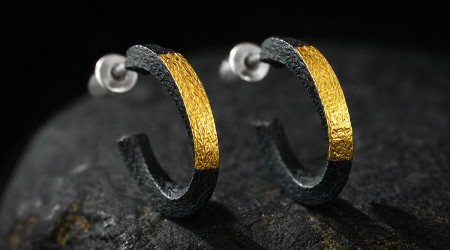
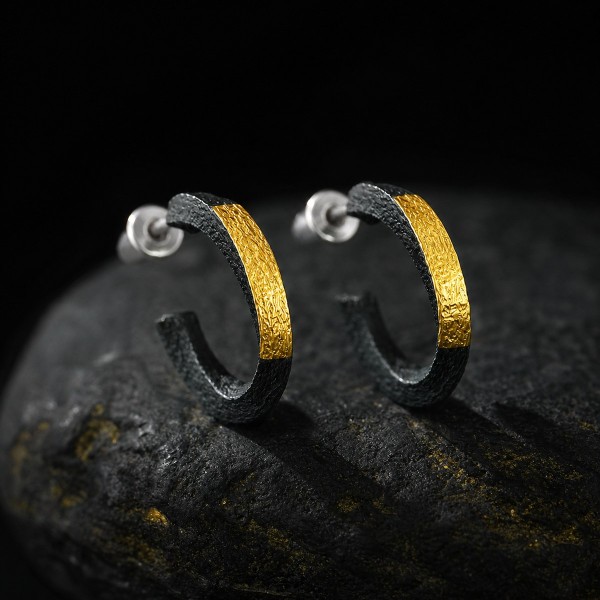
The Black Mobius Hoop Earrings combine a dark fine-silver surface with warm contrasting detail. A buyer can verify the broad form and visual contrast from the photographs and can read the documented material description. The images do not disclose a full sequence of tools, compounds and timings, so this guide does not invent one.
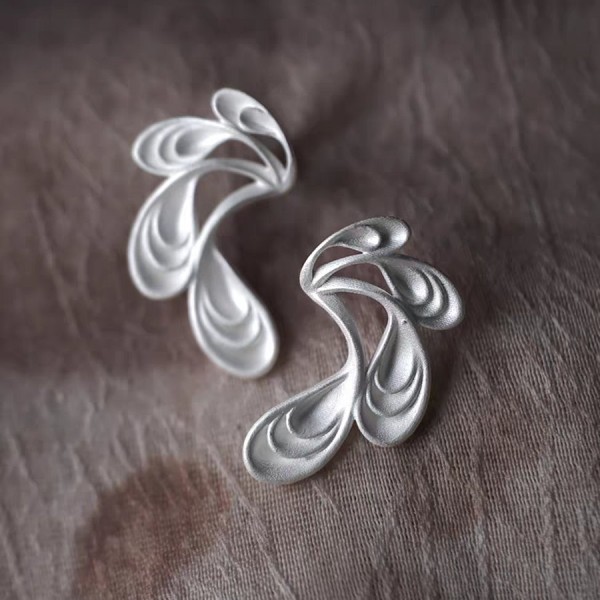
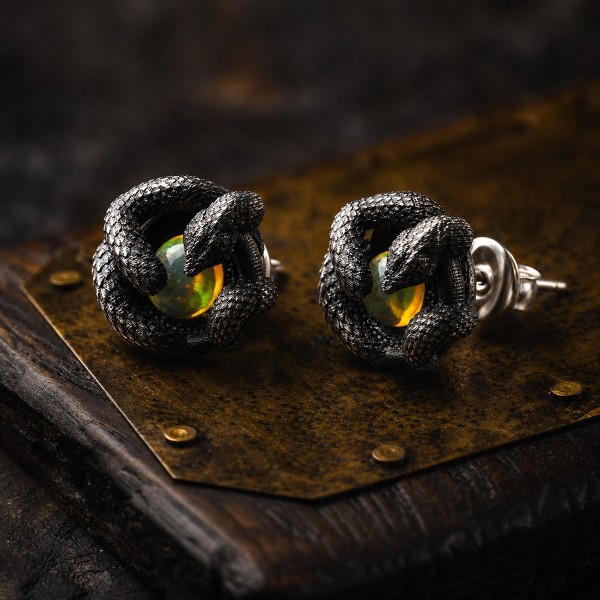
The Peacock Feather Ear Climber presents a satin 925 sterling-silver surface and a directional left/right form. The visible surface supports an appearance description, while the 925 statement addresses composition. The Natural Opal Snake Stud Earrings add an intentionally darkened silver setting around a stone. That surface calls for different care from a plain mirror-polished hoop, but it does not imply a clinical benefit or universal durability advantage.
Does hand-finished mean higher quality?
Not automatically. Manual control can help a skilled maker respond to edges, recesses, joins and texture on an individual object. It can also produce intentional variation. But the word alone does not measure skill, inspection standards, structural integrity, symmetry, comfort or durability. Machine-controlled work can be precise and consistent; hand-controlled work can be excellent, ordinary or defective. Quality needs evidence appropriate to the feature: secure settings, smooth wearable edges, sound joins, functional closures, accurate dimensions and a finish consistent with the description.
Nor does “hand-finished” mean hypoallergenic. Skin response depends on exposure, alloy constituents, coatings, cleanliness, fit and the individual wearer. This article makes no claim that handwork, silver fineness or a particular surface treats infection, prevents allergy, improves circulation or provides another health effect.
Care without erasing the finish
First identify the intended surface. A soft cloth used gently may be appropriate for plain bright silver, but repeated rubbing can brighten satin high points and remove intentional dark contrast. Avoid copying a cleaning method from one product to another when stones, inlay, patination, coatings or glued components differ. Our oxidized silver care guide explains why darkened surfaces should not be treated as tarnish that must be removed.
Stop cleaning if a post bends, a join opens, a stone moves, a coating lifts or the surface changes quickly after contact with a chemical. A qualified jeweler can inspect structure and determine whether refinishing would preserve or erase the intended appearance. Refinishing is a material intervention, not a neutral reset button.
Frequently asked questions
Is hand-finished the same as handmade?
No. Hand-finished refers to a finishing operation. Handmade is a broader production claim and has separate conditions in the FTC Jewelry Guides. A product can contain cast or otherwise prepared components and still have a genuinely manual finishing stage, but the narrower wording should not be expanded into the broader claim.
Does 925 prove that an earring was hand-finished?
No. 925 concerns silver fineness. It does not identify the forming, joining, polishing or surface-treatment method.
Can photographs prove hand-finishing?
Photographs can show appearance and sometimes tool-like variation, but they normally cannot prove who controlled an operation, how much labor occurred, or whether a machine produced a similar texture. Use photos with a specific written record.
Should every hand-finished earring look slightly different?
Manual control may permit variation, but visible difference is not mandatory and inconsistency is not proof of authenticity. A skilled finisher may intentionally produce close matches. Product dimensions and photographs should define the acceptable result.
Does hand-finished mean made in the seller's country?
No. Country of origin is a separate claim. A local finishing stage does not, by itself, establish where the complete product was made.
What is the best question to ask before buying?
Ask which specific operation is performed by hand and which other production stages or components are not covered by the claim. Then check that answer against the material specification, photographs, dimensions and care instructions.
Sources and review date
- U.S. Electronic Code of Federal Regulations, 16 CFR 23.2: Misuse of “handmade,” “hand-polished,” and related terms.
- Federal Trade Commission, Buying Platinum, Gold, and Silver Jewelry.
- Federal Register, 2018 final revisions to the Jewelry Guides.
- Federal Trade Commission, Complying with the Made in USA Standard.
- UK Government, Hallmarking in the UK: consumer protection.
- American Institute for Conservation, Metals Conservation Wiki.
- U.S. National Park Service, Curatorial Care of Metal Objects.
Editorial review date: August 18, 2026. This guide interprets publicly available consumer and conservation sources. It is not a certification of an individual object, legal advice, or a substitute for material testing.