Can you share earrings? For earrings that pass through a piercing, keeping your own pair is the more cautious everyday choice, especially while a piercing is healing. A borrowed pair can look clean without having a verified hygiene history. Washing, an alcohol wipe and professional sterilization are different things. This guide does not establish a safe home procedure for sharing earrings, or claim that every instance of sharing causes an infection.
The useful question is not simply “did someone clean them?” It is whether you know the jewelry's previous use, complete construction, cleaning compatibility and suitability for the piercing. A meaningful initial can be personal without being passed between wearers; see our custom initial earring gift checklist for a separate pair chosen for its recipient.
Define the situation before deciding
This discussion concerns previously worn earrings with posts or other parts inserted into pierced ears. It does not treat clip-on jewelry, a newly pierced ear and a fully healed piercing as interchangeable. Nor does an intact-looking piercing prove that a previously worn earring is suitable.
Professional piercing practice sets a particularly careful boundary. The Association of Professional Piercers (APP) identifies customer try-on of piercing jewelry as a studio-hygiene warning sign. It also describes sealed sterile packaging for jewelry used in a piercing procedure. Those are professional studio standards, not a retail certification for every fashion earring. Source: APP, Picking Your Piercer.
Clean, disinfected and sterile are not synonyms
The CDC distinguishes removal of visible soil from disinfection and sterilization. Disinfection does not necessarily eliminate bacterial spores; sterilization has a different, more comprehensive meaning. Its guidance is written for healthcare infection control, not specifically for borrowing ornamental earrings. The distinction nevertheless explains why appearance alone cannot verify a microbial condition. Source: CDC definitions.
Keep three questions separate:
- Appearance: is there visible residue, staining or debris?
- Material compatibility: could a treatment damage the finish, inlay, setting or other component?
- Hygiene verification: is there evidence of an appropriate, validated process rather than an informal claim?
Answering the first two does not automatically answer the third. Our earring odor and cleaning guide addresses residue and smell; neither the presence nor absence of odor establishes sterility.
What an alcohol wipe cannot prove
The CDC's discussion of chemical disinfectants notes that alcohol does not destroy bacterial spores and is not a sterilizing method for medical or surgical equipment. This is not a claim that alcohol has no disinfectant uses. It means “wiped with alcohol” is not equivalent to “sterile,” and we cannot turn that phrase into a universal clearance to share piercing jewelry. Source: CDC, Chemical Disinfectants.
Do not infer a safe concentration or contact time for an unknown earring from this article. A healthcare document is not a tested home protocol for its backs, crevices, coatings or mixed materials.
Healing ears need a separate decision
Do not swap borrowed earrings into a healing piercing as a style experiment. APP aftercare guidance advises leaving initial jewelry in place during healing unless there is a problem with its size, style or material, with necessary changes handled by a qualified piercer. Its warning against alcohol and other harsh products during healing concerns tissue care; it should not be confused with a complete jewelry-cleaning compatibility test. Follow your professional's individualized advice. Source: APP aftercare.
If a piercing is painful, hot, swollen, unusually red or dark, discharging pus, or accompanied by feeling unwell, seek medical help instead of testing another earring or stronger cleaner. NHS guidance says to leave jewelry in unless a doctor tells you to remove it. This guide cannot diagnose infection. Source: NHS, Infected Piercings.
A finish-safe cleaner is not a hygiene certificate
Jewelry may include stones, treatments, adhesives or delicate settings that respond differently to cleaning. GIA emphasizes knowing the materials and treatments, and warns that ultrasonic vibration can loosen stones. A method that suits one construction may not suit another; consult a knowledgeable jeweler for the exact piece. Source: GIA jewelry-care guidance.
The Canadian Conservation Institute likewise treats silver construction and surface finish as important: composite or hollow objects can make immersion problematic, and abrasive polishing removes material. Its museum-conservation advice is not a piercing-hygiene protocol. It supports checking the object before choosing a surface treatment, not assuming that a brighter finish is safer to wear. Source: CCI, Care of Silver.
For intentional dark surfaces, read our oxidized silver care guide. Removing the dark finish is not a necessary sign of successful hygiene.
A practical framework for borrowing or secondhand earrings
- Unknown history: pause rather than treat “cleaned” as proof. Ask what was done, by whom, and for which materials.
- Healing or irritated piercing: use professional advice, not a borrowed-pair trial.
- Previously worn jewelry for professional assessment: APP asks visitors to bring it in a bag or sealed container and not place it on the counter. Ask the studio before bringing it.
- Healed piercing, known jewelry: healing status alone is not a guarantee. If suitability or processing remains uncertain, keep a separate personal pair.
- Gift or matching style: buying each wearer their own pair avoids this particular sharing decision; it does not create an allergy-free or infection-proof product.
Do not improvise sterilization with a household appliance. Whether a particular previously worn piece can be processed appropriately is a question for a qualified professional who can assess its construction and intended use.
A real product example: personal letters, separate wearers
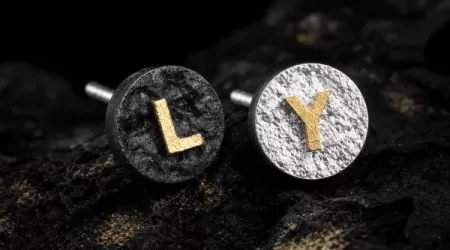
Our Personalized Initial Stud Earrings are described as 999 fine silver discs with 24K gold letter inlay. The currently listed letters are L, Z, N, W, M, Y, C, X, H, S, J, G, O and Q, not a verified full alphabet. Choose only an available option and confirm the selected single or pair configuration.
Those decorative material facts do not verify the metal of every post or back, a microbial test result, or suitability for a new piercing. We do not claim antibacterial protection, universal skin tolerance or an approved sterilization method. For construction terminology, see the 24K gold inlay guide.
Conclusion and evidence limits
Keep personal pierced-ear jewelry personal when its history or suitability is uncertain. Treat visible cleanliness, material care and verified hygiene as separate decisions, and involve a qualified piercer or clinician where appropriate. The sources below explain professional practice, healthcare terminology, warning signs and material limits. They do not quantify the infection risk of sharing a specific retail earring, and this article offers no guarantee that a home-cleaned pair is safe to share.
Leave a comment