Direct answer: sterling-silver earrings usually darken because sulfur-containing gases react with the metal surface and form tarnish, principally silver sulfide. But a black, grey or selectively dark surface may also be an intentional oxidized finish placed by the maker to emphasize texture. Colour alone cannot tell you which one you are seeing. Before cleaning, compare the darkening pattern, the product description, the original photographs and every other material in the earring. If the finish is uncertain, stop at gentle surface cleaning and ask the seller or a jeweller who works with patinated silver.
Quick answer
Silver tarnish is mainly a surface reaction with sulfur-containing compounds, not proof that the earring is fake. Intentional oxidation can look similar but is a designed finish, so identify the construction and finish before cleaning.
What “tarnish,” “oxidized silver” and “patina” mean
Tarnish is a surface reaction product that develops as silver is exposed to its environment. The Canadian Conservation Institute (CCI) explains that sulfur-containing gases can discolor and then darken silver as a surface layer forms. The black component is commonly silver sulfide. Tarnish is not a reliable purity test, and a dark surface is not proof that an earring is counterfeit, unsafe or permanently damaged.
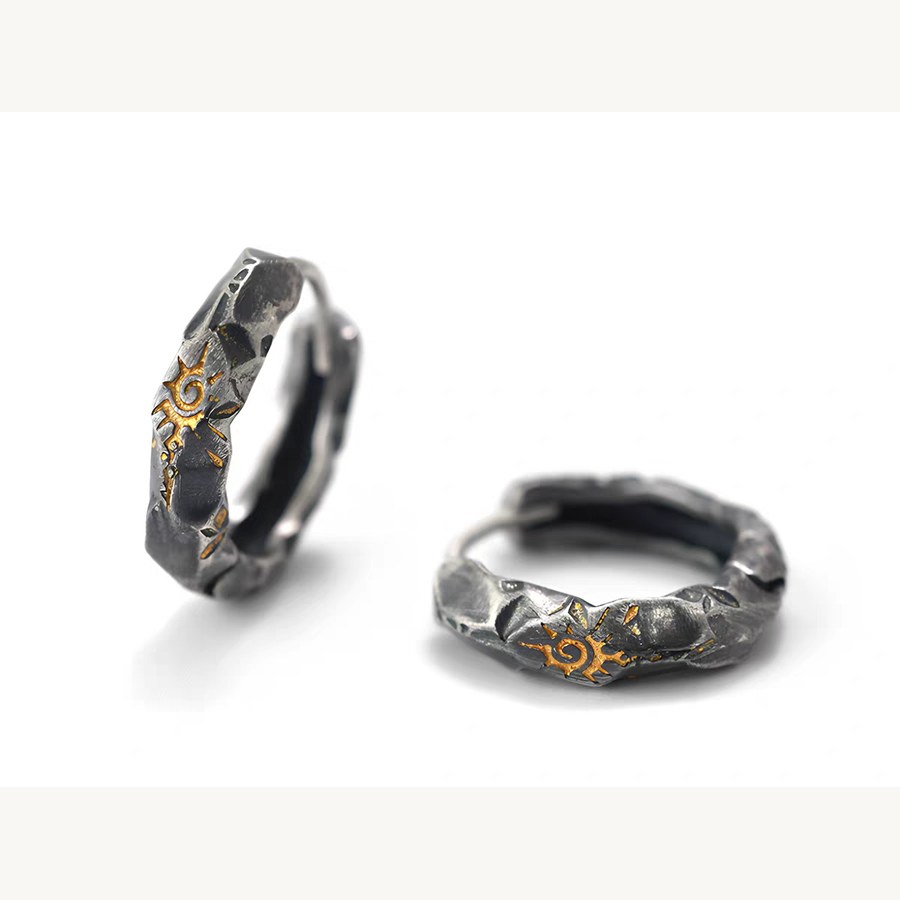
Intentional oxidation is the jewellery trade’s common name for a deliberately darkened silver surface. Strictly speaking, “oxidized” is imperfect chemical shorthand: many black silver finishes are sulfide patinas rather than simple silver oxide. The useful distinction for a buyer is not the workshop label but the maker’s intent. Was the dark surface designed into the piece, or did it develop later?
Patina is a broader appearance term for a surface state valued as part of an object’s history or design. It may be deliberately produced, may develop with age, or may combine both. It does not identify one chemical compound. A seller should describe a designed black finish clearly; a buyer should not treat every dark recess as removable dirt.
Why sterling silver changes colour
Sterling silver is an alloy conventionally described as 92.5% silver with the balance made up of other metal, commonly copper. For a fuller comparison of the two silver finenesses used across the current collection, read our guide to 925 sterling silver versus 999 fine silver earrings. Fineness does not make either alloy immune to environmental sulfur.
The CCI’s silver-tarnish guidance describes sulfur-containing gases in air as a primary cause. Hydrogen sulfide is one example. Sulfur sources can occur in polluted air and in ordinary materials around an object. The rate and appearance depend on exposure, humidity, surface condition, alloy composition and the presence of contaminants. This is why two earrings stored in different boxes can change at different rates even when they were made from the same alloy.
The chemistry of sterling is more complicated than the slogan “silver plus sulfur equals black.” A peer-reviewed RSC Advances study found silver sulfide to be the main corrosion product of silver in sulfide environments, while copper-containing phases influenced early stages of sterling-silver corrosion. The surface film changed as exposure continued. Another open-access Heritage Science study found that films made on identical sterling-silver samples differed with the sulfidation method. Laboratory-accelerated tarnish therefore does not automatically reproduce a naturally aged object.
For an earring owner, the practical lesson is restraint: a colour photograph cannot identify the full surface chemistry, and one household recipe cannot be assumed suitable for every darkened surface.
Evidence table: what a visual clue can and cannot establish
| Observation | Reasonable interpretation | What it does not prove | Next check |
|---|---|---|---|
| Dark colour sits mainly in carved recesses while high points remain bright | Consistent with an intentional antiqued or oxidized finish | That every dark area is original or chemically identical | Compare the listing and original product photographs |
| A previously bright surface develops a yellow, brown, blue-grey or black film | Consistent with environmental tarnish progressing over time | The exact contaminant, alloy or safe removal method | Review storage, cosmetics, moisture and handling history |
| Darkening is strongest around solder, a hinge, the post or a mixed-metal edge | Different materials or local exposure may be influencing the change | That the joint has failed or the earring is fake | Inspect construction and obtain professional advice before immersion |
| Black residue transfers to a cloth or skin | Loose surface material or contamination may be present | An allergy, infection or therapeutic effect | Stop wearing, clean gently, and seek clinical advice for symptoms |
| One earring changes faster than its mate | Exposure, handling or storage may differ | Different silver purity | Compare where and how each piece is worn and stored |
A six-step decision framework before cleaning
1. Read the material and finish description
Look for separate statements about the decorative front, post, back, stones, inlay, plating and surface finish. “Silver-coloured” is not a material identity. “Oxidized,” “blackened,” “antiqued” or “patinated” indicates that at least part of the dark surface may be intentional. Save the product page or invoice because future colour comparisons are easier when the original description is available.
2. Compare the present surface with the original image
Do not expect studio lighting and a phone photograph to match perfectly. Instead, compare the pattern. Were recessed lines already dark? Were the post and back bright? Was gold detail sharply separated from black silver? Pattern continuity is more useful than judging a single RGB colour.
3. Map every material zone
Treat an earring as a small composite object. An oxidized silver face may also contain a natural stone, a gold inlay, brass detail, solder and a separate closure. The CCI advises examining construction, joins, gilding and non-metal components before selecting a treatment. That conservation principle transfers to jewellery even though museum procedures should not be copied as home recipes.
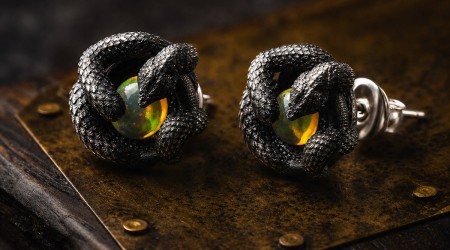
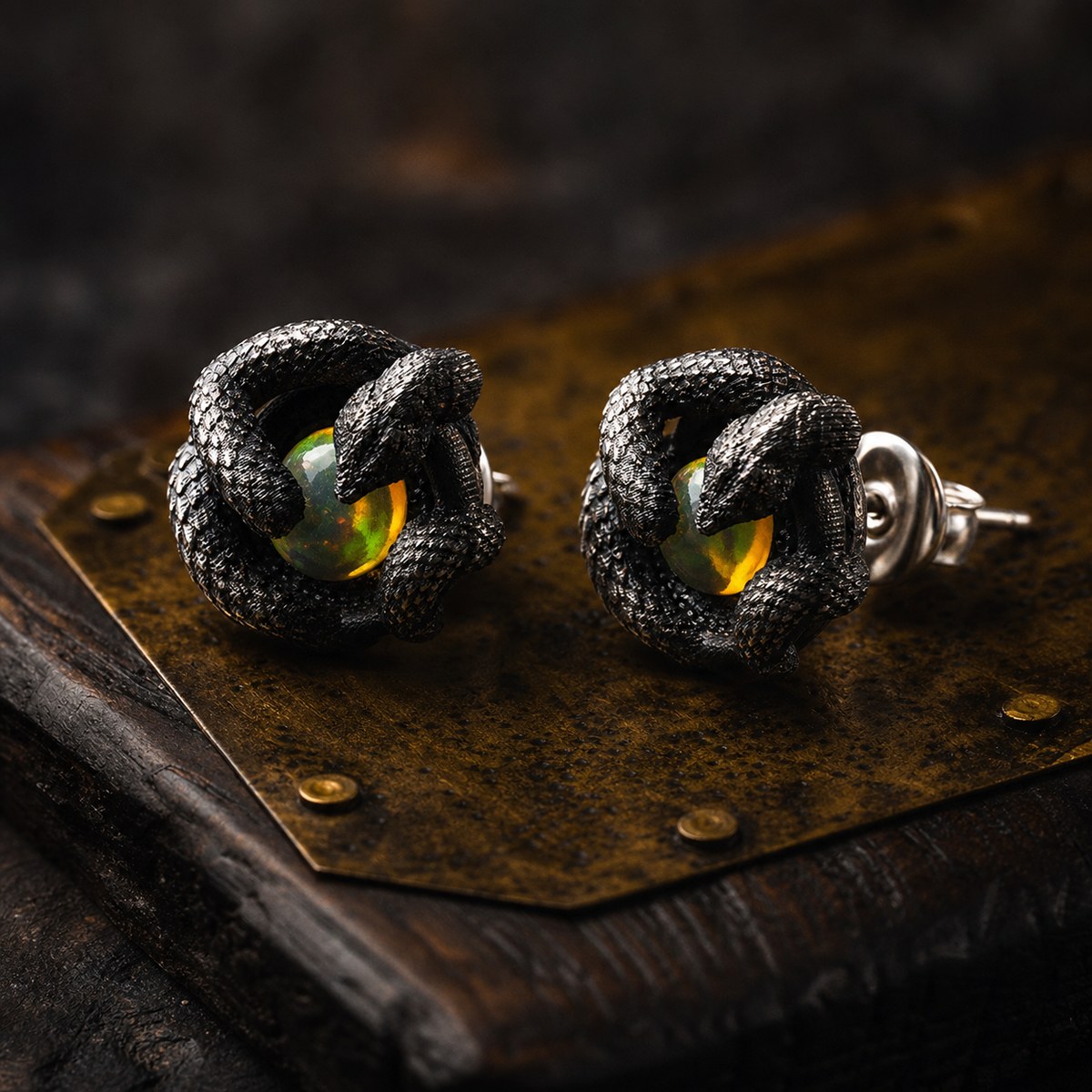
For example, Skullearring’s natural-opal snake stud is described as natural opal in an oxidized silver design. The desired appearance includes dark serpent forms around the stone. The correct question is not “How do I make all of it bright?” but “How do I remove surface soil without changing the opal or the designed dark contrast?”
4. Separate loose soil from bonded surface colour
Begin with good light and magnification. Dust, dried cosmetic and skin residue may sit on top of either bright or dark silver. A stable dark layer that follows the maker’s texture is different from removable debris. Do not scrape with a pin or test a hidden area with a chemical simply to “see what happens.” A hidden spot can contain solder, plating or a deliberately different finish.
5. Choose the least aggressive action
If the piece is structurally sound and its care instructions allow it, start with a dry soft brush or lint-free cloth. If more cleaning is needed, use the product-specific guidance. Our separate guide to caring for oxidized silver earrings explains why dips, baking soda, abrasive pastes and polishing cloths should not be taken across deliberately blackened areas.
CCI guidance warns that polishing removes tarnish and also some underlying silver. Repeated cleaning can soften crisp detail; plating and mixed finishes may be damaged faster. This does not mean that all cleaning is forbidden. It means the target appearance and material structure must be identified first.
6. Stop when the evidence is insufficient
Ask the seller or a qualified jeweller when the original finish is unknown, the surface is flaking, the post or hinge is damaged, a stone is loose, colour change sits around a joint, or the earring combines silver with a porous or heat-sensitive gem. A professional should examine an object before recommending immersion, chemical dip, ultrasonic cleaning, replating or repatination.
Unwanted tarnish versus designed oxidation: different goals
| Surface state | Care goal | Low-risk first response | Avoid |
|---|---|---|---|
| Bright silver with light new tarnish | Remove surface soil; decide whether tarnish reduction is necessary | Check construction, then use maker-approved gentle care | Automatic escalation to an aggressive polish |
| Intentional dark recesses with bright high points | Preserve the designed contrast | Clean zones selectively with minimal moisture | Whole-piece dip or abrasive polishing across dark areas |
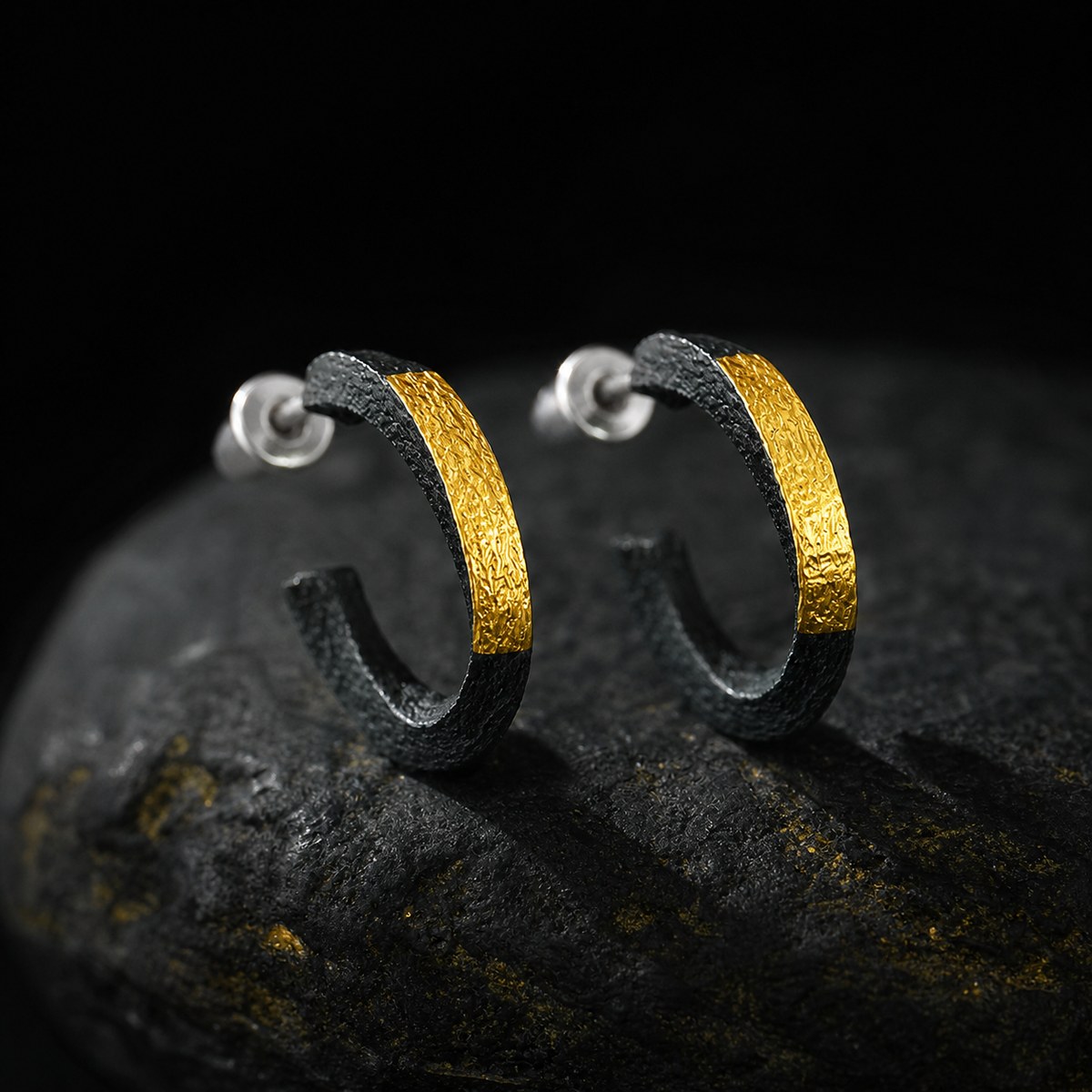
| Mixed silver and gold detail | Protect both metals and their boundary | Use construction-specific instructions | Assuming a plain-silver product is safe for inlay |
| Silver with opal or another stone | Protect metal, setting and gemstone together | Follow the most sensitive component’s limits | Steam, ultrasonic or soaking without verified approval |
| Unknown finish or plated surface | Avoid irreversible change | Document, dust gently and seek identification | “Test” polishing that may expose base metal |
Fine-gold details add another reason for zone-by-zone care. Our 24K gold inlay on silver guide explains the construction language and why a mixed surface should not be treated as a uniform sheet of plain silver.
Why common “tarnish hacks” are a poor diagnostic tool
A household method can appear successful because it makes a surface brighter, yet brightness is not proof that the treatment was appropriate. Chemical dips may remove a dark design layer; abrasives remove metal; electrochemical reduction can change appearance and leave a surface that requires further treatment. The CCI’s methods are written for trained conservation decision-making and include warnings about plated, gilded, hollow and composite objects.
The National Park Service’s care guidance likewise emphasizes examination, gentle cleaning and material-specific decisions. These sources are useful because they make irreversible trade-offs visible. They should not be treated as permission to reproduce museum treatment on a small earring without understanding its construction.
Storing silver well reduces the pressure to clean repeatedly. After identifying and gently cleaning a piece, use our conservation-informed guide to storing sterling-silver earrings. Clean, dry, separated storage helps limit pollutants, moisture and abrasion; it cannot guarantee that silver will remain unchanged forever.
When colour change is a wear or health question
Tarnish is a surface-material issue, not a medical diagnosis. If an ear is painful, hot, swollen, bleeding or producing discharge, stop using the earring and seek advice from a qualified healthcare professional. Do not infer infection, metal allergy or safety from the silver’s colour. Conversely, a dark earring does not provide antimicrobial or healing benefits merely because laboratory research describes properties of silver in other forms and conditions.
Mechanical damage is also separate from tarnish. A loose post, cracked hinge, distorted hoop or moving stone needs repair assessment. Polishing cannot restore a weakened joint, and cleaning around a damaged setting may make stone loss more likely.
FAQ
Does sterling silver tarnish because it is low quality?
No. Sterling silver can tarnish because its surface reacts with sulfur-containing compounds in the environment. Alloy composition, exposure, humidity and surface condition affect the process. Tarnish alone is not a quality verdict or purity test.
Is blackened silver the same as tarnished silver?
Not as a care category. A deliberately blackened surface may use related sulfide chemistry, but it was created to achieve a visual result. Unwanted tarnish developed without that design intention. The chemistry can overlap while the correct treatment goal is opposite.
Can I identify intentional oxidation from a photograph?
You can form a cautious hypothesis when darkness follows recesses and matches the original listing, but a photograph cannot prove the compound, treatment history or complete construction. Product documentation and direct examination are stronger evidence.
Will 999 fine silver never tarnish?
No. Higher silver fineness changes the alloy composition, but sulfur exposure can still darken fine silver. It may behave differently from copper-containing sterling; it is not immune.
Should I polish only the bright high points?
Selective polishing is a workshop technique, but at-home polishing can still remove metal, soften detail or touch adjacent stone and inlay. Follow the maker’s care instructions or use a jeweller familiar with intentional patina.
Can intentional oxidation wear away?
Yes. A surface patina can become brighter at high-contact points. That evolution may be expected, but uneven loss can be assessed and, in some cases, professionally renewed. Do not re-blacken gemstone or mixed-metal earrings with an improvised chemical bath.
Evidence limits and review date
This guide distinguishes documented material concepts and practical decision points. It cannot identify an individual earring’s alloy, coating, patina chemistry, contamination, treatment history or medical safety from a photograph. Product observations are limited to visible construction and current product-page wording. When documentation conflicts with the object, pause and obtain direct professional assessment.
Sources reviewed: Canadian Conservation Institute, “Understanding how silver objects tarnish”; Canadian Conservation Institute Note 9/7, “Silver – Care and Tarnish Removal”; Tissot et al., RSC Advances, “The influence of the constituent elements on the corrosion mechanisms of silver alloys in sulphide environments”; Storme et al., Heritage Science, “The sulfidation process of sterling silver in different corrosive environments”; U.S. National Park Service Conserve O Gram 10/2, “Caring for Silver and Copper Alloy Objects”; Getty Conservation Institute, “Conserving the Berthouville Treasure.” Last reviewed: August 2, 2026.
- Canadian Conservation Institute: Understanding how silver objects tarnish
- Canadian Conservation Institute Note 9/7: Silver – Care and Tarnish Removal
- RSC Advances: Corrosion mechanisms of sterling silver in sulphide environments
- Heritage Science: Sulfidation of sterling silver in different corrosive environments
- U.S. National Park Service: Caring for Silver and Copper Alloy Objects
- Getty Conservation Institute: Conserving the Berthouville Treasure
To compare real forms after establishing the care boundaries, browse the current silver earring collection. Product pages should remain the authority for what each listing includes.
Leave a comment