Direct answer: darkening on a sterling silver earring is usually tarnish, not proof that the piece is fake and not automatically a sign that it is unsafe. Tarnish is a surface reaction: sulfur-containing gases and other environmental factors form a thin layer on silver. The right response depends on the whole object. A plain, polished sterling stud can tolerate a different cleaning method from an intentionally oxidized earring, a plated piece, or an earring set with opal, turquoise, pearl, adhesive, enamel, or a delicate surface texture.
Quick answer
Begin with the least aggressive method that is safe for every material in the earring. Dry wiping and mild soap suit many plain pieces, while intentional oxidation, gemstones, gold or brass inlay and glued components require more specific care.
This guide gives a practical decision system for identifying likely tarnish, deciding whether to clean, choosing the least aggressive useful action, and knowing when to stop. It is a jewelry-care guide, not a medical diagnosis. Redness, swelling, discharge, heat, persistent itching, or pain around a piercing should be assessed separately from the appearance of the metal.
What silver tarnish is—and what it is not
The Canadian Conservation Institute (CCI) describes silver tarnish as gradual discoloration caused mainly by sulfur-containing gases. A very thin film can look yellow; as it grows it may appear red, blue, purple, brown, or black. The colors do not necessarily represent different metals. CCI explains that some colors come from thin-film interference: light reflects from both the tarnish surface and the silver below it. See CCI’s illustrated explanation of how silver tarnish develops.
Tarnish is therefore different from loose dirt, dried cosmetic residue, soap film, or skin oils. It is also different from a worn-through plating layer, a deep scratch, a loose stone, a cracked solder joint, or green corrosion caused by copper-bearing components. Those conditions require different decisions. Cleaning harder will not restore missing plating, repair a joint, or make a loose setting secure.
A “925” mark indicates a silver fineness of 92.5 percent; it does not promise that the surface will never change. GIA notes that sterling silver commonly uses other metals to improve durability and that silver jewelry requires appropriate care. For a separate guide to what a hallmark can and cannot establish, read How to Tell If Earrings Are Real Sterling Silver.
A five-question diagnosis before you clean
| Question | Why it matters | Safer response |
|---|---|---|
| Is the dark area even and superficial? | Even yellow, brown, blue, or black change is consistent with tarnish; pits, flakes, cracks, or exposed base metal suggest another problem. | Start with inspection and a dry soft cloth, not a chemical dip. |
| Is the finish intentionally oxidized or antiqued? | Darkness may be a designed contrast in recesses. | Do not aim for uniform brightness; clean only unwanted surface soil. |
| Are stones, pearls, enamel, adhesives, plating, or mixed metals present? | A method acceptable for plain sterling may harm the non-silver parts. | Follow the most fragile component’s care limits or consult a jeweler. |
| Is there structural damage? | Cleaning can worsen a loose post, bent clasp, cracked joint, or unstable setting. | Stop and obtain repair before cleaning. |
| Is the concern actually skin irritation? | Tarnish appearance cannot diagnose allergy, infection, or mechanical pressure. | Remove the earring if appropriate and seek qualified medical or piercing advice for symptoms. |
This separation matters because a blackened recess can be intentional, while a bright earring can still have an unsuitable post, backing, or alloy for a particular wearer. Conversely, an evenly tarnished sterling surface can be chemically stable even though the owner dislikes its appearance. Surface color is evidence about the surface—not a complete verdict on authenticity, hygiene, or biocompatibility.
Why prevention is better than frequent polishing
Polishing does not merely “lift” all tarnish without consequence. CCI warns that tarnish removal can take away a small amount of underlying silver and that repeated cleaning can soften engraved, chased, embossed, or plated detail. The U.S. National Park Service makes the same conservation point in Conserve O Gram 10/2: preventive storage reduces the need for repeated intervention.
For everyday earrings, the conservation principle translates into a simple rule: prevent contamination first, wipe gently after wear, and polish only when the appearance actually needs it. This does not mean treating jewelry like a museum object. Earrings are designed to be worn. It means recognizing that every abrasive action has a cost, especially on satin finishes, engraved lines, fine edges, and intentional oxidation.
Reduce exposure after wear
- Put earrings on after perfume, hairspray, lotion, and cosmetics have dried.
- Remove them before swimming or using household cleaners. GIA’s jewelry-care guidance notes that chemicals can discolor precious metals and harm some gemstones.
- After wear, wipe posts, backs, and accessible metal surfaces with a clean, soft, lint-free cloth.
- Allow a clean earring to dry fully before storage; do not seal moisture into a pouch.
- Store pieces separately so posts and hard edges cannot scratch neighboring surfaces.
Choose storage materials carefully
CCI recommends closed or sealed storage where practical because sulfur-containing gases can be difficult to isolate. Its storage guidance for metals also cautions that rubber and some surrounding materials can contribute sulfur compounds. For jewelry, a clean polyethylene bag or an anti-tarnish pouch designed for silver can slow exposure. Keep each earring pair dry and separate, and do not assume that any soft-looking foam or rubber insert is chemically neutral.
The least-aggressive useful cleaning ladder
The safest practical sequence moves from observation to progressively stronger action. Do not jump to a dip, abrasive powder, foil bath, toothpaste, or powered tool simply because a short video promises instant brightness.
Step 1: document the starting condition
Photograph the front, back, post, backing, stones, and any dark recesses under neutral light. Note whether the piece was sold with an oxidized, satin, hammered, brushed, plated, or polished finish. This record helps distinguish genuine change from a feature that was present from the beginning.
Step 2: remove loose surface soil
Use a clean, dry, soft cloth with light pressure. Support the earring close to the area being wiped; do not pull a thin post, openwork leaf, wing tip, or stone setting. Stop if the cloth catches, a stone moves, or a joint flexes.
Step 3: decide whether water is compatible
Plain sterling silver may often be washed gently, but “silver earring” does not describe the entire object. Porous or moisture-sensitive gems, pearls, adhesive-set components, enamel damage, intentional patina, and some plated or coated surfaces may rule out immersion. GIA’s cleaning guidance stresses that gemstones and treatments have different limits. When the construction is unknown, do not soak it.
Step 4: use a product designed for the confirmed surface
If a plain, structurally sound sterling piece still needs tarnish removal, use a silver-care product whose instructions explicitly match that surface. Apply it locally and minimally. Avoid polishing across satin texture or into dark recesses that provide intentional contrast. Rinse or remove residues exactly as the product directs, then dry completely.
CCI’s detailed Silver—Care and Tarnish Removal note explains why silver dips, over-polishing, and uncontrolled abrasion can damage detail or plated surfaces. Its specialist method using precipitated calcium carbonate is a conservation procedure, not a universal home recipe. The lesson for jewelry owners is restraint: match the method to the object and remove as little material as necessary.
Step 5: stop when the risk becomes uncertain
A professional jeweler or conservator is the better next step when the earring is plated, antique, valuable, stone-set, glued, enamelled, intentionally blackened, structurally damaged, or made from unidentified mixed materials. Smithsonian’s Museum Conservation Institute summarizes comparative research showing that abrasives remove different amounts of silver and produce different surface effects; “clean” is not a single, material-neutral outcome. See its record for A Comparative Study of Silver Cleaning Abrasives.
Methods to avoid as a default
Toothpaste
Toothpaste is formulated for teeth, not for preserving jewelry finishes. Its abrasive system varies by product and can scratch or gradually flatten detail. The full evidence and exceptions are covered in Can You Clean Silver Earrings With Toothpaste?.
Uncontrolled foil-and-baking-soda baths
Electrochemical reduction can change tarnish rather than abrade it away, but that does not make every kitchen version safe for every earring. The reaction depends on electrical contact, electrolyte, temperature, time, construction, and the corrosion layer. It can affect intentional patina and leaves unanswered questions about stones, solder, plating, coatings, and trapped solution. Museum methods are controlled treatments, not blanket endorsements for mixed-material jewelry.
Strong chemical dips
Dips can reach recesses quickly, which is precisely why they can erase designed contrast or over-clean textured detail. They can also be inappropriate for stones and mixed materials. Never treat “fast” as equivalent to “low risk.”
Powered polishing
Rotary tools generate friction and can round edges, remove finish, catch posts, or loosen settings. They belong in skilled hands with an identified construction and a defined surface goal.
Worked examples from real earring constructions
Plain polished sterling stud
When the earring is confirmed solid sterling, has no stones or coating, and is structurally sound, a soft cloth followed by a compatible silver-care product may be reasonable. Inspect the post and backing separately; accumulated residue is not the same as tarnish.
Oxidized sculptural stud
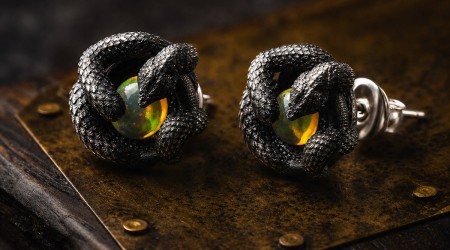
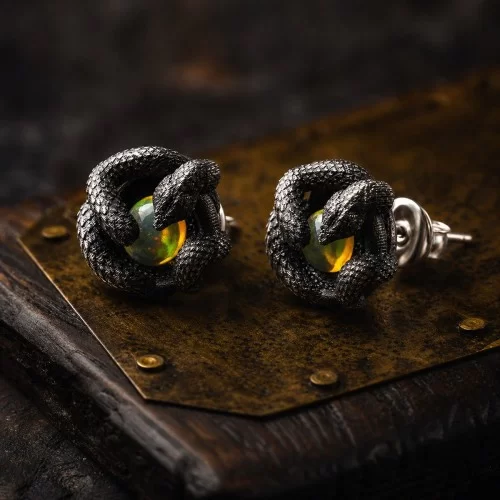
For a design such as the oxidized snake stud with natural opal, dark recesses and the stone are part of the object. Aggressive polishing could erase contrast, while immersion or chemicals may be unsuitable for the stone or setting. Surface dust and fingerprints should be handled conservatively.
Mixed silver and brass initial stud
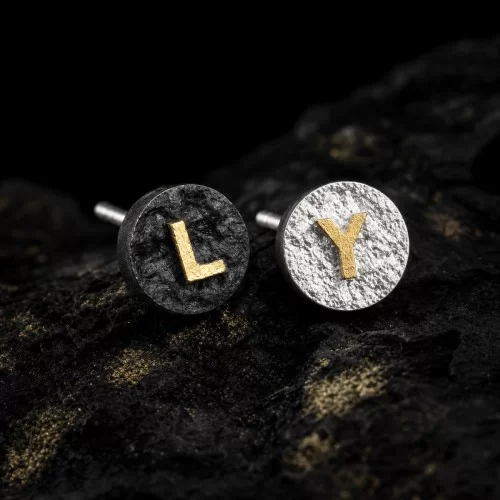
The custom letter stud combines sterling silver with a brass character. Brass and silver do not necessarily respond identically to the same cleaner. A universal “silver dip” assumption is therefore weak; local, material-specific care is preferable.
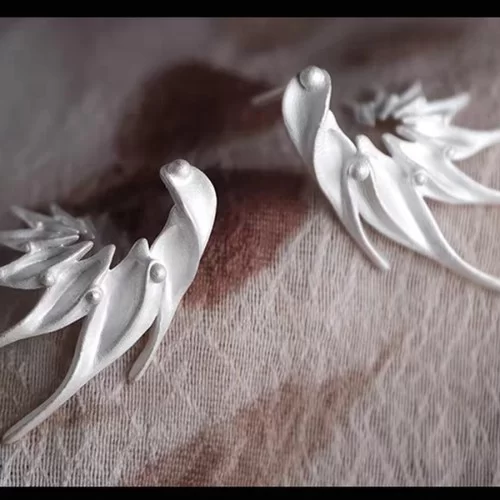
Satin directional ear climber
A satin piece such as the silver bird ear climber depends on soft directional texture rather than mirror shine. Polishing for maximum brightness can change the intended finish. Support the centre and fastening rather than rubbing or bending fine sculptural tips.
Tarnish, hygiene, and skin symptoms are separate questions
A tarnished surface can hold residue in the same way any textured surface can, but tarnish color alone does not diagnose contamination, allergy, or infection. If a healed piercing becomes itchy or inflamed, consider mechanical pressure, post length, backing fit, surface damage, cleaning products, and metal exposure rather than assuming that visible darkening is the sole cause. The article Nickel in Earrings: Why Release Rate Matters explains why a composition label and an exposure outcome are not identical.
For a new or unhealed piercing, jewelry selection and aftercare have stricter requirements. Do not use this tarnish guide as an initial-piercing protocol; see Is Sterling Silver Safe for a New Piercing? and consult a qualified piercer or clinician when symptoms are present.
FAQ
Does black tarnish mean sterling silver is fake?
No. Genuine silver tarnishes. A hallmark, seller documentation, construction, and appropriate testing are more useful authenticity evidence than surface color alone. Tarnish also does not prove authenticity, because other metals and coatings can darken.
Can I prevent tarnish completely?
Not realistically during normal wear. You can slow it by reducing exposure to sulfur-containing materials, cosmetics, household chemicals, moisture, and unsuitable storage materials. Prevention reduces cleaning frequency; it does not create a permanent guarantee.
Should I remove all black color?
Only if it is unwanted tarnish on a surface that can be cleaned safely. Blackened recesses may be intentional oxidation that defines the design. Set a surface goal before cleaning.
Is a polishing cloth always safe?
No. Some cloths contain polishing compounds, and repeated rubbing can change plating, satin texture, engraving, or intentional patina. Confirm what the cloth contains and what the earring surface is.
When should I use a professional?
Use a jeweler or conservator when the piece is valuable, antique, plated, stone-set, glued, enamelled, heavily corroded, structurally damaged, or made from unidentified materials. Seek medical advice for persistent skin symptoms; cleaning jewelry is not a substitute for diagnosis.
Bottom line
Silver tarnish is a surface reaction, not a moral verdict on quality and not a medical diagnosis. The best care sequence is: identify the full construction, distinguish tarnish from residue or damage, preserve intentional finishes, prevent exposure, begin with the least aggressive useful action, and stop when materials or structure are uncertain. That framework protects more value than any one “instant cleaning” recipe.
Evidence boundary: museum conservation sources address preservation of silver objects under controlled conditions. Their principles—identify materials, prevent deterioration, and minimize intervention—are useful for jewelry, but specific museum treatments should not be copied blindly onto wearable mixed-material earrings.
Sources reviewed: Canadian Conservation Institute; U.S. National Park Service; Smithsonian Museum Conservation Institute; Gemological Institute of America. Reviewed 10 August 2026.
Leave a comment