Direct answer: a “925” or “Sterling” mark is evidence of the purity being claimed, but the mark alone is not universal proof. Check the seller’s material disclosure and identity, distinguish solid sterling from silver plate, and use a qualified jeweler or assay service when certainty matters. Color, tarnish, magnetism, ice and polishing-cloth marks cannot establish 92.5% silver by themselves.
Quick answer
Start with a 925 or equivalent fineness mark and check whether the construction matches the claim, but treat marks and home tests as clues rather than proof. Reliable composition confirmation requires an appropriate professional test and interpretation.
What “real sterling silver” means
Sterling silver is an alloy. The U.S. Federal Trade Commission says sterling descriptions refer to 92.5% pure silver and that “925” means 925 parts per 1,000. It separately defines silver plate as a silver layer over another metal. The Gemological Institute of America likewise identifies 925 as the common sterling-jewelry standard.
Use an evidence ladder
| Check | What it supports | Limit |
|---|---|---|
| 925, .925, Sterling or Ster. | The represented fineness | A stamp can be inaccurate or apply to only one component |
| Listing, receipt and maker | Who stands behind the claim | Not an independent assay |
| Recognized full hallmark | Jurisdiction-specific assay and traceability | Small legitimate items may be exempt |
| Professional analysis | Measured composition at tested areas | Coatings and mixed parts require interpretation |
1. Read the mark, then verify its scope
Inspect the post, back, hook or another protected area. The FTC’s Jewelry Guides require truthful precious-metal representations. Canada’s Competition Bureau also lists .925 and sterling terminology for qualifying silver articles in its marking requirements. Ask whether the claim covers the whole earring, only the post, or a plated surface. No stamp is not conclusive proof of a fake, and a stamp is not conclusive proof of authenticity.
2. Do not confuse 925 with a full hallmark
Under the UK system, British Hallmarking Council guidance describes compulsory sponsor, fineness and assay-office marks. It also gives a 7.78-gram silver threshold, so an unhallmarked lightweight earring is not automatically counterfeit. Rules vary by market.
3. Treat home tests as clues, not assays
A strong magnetic attraction, unusual surface change or inconsistent mark can justify further checking. Their absence does not measure silver percentage: many non-silver metals are not strongly magnetic, and plating, findings, coatings and storage change what you observe. Tarnish is a surface reaction, as explained in our silver-tarnish evidence review. A green mark is not an authenticity or allergy test; see the metal-stain guide. Avoid improvised acid testing, which can damage jewelry and creates chemical-handling risks.
4. Use professional testing when the stakes justify it
Canada’s regulator reported using X-ray fluorescence screening and referring problematic pieces for additional testing. A peer-reviewed assay-office study documents both the advantages and limitations of XRF. Ask what areas were tested, whether posts and backs were checked separately, and whether the method can distinguish a surface layer from the body.
Metal verification does not identify a gemstone. If a listing also names ruby, review the separate guide to ruby earring meaning, treatment disclosure and stone identity before assuming that the word “ruby” proves natural origin, treatment status or a laboratory report.
A buyer checklist
- Reject vague “silver-tone” wording if you want sterling.
- Inspect every component for marks.
- Keep the listing and receipt and identify the seller.
- Check whether a hallmark is complete for its jurisdiction.
- For a disputed or valuable piece, request multi-point professional testing and a written result.
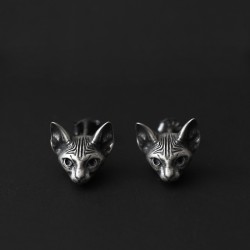
For a product example, the material is stated directly in the title of Skullearring’s 925 silver cat stud earrings. Compare terminology across the silver earring collection and the guide to 925 versus 999 silver.
Conclusion and limits
The reliable answer is layered: marks identify a claim, documentation creates accountability, recognized hallmarks add jurisdiction-specific verification, and professional testing supplies measured evidence. This guide cannot authenticate a specific earring remotely or certify every component.
References
- FTC Jewelry Guides
- FTC consumer silver guidance
- GIA silver guide
- British Hallmarking Council
- Competition Bureau Canada
- Peer-reviewed XRF study
A practical evidence ladder for checking sterling silver earrings
Authenticity is not a single yes-or-no observation. It is a conclusion built from evidence of different strengths. A useful order is: identify the seller and product claim; inspect the complete mark rather than one number; compare the construction with the claim; reject tests that only eliminate obvious counterfeits; and use a qualified laboratory when the financial or legal stakes justify it. This order matters because a copied “925” stamp can appear on base metal, while an unmarked small earring may still be silver in jurisdictions or circumstances where marking is not compulsory.
Start with the written product specification. Record whether the seller claims sterling silver for the whole earring, only the decorative front, or only a coating. Also record the post, back, inlay, stone setting and any deliberately oxidized area separately. “Silver color,” “silver tone,” “silver plated” and “sterling silver” are not interchangeable descriptions. In the United States, the FTC Jewelry Guides govern how precious-metal content may be represented. The safest buyer practice is therefore to preserve the listing, invoice and any material disclosure before trying a physical test.
Step 1: read every part of the mark
A fineness mark such as 925 expresses a claim of 925 parts silver per thousand, commonly described as sterling silver. A word mark such as “STERLING” communicates the same basic fineness claim in markets where that term is regulated. However, the number is only one part of the evidence. Look for a maker, sponsor or responsibility mark, an assay-office symbol where the legal system uses independent hallmarking, and a date or convention mark where applicable. Photograph the mark at high resolution before cleaning because polishing can soften shallow details.
Jurisdictions do not use one global hallmarking system. The United Kingdom’s statutory hallmark normally combines a sponsor’s mark, a fineness mark and an assay-office mark, subject to exemptions described by the British Hallmarking Council. North American goods may instead carry a quality mark accompanied by a registered or responsible party’s identity. An imported earring can therefore be genuine without displaying a British assay mark. Conversely, a stand-alone 925 stamp should not be treated as laboratory proof.
Step 2: test the claim against the construction
Examine wear points with magnification: the post, hinge, clasp edge, back and any high point that rubs against skin or clothing. A plated object may reveal a differently colored substrate where the surface has worn through. That observation is useful evidence of plating, but the absence of wear does not prove solid sterling. Modern coatings can be durable, and a new piece may not yet show a boundary. Solder joints may also differ slightly in color without disproving the silver claim because joining alloys must flow at a lower temperature than the main body.
Designs that intentionally combine metals need a narrower question. For example, a silver stud with a brass inlay should not be judged as if every visible yellow area were supposed to be gold. Likewise, an oxidized surface is a deliberate finish, not automatically dirt or evidence of a base-metal core. The product description should identify these components. If it does not, ask the seller to specify the claimed material of the body, post, backing and decorative inserts in writing.
Step 3: understand what home checks can and cannot establish
| Check | What a result may suggest | Why it is not proof |
|---|---|---|
| Magnet | Strong attraction can reveal some steel components or a non-silver core. | Many non-silver alloys are also non-magnetic; clasps may contain a small spring. |
| Visual wear | A contrasting layer may indicate plating. | No visible wear does not establish bulk composition. |
| Tarnish | Darkening can be consistent with silver reacting with sulfur compounds. | Other metals and coatings can discolor; protected silver may remain bright. |
| Ice or thermal feel | Silver conducts heat efficiently. | Size, room temperature and other conductive metals make the result ambiguous. |
| Acid spot test | A trained operator may screen an exposed area. | It is destructive, surface-sensitive and unsafe without proper procedure. |
| XRF screening | Can estimate elemental composition non-destructively near the tested surface. | Calibration, geometry, plating thickness and sampling location affect interpretation. |
Magnet-test limit: a weak or absent response is compatible with silver but does not prove 925 fineness. See the evidence-based guide to what a magnet test can—and cannot—show about sterling-silver earrings.
The magnet check is best used as an exclusion screen. Sterling silver itself is not ferromagnetic, so a strong response from the decorative body deserves investigation. But a weak response near a clasp or earring back may come from a steel spring. More importantly, brass, copper, nickel silver and many stainless grades can give little or no attraction. A “pass” therefore does not identify the metal.
Tarnish is similarly non-specific. Silver can darken through reactions involving sulfur-containing compounds, but the rate depends on environment, storage, cosmetics and surface treatment. Rhodium-plated sterling may resist visible tarnish, while a base metal may discolor for an unrelated reason. Skin color changes are even less reliable because sweat chemistry, cosmetics, plating wear and copper-containing alloys all vary. None of these observations should be used to make a medical claim or diagnose an allergy.
When professional testing is appropriate
Professional testing becomes reasonable when the item is valuable, the mark is inconsistent with the seller’s claim, a resale or insurance decision depends on the result, or a regulatory dispute requires documented evidence. X-ray fluorescence (XRF) is widely used as a non-destructive screening method. Canada’s Competition Bureau has described XRF screening in precious-metal inspections. Yet XRF still requires competent operation and interpretation. It samples a limited region and is especially sensitive to surface layers, geometry and calibration. A thick plating layer can make the surface composition look different from the bulk.
For the strongest conclusion, ask an assay office, qualified gemological laboratory or precious-metal testing professional what method suits the piece. They may combine XRF with density, microscopy, a carefully placed destructive sample or a fire-assay method depending on the object and purpose. Earrings are small assemblies, so testing one point on the decorative front may not establish the composition of the post, solder, back or inlay. Request a report that names the components tested, the instrument or method, the result and the measurement uncertainty or limitation.
A buyer’s decision framework
- Low-cost everyday purchase: prioritize a traceable seller, a clear material description, a return policy and a plausible complete mark. Use visual and magnet checks only to detect obvious contradictions.
- Mixed-metal or stone-set design: ask for a component-level specification. Confirm whether “sterling silver” applies to the main body, the post, or both, and whether yellow details are brass, gold, gold plate or gold inlay.
- Vintage, inherited or high-value earrings: avoid aggressive cleaning and acid tests. Photograph marks and construction, then consult a specialist before altering the surface.
- Possible misdescription: preserve the listing and invoice, ask the seller for clarification, and use an independent written test if a refund or legal complaint depends on composition.
- Sensitive ears: material authenticity and biological tolerance are separate questions. Genuine sterling is an alloy, and posts, solder or backs may differ. For persistent irritation, stop wearing the item and seek qualified medical advice rather than relying on a home metal test.
How Skullearring product examples should be read
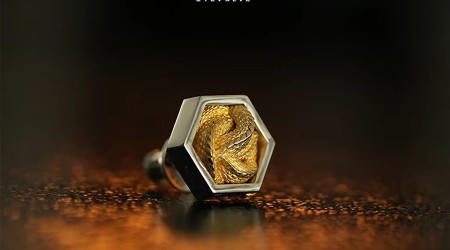
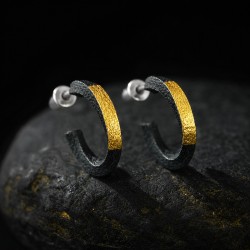
Our catalog includes both 925 sterling-silver and higher-fineness silver descriptions, sometimes combined with brass, gemstones, deliberate oxidation or gold inlay. The material line on each product page should be read literally and component by component. For a broad view, compare the silver earrings collection, the snake earrings collection and the 24K gold-inlay silver earrings collection. These links are examples of disclosed construction, not a substitute for independent assay.
Two related guides answer different questions. 925 vs 999 Silver Earrings explains fineness and practical design trade-offs; it does not authenticate an individual item. How to Care for Oxidized Silver Earrings explains why intentional blackening should be preserved. Keeping those intents separate prevents the common mistake of treating a finish, a stamp and a laboratory result as equivalent evidence.
Limits and uncertainty
No remote guide can authenticate a specific pair of earrings. Photographs do not reveal bulk composition, and marks can be absent, worn, copied or applied under different national rules. A seller’s disclosure and return policy may be sufficient for a routine purchase, while a formal assay may be appropriate for a high-value claim. The correct standard of evidence depends on the decision you need to make.
This guide also does not establish whether an earring is suitable for a particular piercing or skin condition. “Real sterling silver” describes a fineness claim, not guaranteed biocompatibility. Newly pierced ears and symptoms of infection or dermatitis need guidance from qualified health professionals. Treat claims that silver jewelry cures infection, improves circulation or produces other health effects as unsupported unless they are backed by directly relevant clinical evidence.
Frequently asked questions
Does a 925 stamp guarantee sterling silver?
No. It is evidence of the fineness being claimed, but a stamp can be copied. Evaluate the full mark, seller traceability, construction and—when necessary—an independent test.
Will real sterling silver always tarnish?
No. Environment, storage, coatings and cleaning history affect tarnish. Tarnish can be consistent with silver, but its presence or absence is not a decisive authenticity test.
Can a magnet identify sterling silver?
A strong attraction may reveal some non-silver components, but little or no attraction does not prove silver because many other alloys are also non-magnetic.
Is XRF testing conclusive?
XRF is powerful and non-destructive, but it primarily measures the tested region near the surface. A competent operator must account for coatings, shape, calibration and the fact that different earring components may use different alloys.
Should I scratch or acid-test an earring at home?
Not if preserving the finish and value matters. These tests can damage the surface and expose the user to chemicals. Use a qualified tester when a documented result is important.
Editorial review date: 4 August 2026. This article distinguishes regulatory guidance, professional testing limits and brand product observations; it does not certify any item not specifically tested.
Leave a comment