Short answer: ruby earrings can carry three different kinds of meaning: ruby is the documented July birthstone, red gems have accumulated varied historical associations, and a wearer may give a pair a personal meaning. None of those points proves that wearing ruby earrings causes love, confidence, healing, wealth, energy or protection. For a buyer, the more important questions are whether the stone is natural, laboratory-created or an imitation; whether it has been treated; and what the seller can verify in writing.
What is a ruby?
Ruby is the red variety of the mineral corundum. The Gemological Institute of America (GIA) ruby overview explains that chromium is the trace element responsible for ruby's red color. GIA lists a Mohs hardness of 9, but hardness measures resistance to scratching, not immunity from chips, fractures, loose settings or treatment-related damage.
The name of a red stone in a product title is only the beginning of identification. A buyer may still need to know whether the material is natural, laboratory-created or an imitation, and whether treatments affect its care or value.
Evidence at a glance
| Question | Evidence level | Careful conclusion |
|---|---|---|
| Is ruby the July birthstone? | Strong institutional documentation | Yes. This is a recognized tradition and gifting convention. |
| Does ruby have one universal meaning? | Contradicted by varied historical contexts | No. Meaning changes by place, period, object and wearer. |
| Are all rubies natural and untreated? | Contradicted by gemological and regulatory guidance | No. Natural, laboratory-created and imitation materials exist, and treatments are common. |
| Can treatment affect care or value? | Strong GIA and FTC guidance | Yes. Ask what treatment was used and obtain important details in writing. |
| Do ruby earrings cause healing, confidence, love or protection? | No reliable causal evidence in the reviewed sources | Treat such statements as belief or marketing, not established effects. |
Ruby as the July birthstone
GIA identifies ruby as the birthstone for July. It also records ruby as the gem traditionally associated with the 15th and 40th wedding anniversaries. These conventions can make ruby earrings relevant as a birthday or anniversary gift.
A birthstone association describes a social and historical tradition. It does not establish a biological effect, personality trait or guaranteed outcome for someone born in July. A person born in another month can choose ruby simply for its color, design or personal importance.
Historical ruby meanings are beliefs, not product effects
GIA's history section records several beliefs: ruby was called the “king of precious stones” in ancient India; some people associated it with power or youthful energy; Burmese warriors believed it could make them invincible; and some medieval Europeans connected rubies with health, wisdom, wealth or success in love.
Those statements tell us what particular people were reported to believe. They do not demonstrate that a gemstone caused any of those outcomes. Responsible jewelry writing keeps the verbs precise: a culture associated, a source records, or a wearer chooses a meaning. It should not convert historical lore into a promise.
Ruby in jewelry history: specific objects, not a universal code
Museum records show ruby appearing in different materials and traditions. The Metropolitan Museum of Art catalogs an earring from Morocco, dated broadly from the 18th to the 20th century, made with gold, emerald, ruby, enamel and pearl. The Met also records a pair of American or European earrings made with gold, sapphire and ruby.
These objects are good evidence that ruby was used in particular jewelry designs across different places and periods. They are not evidence that every ruby earring communicated the same emotion, religion or status. Material history and symbolic interpretation are separate questions.
Natural, laboratory-created and imitation stones are not the same claim
The US Federal Trade Commission's gemstone buying guide distinguishes three broad categories:
- Natural gemstones form in nature.
- Laboratory-created or synthetic gemstones are manufactured but can have essentially the same chemical, physical and visual properties as their natural counterparts.
- Imitations resemble a gemstone but are made from different material and do not have the same set of properties.
Visual appearance alone may not settle the category. The FTC's jewelry advertising guidance emphasizes clear qualification of laboratory-created and imitation products. A careful buyer asks for the exact identification rather than assuming “red stone” and “natural ruby” are interchangeable.
Why ruby treatment disclosure matters
GIA explains that rubies are often heat treated to alter color or apparent clarity. Other treatments can include lattice diffusion, dyeing, and glass filling of surface-reaching fractures or cavities. Some treatments are stable under ordinary wear; others can create special care requirements or greater vulnerability.
The FTC explains that sellers should disclose treatments when they are not permanent, require special care, or significantly affect value compared with an untreated stone. Its broader Jewelry Guides address deceptive claims about a product's type, quality, composition and treatment.
Before comparing prices, ask:
- Is the stone natural, laboratory-created or an imitation?
- Has it been heated, dyed, diffusion treated or fracture filled?
- Does the treatment require special cleaning or repair precautions?
- Are the stone dimensions or carat weight verified?
- Is there an independent identification report, and what exactly does it state?
How treatment changes cleaning advice
GIA states that warm soapy water and a soft brush are generally appropriate for many rubies. It says ultrasonic and steam cleaners are usually safe for untreated, heat-treated and lattice-diffusion-treated stones, while glass-filled or dyed stones should be cleaned only with a damp cloth.
That difference is why a generic “ruby is hard, so any cleaner is safe” rule is unreliable. If treatment status is unknown, use the gentler method and ask the seller or a qualified jeweler before using heat, steam, ultrasonic cleaning or chemicals. Also inspect posts, backs and settings; a hard gemstone does not prevent metal components from bending or loosening.
What does “ruby earrings meaning” responsibly mean?
A defensible answer separates four levels:
- Verified gemology: ruby is red corundum, with chromium responsible for the red color.
- Documented convention: ruby is July's birthstone and a traditional anniversary gem.
- Historical belief: different communities attributed different powers or values to ruby; these are records of belief, not proof.
- Personal meaning: a wearer may connect red, a birthday, a relationship or a memory with a specific pair.
This framework allows a meaningful story without manufacturing certainty. Personal symbolism can be genuine even when it is not universal or scientifically causal.
Applying the framework to Skullearring's ruby studs
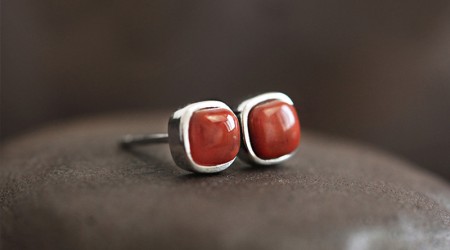
The live record for Skullearring's ruby stud earrings in a 925 sterling-silver setting verifies the listed metal and identifies the red stone in the catalog as ruby. It presents one coordinated pair of studs.
The current record does not verify whether the stone is natural or laboratory-created, its treatment status, geographic origin, carat weight, dimensions or an independent laboratory report. This article does not infer those facts from photographs or from the word “ruby” alone. Contact the store and obtain any fact essential to your purchase before relying on it.
For the metal side of the evaluation, use the evidence-led guide to checking sterling-silver claims and hallmarks. You can also compare the stated alloy boundaries in 925 versus 999 silver earrings or browse the broader silver earrings collection.
What the evidence does not support
The reviewed gemological, regulatory and museum sources do not establish that wearing ruby earrings:
- heals illness, improves circulation or changes physical energy;
- creates confidence, courage or emotional stability;
- attracts love, repairs relationships or guarantees passion;
- brings wealth, success or good luck; or
- protects the wearer from danger or misfortune.
Historical sources may document people making such claims. Documentation that a belief existed is not evidence that the claimed effect occurs.
A seven-point ruby earring checklist
- Confirm whether the listing covers one earring or a pair.
- Verify the metal and any hallmark; do not apply “925” to the stone.
- Ask whether the stone is natural, laboratory-created or an imitation.
- Ask about heating, dyeing, diffusion, filling and special care.
- Verify dimensions and carat weight if size or price comparison matters.
- Read the return policy and keep important representations in writing.
- Treat birthstone and personal symbolism separately from material identity.
Limitations
This article is a consumer research guide, not a laboratory identification or valuation. Museum objects illustrate specific historical uses; they do not represent every culture or prove a universal meaning. FTC guidance describes US consumer-protection principles and may not be the only law relevant to a transaction. None of the cited institutions endorses Skullearring or its products.
Frequently asked questions
What do ruby earrings symbolize?
They can symbolize July, an anniversary, the visual intensity of red, a documented historical belief or a wearer's personal memory. There is no single meaning that applies to every ruby earring.
Are ruby earrings a good July birthday gift?
Ruby is the recognized July birthstone, so ruby earrings can be a relevant gift. Verify the stone identification, treatment, metal, dimensions and return terms rather than relying on birthstone language alone.
Does “ruby” mean the stone is natural and untreated?
No. Natural, laboratory-created and imitation materials exist, and natural rubies may be treated. Ask the seller for the exact identification and treatment information.
Can ruby earrings bring love, confidence or protection?
No reliable evidence reviewed here shows that wearing ruby earrings causes those effects. They may be personal or historical associations, but they should not be presented as guaranteed outcomes.
How should ruby earrings be cleaned?
Care depends on treatment. GIA generally supports warm soapy water and a soft brush for many rubies, but glass-filled or dyed material calls for gentler cleaning with a damp cloth. If treatment is unknown, avoid steam and ultrasonic cleaning until it is verified.
Conclusion
Ruby earrings can be meaningful as July birthstone jewelry, an anniversary gift, a historical reference or a personal choice. The most useful interpretation does not stop at symbolism: it distinguishes evidence from belief and verifies the stone's identity, treatment, dimensions, documentation and care. Meaning can be personal; material claims must still be factual.
Sources
- Gemological Institute of America — July Birthstone
- Gemological Institute of America — Ruby Gem Encyclopedia
- Federal Trade Commission — Buying Gemstones, Diamonds, and Pearls
- Federal Trade Commission — Jewelry Guides
- Federal Trade Commission — In the Loupe
- The Metropolitan Museum of Art — Earring, One of a Pair (Morocco)
- The Metropolitan Museum of Art — Earrings (American or European)
Leave a comment