
Direct answer: sterling silver should not show the strong, immediate attraction associated with a ferromagnetic metal. But a weak or absent response does not prove that an earring is 925 sterling silver. A magnet is a limited screening tool: strong attraction can reveal a ferromagnetic component, while no attraction is only compatible with silver. It does not measure silver fineness, distinguish 925 from 999, or authenticate every part of an earring.
The most useful way to apply the test is component by component—decorative body, post and removable back—then compare the result with the product disclosure, marks and seller record. When composition matters, professional X-ray fluorescence (XRF) or another appropriate assay provides much stronger evidence.
What “sterling silver” actually means
In the United States, the FTC Jewelry Guides in 16 CFR §23.5 state that an item described as “sterling” or “sterling silver” must be at least 925 parts per thousand pure silver. The remaining fraction consists of other material used in the alloy. That legal fineness definition is a compositional standard; it is not a prediction that every complete earring will behave identically near a magnet.
Earrings can contain more than one functional part: a decorative body, post, hinge, spring, clasp, solder joint, stone setting and removable back. A material claim may apply to the entire article or may be qualified for only part of it. That is why our separate guide asks whether every component of a 925 silver earring is sterling.
Why silver is not strongly attracted to a magnet
A peer-reviewed NIST review of pure silver's physical properties describes pure silver as diamagnetic. Diamagnetism is a weak response opposite to an applied magnetic field; it is very different from the strong attraction most people mean when they say that a metal “sticks” to a magnet.
OpenStax's physics treatment of ferromagnets explains that strong ferromagnetic effects occur only in certain materials, including iron, cobalt and nickel. Therefore, a clearly attracted earring component can indicate that a ferromagnetic material is present at the tested location. It still does not identify the component, its proportion or the fineness of the rest of the earring.
How to interpret the result
| Observation | What it can support | What it cannot prove |
|---|---|---|
| Strong, immediate attraction | A ferromagnetic component is probably present where tested | That the whole earring is counterfeit, or what the rest of the metal contains |
| Little or no attraction | The tested part is compatible with silver and many other non-ferromagnetic materials | That the part is 925 sterling, 999 fine silver or even silver at all |
| Moving magnet slows or “drags” | A conductive object and the moving magnetic field may be producing eddy-current braking | A numerical purity grade or an authentication certificate |
| Body, post and back react differently | The earring may use different materials in different components | Which component meets a stated fineness without further evidence |
If one component is strongly attracted
Stop at the narrow finding: the tested component probably contains a ferromagnetic material. Recheck the body, post and back separately, then compare the result with any component-specific wording in the listing. Do not call the whole earring counterfeit unless the seller's exact claim and stronger evidence support that conclusion.
If nothing is strongly attracted
Record the result as “no strong attraction observed,” not “925 confirmed.” The observation rules out some possibilities but leaves many non-ferromagnetic metals and plated constructions unresolved. Continue to marks, disclosure and traceable professional evidence.
What is the silver magnet “slide test”?
Online demonstrations sometimes place a strong magnet on a large silver bar or move it past a conductive object. The magnet may fall or move more slowly than expected. This is not the same phenomenon as magnetic attraction.
The University of Wisconsin–Madison physics demonstration explains that a changing magnetic field induces eddy currents in a conductor; the induced magnetic field opposes the motion that produced it. The USGS describes silver as having the highest electrical conductivity of the metals, so the mechanism is physically relevant to silver.
However, an earring is not a large, uniform bullion sample. Geometry, thickness, magnet strength, movement speed, alloy composition and nearby components all influence an eddy-current demonstration. A tiny curved stud or open hoop may not create a visible slow slide even when its listed material is genuine. Conversely, observing drag does not establish 925 fineness. Treat it as a physics observation, not a purity measurement.
A five-minute, non-destructive screening workflow
- Read the exact material claim. Distinguish “925 sterling silver” from silver-plated, silver-tone, a sterling post only, or an unspecified white metal. The field-by-field product-page checklist shows which disclosures should be explicit.
- Separate removable parts. Take off the clutch or back. Test the decorative body, post and back independently. Keep the magnet away from loose stones and delicate mechanisms, and do not scrape the finish.
- Use attraction only as a screen. Record whether any part moves decisively toward the magnet. Do not upgrade “no attraction” into “verified silver.”
- Inspect marks in context. A 925 stamp is useful evidence of the claim but is not a laboratory result. Compare its location and legibility with the listing, receipt and seller identity. Our broader guide explains how to assess sterling-silver marks, tests and limits.
- Escalate when the decision matters. For a valuable, disputed or safety-critical item, ask a qualified jeweler or assay office which method fits the construction. Avoid destructive acid or filing tests on finished earrings unless an informed professional recommends them.
Why hallmarks and professional analysis are stronger evidence
A complete hallmark and a simple fineness stamp are not always the same thing. British Hallmarking Council guidance on GOV.UK describes a UK hallmark as an independent guarantee of precious-metal purity and identifies the sponsor, fineness and assay-office marks in a full hallmark. It also notes a 7.78 g exemption threshold for silver articles in the UK. This jurisdiction-specific exception is important: a small unhallmarked earring is not automatically counterfeit.
The London Assay Office says that most of its assaying is performed with non-destructive X-ray fluorescence. XRF measures the elemental composition of the analyzed area, which answers a different and more useful question than “does it stick?” The office also explains that a surface layer may need to be removed in some cases to assess the underlying alloy—a reminder that plating and surface analysis require expert interpretation.
The Birmingham Assay Office's silver guidance likewise distinguishes the 925 fineness number from the complete hallmarking and assay process. Professional evidence is not infallible or necessary for every low-value purchase, but it is a more direct route to composition than a home magnet screen.
Product example: test the claim, not the motif
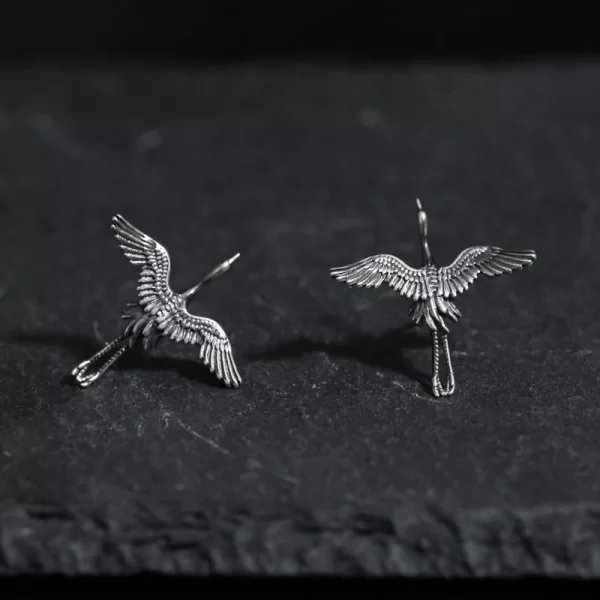
Skullearring's Crane Earrings in 925 Sterling Silver provide a bounded example. The live product record identifies model SED-03, 925 sterling silver, stud construction, coordinated crane motifs and a polished finish with darkened feather detail. It does not separately state the composition of the posts or backs, and it does not publish dimensions or weight. Those fields remain unknown rather than being inferred from the image.
If a buyer screens this type of earring, the decorative body, post and removable back should be observed separately. A response from the back would not by itself overturn the stated material of the decorative body; equally, no response from the body would not independently prove 925 fineness. Product disclosure, marks, seller traceability and—when necessary—analysis must be evaluated together.
For material comparison rather than authentication, read 925 vs 999 silver earrings. To understand why one label may not describe every functional part, use the component-material guide. You can also browse the verified listings in the sterling silver earring collection.
Evidence ladder: from weakest to strongest
- Appearance and online photos: useful for form, marks and visible wear, but unable to measure composition. See what earring photos can and cannot verify.
- Home magnet screen: can flag strong ferromagnetic attraction at a tested component; cannot authenticate sterling.
- Specific seller disclosure and records: identify what is being claimed, by whom and for which component.
- Coherent marks or an applicable independent hallmark: stronger traceable evidence, interpreted under the relevant jurisdiction's rules.
- Qualified elemental analysis or assay: the most direct evidence in this comparison, with method and surface limitations documented.
Conclusion
A genuine sterling-silver component is not expected to snap strongly to a magnet. That makes strong attraction a useful reason to investigate the tested part. The inverse is not proof: weak or absent attraction is shared by many materials and cannot establish 925 fineness. Eddy-current drag is a conductivity-and-geometry effect, not a home assay.
The defensible sequence is simple: read the exact material claim, separate and screen the components, inspect marks and records, preserve unknowns, and use qualified analysis when certainty is important. A magnet can start the investigation; it cannot finish it.
References
- Electronic Code of Federal Regulations, 16 CFR §23.5 — Misrepresentation as to silver content
- NIST Journal of Research — Physical Properties of Pure Silver
- OpenStax College Physics 2e — Ferromagnets and Electromagnets
- University of Wisconsin–Madison Physics — Eddy Currents
- U.S. Geological Survey — Silver Statistics and Information
- GOV.UK — Hallmarking is the law: guidance summary
- London Assay Office — Assaying and hallmarking methods
- Birmingham Assay Office — Silver assay and hallmarking
Related Products
Leave a comment