Direct answer: not necessarily. A truthful “925 sterling silver” description means the silver alloy being described is 925 parts silver per thousand, or 92.5% silver. It does not automatically prove that every detachable or visually distinct part of an earring—the decorative face, straight post, butterfly back, clip, solder, stone setting, brass inlay or plated surface—has the same composition. Some earrings are made throughout from one silver alloy; others combine a sterling body with a different post, back, accent, gemstone or coating. The only reliable way to know is a component-by-component specification backed by the seller or manufacturer.
Read the listing as an assembly, not as one undivided material word. Ask five questions: Which part carries the fineness claim? Are the post and back separately specified? Is a warm-colored area solid precious metal, inlay, electroplate or brass? Are stones and non-metal parts excluded from the metal claim? Which facts are verified, and which are simply not stated? A tiny “925” mark is useful evidence, but it is not a laboratory report for every component.
What 925 actually means
The U.S. Federal Trade Commission’s consumer guidance states that “silver,” “sterling” and “sterling silver” describe products containing 92.5% pure silver, and that products may be marked 925 to express 925 parts silver per thousand. The remaining 7.5% is alloy content; the mark does not identify every other element in that alloy.
The federal Jewelry Guides go further than a shopping summary. 16 CFR 23.5 addresses misrepresentation of silver content and warns against using “silver,” “sterling” or similar terms when the stated fineness is not met. This is a marketing rule about accurate precious-metal representation. It is not a shortcut that lets a buyer infer an undocumented post or backing composition.
International industry language makes the same conceptual distinction. The CIBJO Precious Metals Blue Book defines a precious-metal alloy and separately defines a precious-metal article as an item made entirely or in part from precious metals and their alloys. “In part” matters: modern jewelry can be an assembly of materials while still containing a correctly identified precious-metal component.
One earring, several material zones
| Component | What to verify | What 925 alone does not settle |
|---|---|---|
| Decorative face or hoop body | Base alloy and stated fineness | Post, back, solder, inlay, stone or coating |
| Straight post or ear wire | Its own alloy or recognized material grade | That it matches the decorative face |
| Butterfly, push-back or clutch | Material and whether it is included | That a detachable replacement is sterling |
| Soldered joint | Whether the maker provides a joint or solder disclosure | That a microscopic joining material equals the parent alloy |
| Inlay or applied accent | Solid metal, inlay, foil, brass or another stated material | That gold color means solid gold |
| Plated surface | Coating metal, base metal and process where known | That the whole article is the surface metal |
| Gemstone or glass | Identity, treatment disclosure and setting | Anything about the surrounding metal’s fineness |
The United Kingdom’s hallmarking system offers a useful illustration, although its legal thresholds and marks should not be projected onto every country. The UK government’s hallmarking guidance explains that a hallmark identifies precious-metal type and fineness and includes traceability marks. The London Assay Office’s mixed-metals guidance separately addresses articles that combine precious and non-precious metals. Its core practical lesson is not that every country follows UK rules; it is that different metal components can require different treatment and clear identification.
Face, post and back should be read separately
A stud earring normally has at least three functional zones: the front, the post that passes through the piercing, and the removable back. Those parts can be sourced or manufactured separately. A seller may accurately describe a sterling decorative front while supplying a steel post or silicone back, provided the complete description is not misleading. Conversely, a sterling post does not prove that a decorative brass front is sterling.
This is why “hypoallergenic post,” “silver-tone back” and “925 earring” are incomplete on their own. “Hypoallergenic” has no single universal alloy definition. “Silver-tone” describes appearance, not fineness. “925 earring” needs a scope: does it refer to the body, the post, the back, or all metal components? When the answer affects a purchase, ask the seller to name each part rather than asking whether the earring is merely “real.”
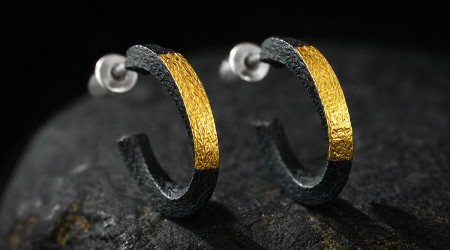
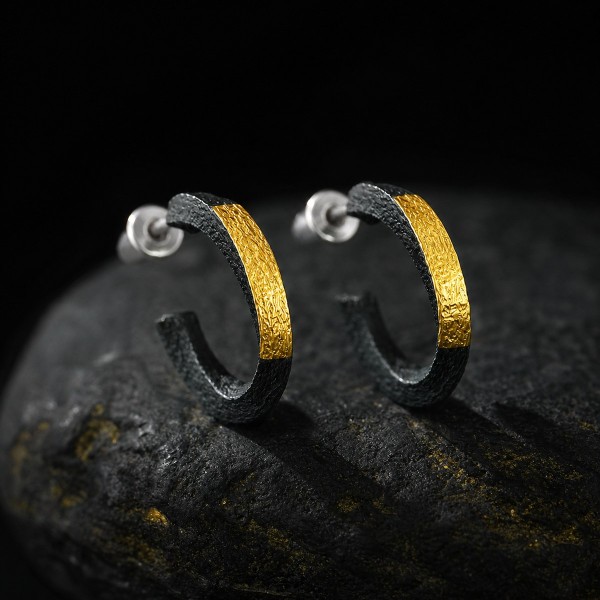
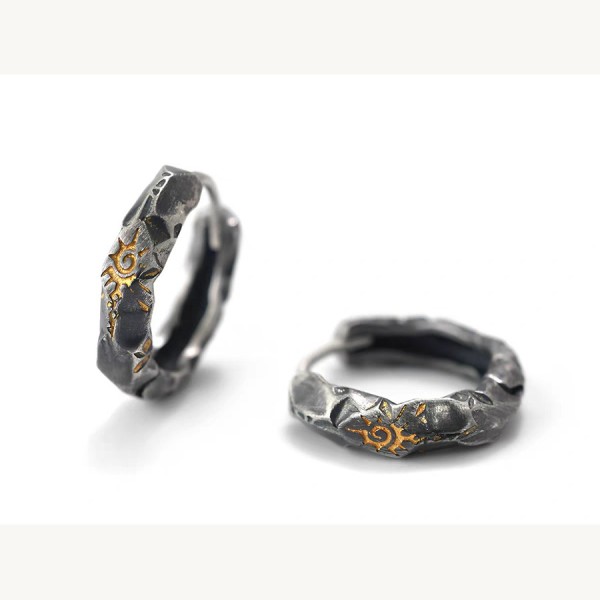
The Black Mobius Hoop demonstrates a stronger disclosure pattern. Its current record identifies an oxidized 999 fine-silver body, a 24K gold inlay and a straight post with an S925 silver push-back closure. Three material facts are tied to three parts. It does not imply that “999” applies to the gold panel or that “S925” changes the fineness of the hoop body.
Inlay, plating and solid metal are different constructions
A gold-colored accent can be solid gold, a mechanically applied layer, electroplate, thin wash, foil, inlay, brass or another alloy. These terms are not interchangeable. The FTC consumer guide distinguishes solid gold from several plated constructions and explains that vermeil is a particular gold-plated product with a sterling-silver base. The site’s gold inlay, vermeil and plating comparison applies those definitions to silver earrings without claiming that one construction is always superior.
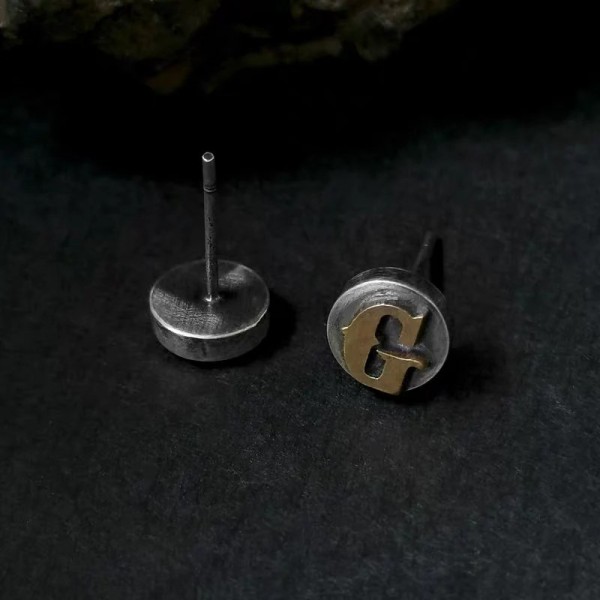
The Custom Letter Stud is a useful limit case. Its verified record says “silver base with brass character inlay” and “straight-post stud,” but it does not state the silver fineness, exact dimensions, weight or post material. The correct conclusion is narrow: the character is brass, the base is described as silver, and several other fields are unknown. It would be inaccurate to upgrade “silver base” to “925 sterling silver throughout” without further evidence.
The Wish Stone Sun Hoop uses another construction: an S925 sterling-silver base with a gold-tone, K-gold-electroplated sun detail. The accent is explicitly not described as solid gold. A plated surface may wear with use; that does not transform the base metal or make the initial component description false. Read the coating and substrate as two separate facts.
Why post material deserves its own line
The post or wire is the metal part that passes through a piercing, so its identity can matter more to some wearers than the front decoration. European nickel restrictions illustrate why regulators treat this contact zone specifically. Entry 27 of Annex XVII to the EU REACH Regulation sets nickel-release limits for articles intended for direct and prolonged skin contact and specifically addresses post assemblies inserted into pierced ears and other pierced parts of the body.
This does not mean every item outside Europe is unsafe, that silver is nickel-free, or that a “925” mark proves compliance with a nickel-release test. Alloy composition and nickel release are different questions. “Nickel-free” can also be used inconsistently in commerce; the site’s nickel release versus nickel-free guide explains why a measurable release standard is more precise than a vague absence claim.
For a fresh piercing, ordinary fashion-earring labels are not enough. The Association of Professional Piercers recommends documented materials meeting specific ASTM or ISO standards for initial jewelry and explains the role of mill certificates and appropriate finish, size and style. Sterling silver does not appear on its list of recommended initial-piercing materials. This guide therefore does not certify any catalog earring for a healing piercing; consult a qualified piercer and relevant medical professional when needed.
A component-level buying checklist
- Draw the assembly. List face/body, post or wire, back/closure, accent, coating and stones as separate rows.
- Copy exact wording. Record “925 sterling silver,” “999 fine silver,” “silver base,” “brass inlay” and “electroplated” without silently upgrading or merging terms.
- Locate the scope of the mark. Note where the 925 stamp sits and whether the product page says it covers the article or a named component. Location alone is not proof of every part.
- Separate surface from substrate. A coating describes the exterior layer; the base-metal statement describes what is underneath.
- Verify the contact component. Ask for post, wire and back materials individually, especially when sensitivity or a fresh piercing is relevant.
- Treat omissions as unknown. Do not infer a post alloy from color, price, title, a nearby 925 stamp or another product by the same brand.
- Keep evidence proportional. A seller specification supports a product-description claim; an assay or recognized test provides stronger material evidence. Neither should be invented.
A precise question to send a seller: “Please confirm the material of the decorative face, the post that passes through the ear, the removable back, and any inlay or plating separately. Which of those parts is covered by the 925 claim?” This is more useful than asking only, “Is it sterling silver?”
What stamps and home tests cannot prove
A stamp can be missing from a very small genuine part or placed on a component that is easier to mark. It can also be applied incorrectly. Therefore presence is evidence of a claim, not conclusive proof; absence is not conclusive proof of a fake. The existing guide to identifying real sterling silver earrings explains why magnet, ice, smell and tarnish observations cannot replace professional analysis.
Likewise, color cannot distinguish solid gold from brass or a plated layer. Tarnish cannot identify an exact alloy. A magnet response may reveal a ferromagnetic component, but a non-response does not calculate silver fineness. Acid tests can damage a finish and test only the contacted area; X-ray fluorescence and fire assay have their own sampling and interpretation limits. Buyers should not perform destructive testing on finished earrings merely to resolve a listing omission.
Where this guide does and does not apply
Use it for
- Comparing product-page material disclosures
- Separating base, accent and coating claims
- Asking about posts and backs
- Recording explicit unknowns
Do not use it for
- Diagnosing allergy or infection
- Certifying jewelry for a fresh piercing
- Proving fineness from a photograph
- Assuming every jurisdiction has identical rules
The difference between 925 sterling and 999 fine silver is a fineness question. This article answers a different question: which physical part does a fineness statement describe? Keep those questions separate. A 999 face with an S925 closure can be accurately disclosed; a 925 base with a brass inlay can also be accurately disclosed. Accuracy comes from scope, not from forcing the whole assembly into one metal name.
Frequently asked questions
If 925 is stamped on the earring back, is the whole earring sterling silver?
Not proven. The mark may identify the back, the article, or a manufacturer’s claimed fineness, depending on context. Check the product specification for the face, post and back separately.
Can a sterling silver earring have a steel post?
Yes, a multi-material assembly is technically possible. Whether the overall marketing is adequate depends on how the parts are described. The post should be disclosed separately when its composition matters.
Does 925 mean nickel-free?
No. 925 states silver fineness, not the full identity of the remaining alloy fraction and not a tested nickel-release rate. Ask for alloy or compliance evidence rather than inferring it from the fineness mark.
Is a brass inlay fake gold?
Not when it is clearly sold as brass. Brass, solid gold, gold inlay and electroplate are different materials or constructions. The problem is misdescription, not the honest use of brass.
Does gold plating change a sterling-silver base into a gold earring?
It adds a gold surface layer over the stated base. A complete description identifies both coating and substrate, such as gold-plated sterling silver or vermeil when the applicable definition is met.
What if the product page does not state the post material?
Treat it as unknown and ask before purchase if it affects your decision. Do not infer it from the face material, price, color, photographs or a generic title.
Is sterling silver suitable for a new piercing?
The Association of Professional Piercers does not list sterling silver among its recommended materials for initial piercings. Seek documented initial jewelry from a qualified piercer; this article is not medical or piercing-care advice.
Sources and review date
- Federal Trade Commission, Buying Platinum, Gold, and Silver Jewelry.
- Electronic Code of Federal Regulations, 16 CFR 23.5: Misrepresentation as to silver content.
- UK Government, Hallmarking in the UK: consumer protection.
- London Assay Office, Hallmarking Mixed Metals.
- CIBJO, The Precious Metals Blue Book.
- European Union, REACH Regulation, Annex XVII, entry 27: nickel restrictions.
- Association of Professional Piercers, Jewelry for Initial Piercings.
Editorial review date: August 20, 2026. Product examples were checked against current public Skullearring records. This guide explains material disclosure and does not provide an assay, allergy diagnosis, healing claim or guarantee that any earring is suitable for every wearer.
Related guide: Compare butterfly, screw, locking and flat-back earring closures by mechanism, support, comfort and disclosure limits.