
Short answer: “Nickel-free” and “hypoallergenic” are not interchangeable proof that earrings will never cause a reaction. For skin exposure, the more useful question is whether the finished, skin-contacting parts have a verified nickel release rate under a named test or regulatory standard. A material name or marketing label alone cannot predict every wearer’s response.
This guide explains the evidence without making a medical promise. It also separates ordinary earrings for healed ears from jewelry intended for a fresh piercing, where professional standards are stricter.
Nickel content and nickel release are different measurements
Nickel content describes how much nickel is present in an alloy or component. Nickel release describes how much nickel ion leaves the finished surface under specified conditions. Skin is exposed to what reaches it, so regulators concerned with prolonged skin contact use release—not just total content—as a key measure.
The European Commission’s scientific review explains that nickel ions released from alloys are the sensitising agent and that contact with sweat or biological fluids can increase release. This does not mean nickel content is irrelevant. It means composition alone is an incomplete description of exposure.
| Claim or document | What it can tell you | What it cannot prove |
|---|---|---|
| “Nickel-free” label | The seller is making a composition or exposure claim | A universal definition, test method or zero risk |
| “Hypoallergenic” label | The product is positioned as less likely to cause reactions | Which allergen was controlled or whether the item was tested |
| Alloy name such as sterling silver | The named material family | The composition of every solder, post, back, plating or surface |
| Named nickel-release test result | Measured release under stated test conditions | That no sensitised individual will react |
| Mill certificate | Chemical and physical results for a documented metal batch | Condition of every later coating, joint or finished surface unless traceability continues |
What the European nickel restriction actually measures
For articles intended to come into direct and prolonged contact with skin, European REACH guidance describes a nickel-release limit of 0.5 micrograms per square centimetre per week. For coated articles, the coating must keep release within that limit for at least two years of normal use. Separate, stricter provisions apply to posts placed into pierced ears and other pierced parts of the body.
These numbers are regulatory limits, not a guarantee that every person with established nickel allergy will tolerate every compliant item. The European scientific committee notes that allergic eczema can occur in sensitised people even with relatively low release. Jurisdictions also differ, so a European compliance statement should not be silently treated as a worldwide definition of “nickel-free.”
Why “hypoallergenic” needs a follow-up question
“Hypoallergenic” is useful only when the seller explains the basis for it. The claim might refer to the main alloy, a coating, the post, the back, or an internal testing policy. Those are not equivalent.
A better product question is: Which parts touch the ear, what are they made from, and is there a named test or specification for the finished item? Earrings are assemblies. A decorative front, post, solder, plating and back can have different compositions, and an answer about only the decorative body may leave the highest-contact components unaddressed.
A practical evidence hierarchy for earring buyers
- Strongest: a traceable finished-product nickel-release result or explicit compliance statement naming the relevant standard and skin-contact parts.
- Strong: a material certificate tied to a recognized specification, plus documented control of posts, backs, solder and coatings.
- Useful but incomplete: a precise alloy declaration for all skin-contact components.
- Weak: “nickel-free,” “sensitive,” “safe metal” or “hypoallergenic” without scope, method or documentation.
- Not evidence: colour, price, magnet response or a seller’s statement that nobody has complained.
The Association of Professional Piercers explains that a mill certificate reports chemical and physical properties and links a metal batch to a specification. That is materially stronger than a generic label, although finished-jewelry construction and traceability still matter.
Fresh piercings require a separate standard
Do not use this label guide to select starter jewelry for an unhealed piercing. The APP’s initial-jewelry guidance focuses on verified implant-compatible grades, surface finish, construction and fit. It also makes clear that compliance with an ordinary skin-contact nickel directive alone is not the complete initial-jewelry standard.
For the full distinction, see our evidence-based guide to sterling silver in a new piercing versus a healed ear. A qualified piercer should choose and fit jewelry for a fresh or troubled piercing.
What sterling silver does—and does not—tell you
A 925 sterling-silver description identifies a silver fineness category; it does not by itself document nickel release from the entire finished earring. The post, back, solder and any plating still need to be included in the claim’s scope. Likewise, a “925” mark is not a laboratory report.
If you are comparing a listed sterling-silver design such as Skullearring’s 925 silver cat stud earrings or ruby sterling-silver earrings, treat the product page as evidence only for the attributes it explicitly states. Ask customer service for clarification when a component, coating or test is not documented. We do not infer a nickel-release certification from a material name.
If earrings cause itching, redness or swelling
Stop wearing the suspected item rather than using the reaction as a home “test.” The American Academy of Dermatology identifies earrings and earring backs as common sources of nickel exposure and recommends avoiding nickel when allergy is known. It also advises professional assessment when a rash blisters, appears infected, or repeatedly returns.
The FDA describes patch testing as the validated method used to diagnose allergic contact dermatitis and identify the relevant allergen. A magnet, acid kit or dimethylglyoxime screening result cannot diagnose a person. Symptoms can also have causes other than nickel, including another metal, trapped moisture, irritation or infection.
Seven questions that make an earring claim testable
- Does “nickel-free” refer to total composition, release rate, or both?
- Which test method or regulation supports the claim?
- Were the post and back tested, not only the decorative front?
- Are solder joints and coatings included?
- Is the evidence for the finished item or only a raw-material batch?
- If coated, how is normal wear accounted for?
- Is the earring intended for a healed ear or an initial piercing?
For broader material and symptom context, continue with our guide to sterling-silver earrings for sensitive ears and our explanation of what marks and home checks can—and cannot—prove about sterling silver.
Conclusion
The most defensible earring claim is specific: it names the skin-contact parts, material specification, test method, release threshold and scope. “Nickel-free” or “hypoallergenic” without those details is a starting point for a question, not the end of an evidence review. Verified compliance can reduce uncertainty, but it cannot promise that no individual will react.
Authoritative sources
- European Commission: REACH nickel restriction interpretation
- European Commission SCHER: health effects of nickel
- American Academy of Dermatology: nickel allergy avoidance
- U.S. FDA: diagnosis of allergic contact dermatitis and patch testing
- Association of Professional Piercers: jewelry for initial piercings
- Association of Professional Piercers: mill certificate criteria
- Association of Professional Piercers: procedure manual and materials standards
Evidence boundary: This article provides general education, not diagnosis or treatment. Regulations and test standards can change, and product-level compliance must be verified for the specific item and market.
A three-layer audit for any nickel claim
A defensible claim has three layers: the component, the evidence, and the use case. If one layer is missing, the buyer cannot tell what the statement actually covers. This is especially important for earrings because the decorative front, post, solder joint, coating and backing may not share one composition.
| Audit layer | Question to ask | Why it changes the decision |
|---|---|---|
| Component | Which exact skin-contact parts are included? | A statement about the decorative body may say nothing about the post or back that remains against the ear. |
| Evidence | Is the claim based on alloy composition, a mill certificate, or a finished-item release test? | These documents answer different questions and should not be treated as interchangeable. |
| Use case | Is the item intended for a healed lobe, prolonged skin contact, or an initial piercing? | Ordinary consumer-jewelry compliance is not the same as professional initial-piercing suitability. |
How to read a product page without filling evidence gaps yourself
Start by copying the seller's exact wording. “925 sterling silver” is a material-fineness statement. “Nickel-free” is a separate claim. “Tested to EN 1811” would be a test-method statement. None automatically supplies the missing parts of another. If a page names only the main body material, record the post, back, solder and coating as not stated rather than assuming they match.
Next, look for a scope sentence. Strong wording identifies both the tested parts and the standard. A useful example would be: “The finished post and backing were tested for nickel release under [named method].” A vague badge saying “safe for sensitive ears” does not tell you which allergen was considered, what was tested, or whether the claim applies after surface wear.
Finally, keep medical and product questions separate. A product document can describe a material or release result; it cannot diagnose the reason for itching or redness. The FDA's discussion of patch testing concerns clinical diagnosis, while the European nickel restriction concerns product exposure limits. They address different decisions.
A worked comparison: what can actually be concluded?
Imagine two listings. Listing A says “hypoallergenic sterling silver.” Listing B names the metal used for every skin-contact component and supplies a finished-item nickel-release result tied to a recognized method. Listing B offers stronger evidence even if Listing A uses more reassuring language. That does not make Listing B universally reaction-proof; it simply makes its claim narrower, testable and easier to audit.
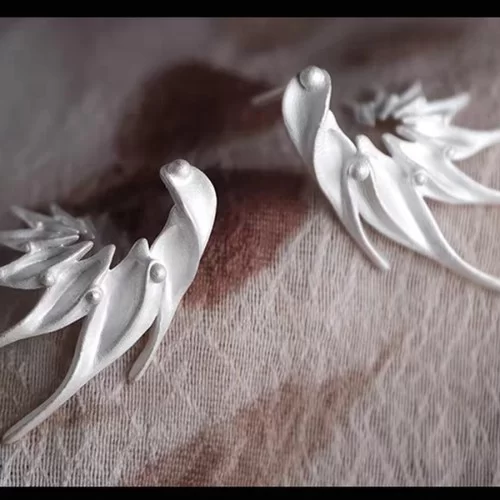
The same discipline applies when viewing a real design. Our silver bird ear climber page can support observations about its stated sterling-silver material, directional form and visible finish. It should not be cited as proof of a nickel-release certification unless such documentation is explicitly provided. This boundary protects the reader from converting a catalog attribute into a laboratory conclusion.
Decision path for a healed ear
- Identify the claim. Write down whether it concerns composition, nickel release, a named standard, or only marketing language.
- Map the contact parts. Include the post, back, solder, plating and decorative body where each touches skin.
- Ask for traceable evidence. Prefer a finished-item test or a documented material specification with continuous component traceability.
- Check the use case. Do not transfer guidance for healed-ear fashion earrings to an unhealed piercing.
- Act on symptoms conservatively. Remove the suspected item and seek appropriate professional advice when symptoms persist, blister, spread or appear infected.
For an unhealed piercing, stop this consumer-product comparison and use the stricter pathway described in our guide to initial jewelry versus healed-ear sterling silver. The Association of Professional Piercers emphasizes verified material standards, surface finish, construction and professional fit rather than a generic “nickel-free” label.
Frequently asked questions
Does a 925 stamp mean an earring is nickel-free?
No. A 925 mark states silver fineness, not the complete composition of every component and not a measured nickel-release rate. Review our guide to sterling-silver marks, tests and limits for what that mark can and cannot establish.
Is a release result the same as zero nickel?
No. A release test measures migration under defined conditions. It does not necessarily report total nickel content, and compliance with a limit is not a promise that no sensitized person will react.
Can a coating make the claim permanent?
Not automatically. Coatings can wear, scratch or expose edges. A useful claim should identify the durability requirement and the condition under which the finished article was evaluated.
What is the single best question to send a seller?
Ask: “Which skin-contact components are covered by this nickel claim, and what named specification or finished-item test supports it?” The answer should be specific enough that another reviewer could check the same evidence.
Reviewed: 6 August 2026. This extension preserves the article's evidence boundary: it explains how to evaluate claims and does not diagnose allergy, certify an individual product, or promise tolerance.
Everyday-wear context: Nickel-release evidence is only one part of the decision. Our daily sterling-silver earring guide also checks healed-piercing status, complete components, fit, weight, backing pressure and finish-specific care.
Short answer: “Nickel-free” and “hypoallergenic” are not interchangeable proof that earrings will never cause a reaction. For skin exposure, the more useful question is whether the finished, skin-contacting parts have a verified nickel release rate under a named test or regulatory standard. A material name or marketing label alone cannot predict every wearer’s response.
This guide explains the evidence without making a medical promise. It also separates ordinary earrings for healed ears from jewelry intended for a fresh piercing, where professional standards are stricter.
Nickel content and nickel release are different measurements
Nickel content describes how much nickel is present in an alloy or component. Nickel release describes how much nickel ion leaves the finished surface under specified conditions. Skin is exposed to what reaches it, so regulators concerned with prolonged skin contact use release—not just total content—as a key measure.
The European Commission’s scientific review explains that nickel ions released from alloys are the sensitising agent and that contact with sweat or biological fluids can increase release. This does not mean nickel content is irrelevant. It means composition alone is an incomplete description of exposure.
| Claim or document | What it can tell you | What it cannot prove |
|---|---|---|
| “Nickel-free” label | The seller is making a composition or exposure claim | A universal definition, test method or zero risk |
| “Hypoallergenic” label | The product is positioned as less likely to cause reactions | Which allergen was controlled or whether the item was tested |
| Alloy name such as sterling silver | The named material family | The composition of every solder, post, back, plating or surface |
| Named nickel-release test result | Measured release under stated test conditions | That no sensitised individual will react |
| Mill certificate | Chemical and physical results for a documented metal batch | Condition of every later coating, joint or finished surface unless traceability continues |
What the European nickel restriction actually measures
For articles intended to come into direct and prolonged contact with skin, European REACH guidance describes a nickel-release limit of 0.5 micrograms per square centimetre per week. For coated articles, the coating must keep release within that limit for at least two years of normal use. Separate, stricter provisions apply to posts placed into pierced ears and other pierced parts of the body.
These numbers are regulatory limits, not a guarantee that every person with established nickel allergy will tolerate every compliant item. The European scientific committee notes that allergic eczema can occur in sensitised people even with relatively low release. Jurisdictions also differ, so a European compliance statement should not be silently treated as a worldwide definition of “nickel-free.”
Why “hypoallergenic” needs a follow-up question
“Hypoallergenic” is useful only when the seller explains the basis for it. The claim might refer to the main alloy, a coating, the post, the back, or an internal testing policy. Those are not equivalent.
A better product question is: Which parts touch the ear, what are they made from, and is there a named test or specification for the finished item? Earrings are assemblies. A decorative front, post, solder, plating and back can have different compositions, and an answer about only the decorative body may leave the highest-contact components unaddressed.
A practical evidence hierarchy for earring buyers
- Strongest: a traceable finished-product nickel-release result or explicit compliance statement naming the relevant standard and skin-contact parts.
- Strong: a material certificate tied to a recognized specification, plus documented control of posts, backs, solder and coatings.
- Useful but incomplete: a precise alloy declaration for all skin-contact components.
- Weak: “nickel-free,” “sensitive,” “safe metal” or “hypoallergenic” without scope, method or documentation.
- Not evidence: colour, price, magnet response or a seller’s statement that nobody has complained.
The Association of Professional Piercers explains that a mill certificate reports chemical and physical properties and links a metal batch to a specification. That is materially stronger than a generic label, although finished-jewelry construction and traceability still matter.
Fresh piercings require a separate standard
Do not use this label guide to select starter jewelry for an unhealed piercing. The APP’s initial-jewelry guidance focuses on verified implant-compatible grades, surface finish, construction and fit. It also makes clear that compliance with an ordinary skin-contact nickel directive alone is not the complete initial-jewelry standard.
For the full distinction, see our evidence-based guide to sterling silver in a new piercing versus a healed ear. A qualified piercer should choose and fit jewelry for a fresh or troubled piercing.
What sterling silver does—and does not—tell you
A 925 sterling-silver description identifies a silver fineness category; it does not by itself document nickel release from the entire finished earring. The post, back, solder and any plating still need to be included in the claim’s scope. Likewise, a “925” mark is not a laboratory report.
If you are comparing a listed sterling-silver design such as Skullearring’s 925 silver cat stud earrings or ruby sterling-silver earrings, treat the product page as evidence only for the attributes it explicitly states. Ask customer service for clarification when a component, coating or test is not documented. We do not infer a nickel-release certification from a material name.
If earrings cause itching, redness or swelling
Stop wearing the suspected item rather than using the reaction as a home “test.” The American Academy of Dermatology identifies earrings and earring backs as common sources of nickel exposure and recommends avoiding nickel when allergy is known. It also advises professional assessment when a rash blisters, appears infected, or repeatedly returns.
The FDA describes patch testing as the validated method used to diagnose allergic contact dermatitis and identify the relevant allergen. A magnet, acid kit or dimethylglyoxime screening result cannot diagnose a person. Symptoms can also have causes other than nickel, including another metal, trapped moisture, irritation or infection.
Seven questions that make an earring claim testable
- Does “nickel-free” refer to total composition, release rate, or both?
- Which test method or regulation supports the claim?
- Were the post and back tested, not only the decorative front?
- Are solder joints and coatings included?
- Is the evidence for the finished item or only a raw-material batch?
- If coated, how is normal wear accounted for?
- Is the earring intended for a healed ear or an initial piercing?
For broader material and symptom context, continue with our guide to sterling-silver earrings for sensitive ears and our explanation of what marks and home checks can—and cannot—prove about sterling silver.
Conclusion
The most defensible earring claim is specific: it names the skin-contact parts, material specification, test method, release threshold and scope. “Nickel-free” or “hypoallergenic” without those details is a starting point for a question, not the end of an evidence review. Verified compliance can reduce uncertainty, but it cannot promise that no individual will react.
Authoritative sources
- European Commission: REACH nickel restriction interpretation
- European Commission SCHER: health effects of nickel
- American Academy of Dermatology: nickel allergy avoidance
- U.S. FDA: diagnosis of allergic contact dermatitis and patch testing
- Association of Professional Piercers: jewelry for initial piercings
- Association of Professional Piercers: mill certificate criteria
- Association of Professional Piercers: procedure manual and materials standards
Evidence boundary: This article provides general education, not diagnosis or treatment. Regulations and test standards can change, and product-level compliance must be verified for the specific item and market.
A three-layer audit for any nickel claim
A defensible claim has three layers: the component, the evidence, and the use case. If one layer is missing, the buyer cannot tell what the statement actually covers. This is especially important for earrings because the decorative front, post, solder joint, coating and backing may not share one composition.
| Audit layer | Question to ask | Why it changes the decision |
|---|---|---|
| Component | Which exact skin-contact parts are included? | A statement about the decorative body may say nothing about the post or back that remains against the ear. |
| Evidence | Is the claim based on alloy composition, a mill certificate, or a finished-item release test? | These documents answer different questions and should not be treated as interchangeable. |
| Use case | Is the item intended for a healed lobe, prolonged skin contact, or an initial piercing? | Ordinary consumer-jewelry compliance is not the same as professional initial-piercing suitability. |
How to read a product page without filling evidence gaps yourself
Start by copying the seller's exact wording. “925 sterling silver” is a material-fineness statement. “Nickel-free” is a separate claim. “Tested to EN 1811” would be a test-method statement. None automatically supplies the missing parts of another. If a page names only the main body material, record the post, back, solder and coating as not stated rather than assuming they match.
Next, look for a scope sentence. Strong wording identifies both the tested parts and the standard. A useful example would be: “The finished post and backing were tested for nickel release under [named method].” A vague badge saying “safe for sensitive ears” does not tell you which allergen was considered, what was tested, or whether the claim applies after surface wear.
Finally, keep medical and product questions separate. A product document can describe a material or release result; it cannot diagnose the reason for itching or redness. The FDA's discussion of patch testing concerns clinical diagnosis, while the European nickel restriction concerns product exposure limits. They address different decisions.
A worked comparison: what can actually be concluded?
Imagine two listings. Listing A says “hypoallergenic sterling silver.” Listing B names the metal used for every skin-contact component and supplies a finished-item nickel-release result tied to a recognized method. Listing B offers stronger evidence even if Listing A uses more reassuring language. That does not make Listing B universally reaction-proof; it simply makes its claim narrower, testable and easier to audit.
The same discipline applies when viewing a real design. Our silver bird ear climber page can support observations about its stated sterling-silver material, directional form and visible finish. It should not be cited as proof of a nickel-release certification unless such documentation is explicitly provided. This boundary protects the reader from converting a catalog attribute into a laboratory conclusion.
Decision path for a healed ear
- Identify the claim. Write down whether it concerns composition, nickel release, a named standard, or only marketing language.
- Map the contact parts. Include the post, back, solder, plating and decorative body where each touches skin.
- Ask for traceable evidence. Prefer a finished-item test or a documented material specification with continuous component traceability.
- Check the use case. Do not transfer guidance for healed-ear fashion earrings to an unhealed piercing.
- Act on symptoms conservatively. Remove the suspected item and seek appropriate professional advice when symptoms persist, blister, spread or appear infected.
For an unhealed piercing, stop this consumer-product comparison and use the stricter pathway described in our guide to initial jewelry versus healed-ear sterling silver. The Association of Professional Piercers emphasizes verified material standards, surface finish, construction and professional fit rather than a generic “nickel-free” label.
Frequently asked questions
Does a 925 stamp mean an earring is nickel-free?
No. A 925 mark states silver fineness, not the complete composition of every component and not a measured nickel-release rate. Review our guide to sterling-silver marks, tests and limits for what that mark can and cannot establish.
Is a release result the same as zero nickel?
No. A release test measures migration under defined conditions. It does not necessarily report total nickel content, and compliance with a limit is not a promise that no sensitized person will react.
Can a coating make the claim permanent?
Not automatically. Coatings can wear, scratch or expose edges. A useful claim should identify the durability requirement and the condition under which the finished article was evaluated.
What is the single best question to send a seller?
Ask: “Which skin-contact components are covered by this nickel claim, and what named specification or finished-item test supports it?” The answer should be specific enough that another reviewer could check the same evidence.
Reviewed: 6 August 2026. This extension preserves the article's evidence boundary: it explains how to evaluate claims and does not diagnose allergy, certify an individual product, or promise tolerance.
Leave a comment