
Direct answer: a photograph can document visible design, finish, construction clues, color options, proportions and any mark that is actually shown. It cannot, by itself, prove that an earring is 925 sterling silver, establish the material of a hidden post or back, measure nickel release, identify a gemstone, certify plating thickness or authenticate a hallmark. Those claims require a complete written specification and, when certainty matters, traceable testing or an assay—not simply a convincing image.
Treat product photography as one layer of evidence. First ask what the image directly records. Then compare it with the product title, component-level materials, dimensions, closure description and seller identity. Finally, mark every unanswered field as unknown. This disciplined approach is more reliable than trying to judge “real silver” from brightness, tarnish, price or a tiny 925 stamp in a close-up.

The evidence ladder: image, disclosure, mark and test
| Evidence | What it can support | What it cannot establish alone |
|---|---|---|
| Product photograph | Visible form, finish, option color, apparent closure and shown marks | Metal fineness, hidden components, nickel release, gemstone identity or coating thickness |
| Written product specification | The seller’s explicit claim for named parts, dimensions and construction | Independent confirmation that the claim is correct |
| 925 or hallmark photograph | That a visible mark is present on the photographed surface | That the mark is authentic or applies to every component |
| Recognized hallmark or assay record | Fineness and traceability within the relevant system | Unstated stones, removable backs or components outside its scope |
| Laboratory analysis | The tested property of the submitted sample or area | Untested components or every production unit |
The distinction begins with legal language. The U.S. Federal Trade Commission’s consumer guidance explains that a product described as sterling silver contains 92.5% pure silver and may be marked 925. 16 CFR 23.5 addresses misrepresentation of silver content. Neither source says that a photograph creates proof. The underlying obligation is an accurate material representation.
A recognized hallmark provides more information than an isolated “925” image. The UK government’s hallmarking summary says hallmarking protects consumers by certifying precious-metal content. The London Assay Office explains that a full hallmark contains component marks, including a sponsor’s mark, fineness mark and assay-office mark. A close-up that shows only “925” is therefore not equivalent to a complete, independently applied hallmark.
What a useful product photo really can show
Good photographs have genuine evidentiary value when their limits are respected. A straight-on image can show the decorative face. A side view can reveal thickness, a post, a hinge or a push-back. A rear view can expose soldered areas and marks. A scale or dimension drawing can support size comparison. A model image can provide approximate visual context, although ear and camera perspective vary. Multiple options photographed under consistent conditions help shoppers compare finish and color.
Images are especially useful for checking whether the written description matches the visible construction. If a listing says “brass inlay,” a close-up should reveal a distinct applied or inset warm-colored character rather than suggesting that the whole front is gold. If a listing offers separate black and white variants, the gallery should make both recognizable. If a closure is described as a push-back, at least one view should show it.
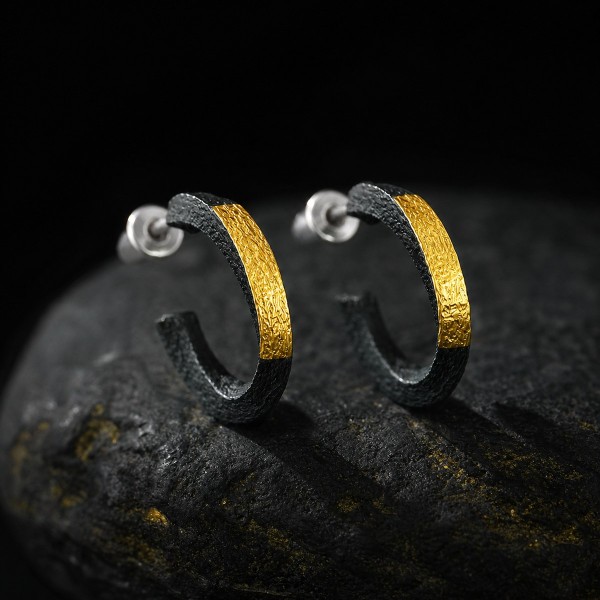
The Black Mobius Hoop demonstrates why image and specification work together. The current record identifies an oxidized 999 fine-silver body, 24K gold inlay and S925 silver push-back closure. The photo helps a buyer locate those visible zones, but it does not measure fineness. For the distinction between 925 and 999, use the site’s 925 versus 999 silver guide; for component scope, use the earring-components guide.
Why color is not a material test
Silver may look white, gray, blackened, warm or highly reflective depending on polish, oxidation, surrounding colors, exposure and lighting. Gold-colored details may be solid gold, an inlay, brass, plate or another material. A dark surface may be intentional oxidation rather than a different base metal. Appearance narrows visual description; it does not calculate composition.
Color also changes through the imaging chain. The Federal Agencies Digital Guidelines Initiative publishes technical guidance for controlled digital imaging, including color management and quality evaluation. NIST’s color-rendering work notes that object appearance under artificial lighting is an important characteristic of a light source. The practical implication is modest but important: a product image is a rendered record created under particular light, camera, processing and display conditions. It is not a spectroscopic material analysis.
Gemstones make this limitation even clearer. GIA’s gem and jewelry photography guidance explains how lighting choices affect the way color and surface appear. For identity, GIA describes comprehensive laboratory analysis rather than visual guessing from a retail photo. A multicolor stone visible in an earring gallery may be described as a gemstone when that is the verified product claim, but its species, natural or laboratory-grown origin, treatment and exact color cause remain unknown unless documented.
A 925 stamp photo is a claim, not a complete verdict
A clear stamp photo is better than no view of a claimed mark because it records location, characters and surrounding construction. Yet it still leaves three questions. Is the mark authentic? Which component does it describe? Was the photographed sample the same specification as the item supplied? A photo cannot answer those questions by itself.
In the United States, an accurate 925 representation concerns silver fineness. In the UK, a complete hallmark uses traceability and assay marks within a statutory system. Other jurisdictions have different rules and thresholds. Do not assume that a bare 925 stamp is a universal government certificate. The site’s sterling-silver authenticity guide explains why magnet, ice, smell and tarnish observations also cannot replace professional analysis.
Best seller question: “Please identify the material and fineness of the decorative front, post or ear wire, removable back, inlay or coating, and any stone separately. Which component carries the shown mark, and is there recognized assay or test documentation?” This is more precise than asking whether an item merely “looks real.”
How to audit a gallery before buying
- Match every option to an image. Confirm that each color, left/right orientation, single/pair choice or closure type is visually represented or clearly labeled.
- Look for front, side and back views. One hero image rarely documents the post, back, hinge, solder or mark.
- Separate appearance from material. Write “warm-colored detail” from the photo, then use only the specification to call it brass, gold, plate or inlay.
- Check scale evidence. Prefer exact millimeter dimensions. Model images are context, not measurement. The online earring-dimensions guide shows how to compare wearable size.
- Read the contact components. Find separate materials for the post, wire and back. A 925 front does not automatically document a hidden post.
- Record unknowns. If the fineness, coating thickness, stone identity or post alloy is missing, keep it unknown instead of filling the gap from the picture.
- Save the listing evidence. Keep the dated specification and order confirmation for material claims important to your purchase.
Three catalog examples—and the correct limits
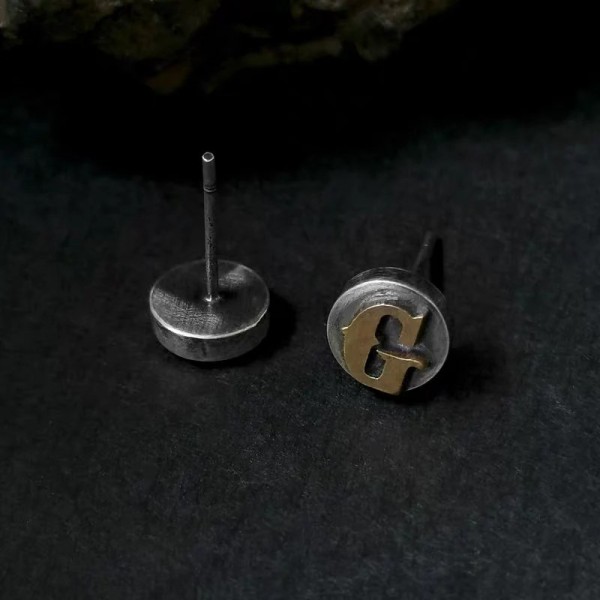
Custom Letter Stud
The gallery shows a round silver-colored base, contrasting character and straight-post form. The product record says silver base and brass character inlay. It does not state 925 fineness or post composition. Correct conclusion: the visible construction is consistent with the disclosed two-tone design; exact silver grade and post material remain unknown.
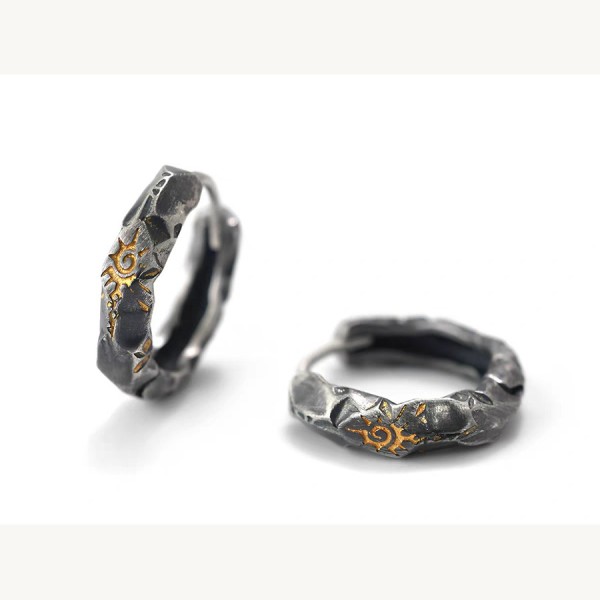
Wish Stone Sun Hoop
The Wish Stone Sun Hoop record identifies an S925 silver base and a gold-tone K-gold-electroplated sun detail, with approximately 17.7 mm outer and 13 mm inner diameter. The image can show the contrast and hoop form. It cannot turn an electroplated detail into solid gold or verify the stated millimeters without scale evidence.
Cyberpunk Mechanical Studs
The Cyberpunk Mechanical Studs record identifies 925 silver construction, multicolor gemstone detail and white, dark and duo options. The photos can compare those finishes and show a gem-like color play. They do not identify a specific gemstone species or treatment. The honest boundary is to preserve the verified generic term “gemstone” and avoid a more specific identification.
When photographs are not enough
Request stronger evidence when
- Fineness determines a high-value purchase
- A hallmark or seller identity seems inconsistent
- A post or back material affects your decision
- A stone’s identity or treatment changes value
- The delivered item differs visibly from the listing
Do not infer from photos
- Nickel-free or a nickel-release rate
- Suitability for a healing piercing
- Hypoallergenic performance for every wearer
- Medical, antimicrobial or wellness benefits
- Guaranteed durability or coating life
A photo cannot diagnose allergy, infection or piercing suitability. “Nickel-free” and measured nickel release are different claims; the nickel-release guide explains that distinction. For a new or problematic piercing, consult a qualified piercer or medical professional rather than relying on product imagery.
Frequently asked questions
Can you tell real sterling silver by its color in a photo?
No. Lighting, white balance, oxidation, polish, reflections and display settings change appearance. Color may describe the photographed finish but cannot establish 925 fineness.
Does a visible 925 stamp prove the whole earring is sterling?
No. It documents that a mark appears on the shown surface. Check authenticity, jurisdiction, seller responsibility and whether the mark applies to the front, post, back or entire article.
Can a photo prove an earring is nickel-free?
No. Nickel content and nickel release are not visible properties. They require reliable material information or applicable test evidence.
Can a photo identify a gemstone?
Usually not with sufficient certainty. Similar-looking natural, laboratory-grown, treated and imitation materials can overlap visually. Use a reliable product disclosure or gemological report when identity matters.
Are model photos accurate for size?
They provide approximate context, but ear anatomy, camera distance and perspective vary. Prefer millimeter dimensions and compare them with a familiar object or measured template.
What gallery views are most useful?
A consistent front view, side profile, rear/closure view, close-up of any mark, measured scale view and one model image provide complementary evidence. No single view replaces the written specification.
What should I do if the delivered earring differs from the photos?
Compare it with the dated listing and order record, document the difference under neutral lighting, and contact the seller. Do not perform destructive home tests before reviewing the return policy.
Sources and review date
- Federal Trade Commission, Buying Platinum, Gold, and Silver Jewelry.
- Electronic Code of Federal Regulations, 16 CFR 23.5: Misrepresentation as to silver content.
- UK Government, Hallmarking: practical guidance summary.
- Goldsmiths’ Company Assay Office London, What is a Hallmark?.
- Federal Agencies Digital Guidelines Initiative, Technical Guidelines for Digitizing Cultural Heritage Materials.
- National Institute of Standards and Technology, Color Rendering of Light Sources.
- Gemological Institute of America, How to Photograph Gems and Jewelry.
- Gemological Institute of America, Analysis of Gemstones at GIA Laboratories.
Editorial review date: August 21, 2026. Product examples were checked against current public Skullearring records. This guide explains evidence limits; it is not an assay, gemological report, allergy diagnosis or guarantee of suitability for every wearer.