Short answer: remove sterling-silver earrings before an MRI unless the MRI facility has explicitly screened the exact item and told you it may remain. “Silver is not strongly magnetic” is not enough to establish MRI safety. Earrings can contain other alloys, posts, backs, solder, stones or inlays; conductive metal can also heat, create image artifacts or interfere with the area being examined.
Tell the MRI team about every piercing and piece of jewelry before entering the controlled area. Follow the facility’s instructions even when an earring has a 925, 999 or gold mark. If a fresh or difficult-to-remove piercing is involved, contact the facility before the appointment rather than replacing or removing it without appropriate advice.
Why the answer is removal, not a home magnet test
MRI uses a powerful static magnetic field, rapidly changing gradient fields and radiofrequency energy. The U.S. Food and Drug Administration identifies projectile effects, heating and other interactions as MRI hazards. These mechanisms are not all answered by asking whether a household magnet sticks to an object.
RadiologyInfo, produced by the ACR and RSNA, tells patients to remove metal objects and jewelry before an MRI and explains that metal may cause burns, become a projectile or degrade the images. The UK National Health Service likewise says metal jewelry should not be worn during the scan.
A home magnet test can answer only a narrow question under uncontrolled conditions. It cannot identify every alloy or hidden component, predict radiofrequency heating, establish what happens at the MRI system’s field strength, or show whether the earring will obscure the anatomy of interest. For the limits of that test outside an MRI setting, read Will a Magnet Stick to Sterling Silver Earrings?
Four separate MRI concerns
| Concern | What it means for earrings | Why appearance or a stamp is insufficient |
|---|---|---|
| Magnetic attraction | A ferromagnetic component may experience force or torque in the magnetic field. | The decorative body, post, backing and solder may not share one composition. |
| Radiofrequency heating | Conductive items can heat and may injure tissue under certain conditions. | Weak magnetic response does not mean poor electrical conductivity. |
| Image artifact | Metal near the head, face, neck or other target anatomy can distort or obscure diagnostic images. | An item can affect image quality without moving dramatically. |
| Unverified construction | Mixed metals, plated parts, stones, glue or unknown findings complicate screening. | A fineness mark describes stated precious-metal content; it is not an MR safety label. |
The American College of Radiology’s MR Safety resources emphasize screening and risk assessment around the MR environment. The FDA’s information for MRI professionals also separates risks related to the static field, gradient fields and radiofrequency energy. That is why one simple material test cannot substitute for the facility’s screening process.
What 925, 999 and 24K marks do—and do not—tell you
A 925 mark describes sterling silver at 925 parts silver per thousand; a 999 mark describes higher-purity silver. A 24K mark can describe high-purity gold in a stated component or inlay. These marks are useful material disclosures, but they do not certify the entire finished earring for an MRI.
Finished earrings are assemblies. A piece marketed as fine silver can use a different alloy for the post or back. A gold-inlay design combines materials and may include a joint or backing that is not visible from the front. Even if each disclosed precious metal is weakly magnetic, the complete object remains conductive and its precise geometry matters.
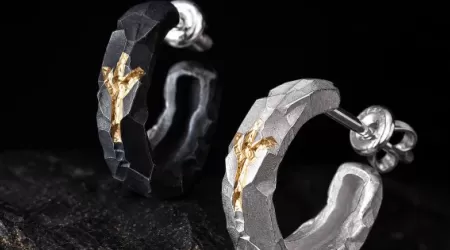
For example, the Faceted Fine-Silver Small Hoop is listed with a 999 fine-silver body, 24K gold inlay and a separate S925 push-back. Those verified listing details help explain why “silver earring” is not a single-material engineering description. They do not make this product—or any Skullearring product—MR Safe or MR Conditional.
MR Safe, MR Conditional and MR Unsafe are specific labels
In professional MRI practice, safety labels are tied to documented testing and conditions. The FDA explains that device safety information may depend on specified conditions of use. A retail description such as “sterling silver,” “fine silver,” “gold inlay” or “nonmagnetic” is not equivalent to an MR Safe or MR Conditional label.
The UK Medicines and Healthcare products Regulatory Agency MRI safety guidance addresses controlled access, screening and management of equipment and objects around MRI systems. Its safety framework reinforces the practical rule for ordinary jewelry: treat undocumented items as items requiring screening, not as self-certified MRI accessories.
Do not ask a jewelry seller to guarantee compatibility with a scanner. The MRI facility knows the examination area, system, workflow and local safety policy. The seller generally does not have the standardized MR test report needed for that decision.
Why conductive jewelry may heat
Silver and gold conduct electricity well. Conductivity is desirable in many technical applications, but it is a separate property from magnetic attraction. Radiofrequency fields can induce currents in conductive objects. The resulting risk depends on factors that include shape, size, contact with skin, position, field configuration and the specific scan.
A peer-reviewed systematic review of MRI radiofrequency thermal injuries includes removal of jewelry among practical prevention measures. It also notes that nonferromagnetic jewelry can still be conductive and may contribute to heating or image artifacts. This is limited clinical safety evidence, not a temperature prediction for a particular earring.
Tape, cloth or a plastic cover does not turn undocumented jewelry into MR-safe jewelry. A cover may change direct contact, but it does not prove that induced current, heating, movement or artifact has been controlled. Only the MRI team should decide whether any mitigation is acceptable.
Image artifacts matter even when the scan feels normal
Metal can disturb the local magnetic field and create signal loss or distortion. Earrings are especially relevant to examinations of the brain, face, jaw, ears, neck and upper spine because they are close to the imaging region. An artifact can reduce diagnostic usefulness even if the wearer notices no movement or warmth.
That makes “I wore it in a previous scan without a problem” poor evidence for a new scan. The anatomy, scanner, sequence, jewelry and positioning may differ. Prior uneventful use is not a safety certificate.
What to do before the appointment
- Read the facility’s instructions early. RadiologyInfo’s MRI preparation guidance recommends leaving jewelry at home or removing it before the examination.
- List every piercing and removable part. Include studs, hoops, backs, spacers and retainers, even when they seem small.
- Remove ordinary earrings at home when removal is easy and appropriate. Store the body and back together so neither is lost.
- Contact the MRI facility before the visit if removal is difficult. Do not arrive assuming staff can remove embedded, threaded or stuck jewelry.
- Bring truthful product information if requested. Material and construction details may support screening, but they do not replace it.
- Report previous surgery, implants and devices separately. Jewelry removal does not complete the wider MRI screening questionnaire.
What if the piercing is new?
Do not make a last-minute decision based only on fear that the hole will close. Tell both the MRI facility and an appropriately qualified piercing or healthcare professional how old the piercing is and whether there are complications. The facility may reschedule, use a local protocol or give other instructions; that decision depends on the clinical situation and scan.
A plastic or glass retainer is not automatically acceptable. The facility must still know about it, and changing jewelry in a healing piercing can cause irritation or trauma. Our guide to sterling silver and new piercings explains why material, healing stage and professional aftercare should not be collapsed into one retail claim.
What if an earring cannot be removed?
Call the imaging department before the appointment. Explain exactly where the jewelry is, whether it moves, how it closes and whether any documentation exists. Do not cut, force or repeatedly twist a stuck item immediately before a scan. The MRI team may need a radiologist or safety lead to assess the situation.
If staff permit an item to remain, follow their instructions during the scan and immediately report warmth, pulling, pain or unusual sensation. Do not interpret permission in one setting as permission for every future MRI.
Common claims checked
| Claim | Evidence-based boundary |
|---|---|
| “A magnet did not stick, so it is safe.” | No. That does not assess heating, artifact, hidden components or scanner-specific conditions. |
| “925 silver is MRI safe.” | A fineness mark is not an MR safety label for the finished earring. |
| “24K gold means the whole earring is safe.” | A gold component or inlay does not characterize the post, back, solder, stone or full assembly. |
| “Tape makes jewelry safe.” | Tape does not establish control of force, heating or artifact. |
| “It was fine last time.” | A previous scan may have used different equipment, sequences, positioning or anatomy. |
Bottom line
Remove sterling-silver earrings before an MRI unless the MRI facility has specifically screened the exact item and instructed otherwise. Do not use a 925 or 999 stamp, gold content, appearance, a household magnet or a previous scan as a substitute for professional screening. The safest preparation is simple: disclose the jewelry early, follow the facility’s instructions and ask before the appointment if removal is difficult.
This article provides general jewelry and MRI-preparation information. It does not replace instructions from the radiology department or individualized medical advice.
Leave a comment