Short answer: plan to remove sterling-silver earrings for a CT scan unless the imaging department tells you they can stay in place. CT does not use the same strong magnetic field as MRI, but metal jewelry can appear on or interfere with the images—especially when the head, neck or nearby anatomy is being scanned. Hospitals often ask patients to leave jewelry at home or remove it before the exam.
A 925, 999 or 24K mark does not create an exemption. Those marks describe stated metal content; they do not certify an earring for medical imaging. Your appointment instructions and the radiographer or CT technologist’s directions control what must be removed.
What official CT preparation guidance says
RadiologyInfo.org, a patient-information service reviewed by radiology professional organizations, says metal objects including jewelry may affect CT images and should be left at home or removed before the exam. It also notes that some examinations may require removal of piercings, hearing aids or removable dental work.
The NHS CT guide explains that the hospital will provide exam-specific instructions and may ask a patient not to wear metal items such as jewelry, metal fasteners, underwired bras or hair clips. This reinforces why the facility's own preparation instructions should take priority.
Medical centers give the same practical message. Cleveland Clinic advises patients to remove metal jewelry or clothing, while the University of Utah Health says a patient may be asked to remove jewelry and metal objects. The wording differs because the body area, scan protocol and facility procedure can differ.
Why metal earrings can affect a CT image
Computed tomography uses X-rays taken from multiple angles and computer processing to build detailed cross-sectional images. The U.S. Food and Drug Administration classifies CT as medical X-ray imaging using ionizing radiation. RadiologyInfo describes an X-ray tube and detectors rotating around the patient while a computer reconstructs the data.
Dense objects can appear prominently and create streaks, shadows or other artifacts in radiographic images. The practical problem is not that CT is measuring silver purity. It is that an object near the anatomy of interest may hide detail or reduce diagnostic image quality.
A peer-reviewed case report in Dentomaxillofacial Radiology documented large ghost images from retained earrings on a panoramic radiograph. The authors warned that jewelry in head and oral imaging can prevent clear visualization and may contribute to repeat imaging. A single case does not define every CT protocol, but it supports the reason departments remove avoidable metal from the field of view.
CT, ordinary X-ray and MRI are not the same
| Setting | Why jewelry may be removed | Reliable action |
|---|---|---|
| CT scan | Metal may affect reconstructed X-ray images, particularly near the scan area. | Follow the CT department’s preparation instructions and technologist. |
| Ordinary or dental X-ray | Jewelry can overlap anatomy or create shadows/ghost images. | Remove items in or near the image field when instructed. |
| MRI | MRI uses strong magnetic and radiofrequency fields, creating different safety and image-quality concerns. | Use the facility’s MRI screening process; see our evidence-led MRI jewelry guide. |
| Airport security | The goal is passenger and baggage screening, not medical imaging. | Read the checkpoint instructions; our airport-security earring guide covers that separate process. |
Advice from one setting should not be copied into another. “It did not trigger an airport detector” does not mean an earring should remain on for CT or MRI. Likewise, a household magnet result is not medical-imaging clearance.
Does the body area being scanned matter?
It can matter to image quality, but patients should not make the final decision themselves. Earrings are especially likely to be relevant during CT or X-ray imaging of the head, face, jaw, sinuses, neck or nearby structures. A metal item far from the planned field may be handled differently at some facilities, while other departments use a simple all-jewelry removal policy.
The safest preparation is to read the appointment letter and ask the imaging department before arrival. Do not assume an abdominal, chest or limb CT automatically lets earrings remain. Staff may change the scan coverage or follow a facility-wide metal-free protocol.
Why 925, 999 and 24K marks do not change the rule
A fineness mark describes stated precious-metal content. Sterling silver is commonly associated with 925, fine silver may be marked 999, and a gold mark can describe a gold component. A finished earring may also include a post, butterfly back, solder, hinge, spring, stone setting or inlay made from another material.
Medical-imaging guidance does not provide a “pure silver” or “24K gold” exception. Even if every metal in a piece were known, the imaging team still needs an unobstructed view and a consistent preparation process. If you want to understand why the body, post and backing can differ, see our guide to materials across an earring’s components.
What to do with a fresh, fixed or difficult-to-remove piercing
- Contact the imaging department before the appointment. Tell them what jewelry is present and where it is relative to the planned scan.
- Do not force a stuck or healing piercing. Forcing jewelry out can injure tissue. Ask the facility and an appropriate piercing or medical professional what preparation is acceptable.
- Do not install a substitute retainer without approval. A material sold as “non-metal” is not automatically accepted by every department or appropriate for every healing piercing.
- Allow extra time. The technologist may need to inspect the area, adapt positioning or follow another local step.
- Accept that the scan may need rescheduling. If the required jewelry cannot be removed and would compromise the examination, the clinical team decides the next step.
This is a preparation issue, not a reason to conceal jewelry from staff. Accurate disclosure helps the team protect both image quality and the piercing.
How to store small earrings safely during the scan
Small studs are easy to lose when removed in a changing area. Bring a closed, rigid or padded jewelry case. Attach each back to its post, keep pairs together and put the case inside a zipped compartment. Do not leave a loose stud or butterfly back in a clothing pocket, paper tissue or open tray.
If an earring is valuable or sentimental, leave it at home when the facility recommends doing so. Medical staff can protect clinical equipment and patient care, but a busy imaging department is not designed to inventory tiny jewelry components.
A real product example: compact initial studs
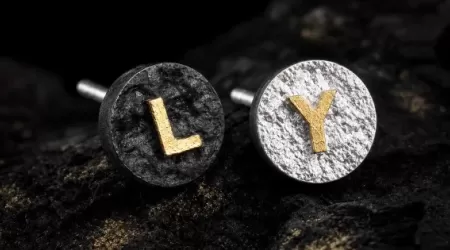
Our Personalized Initial Stud Earrings are listed with a 999 fine-silver body, 24K gold inlay, straight post and butterfly backing, with single or pair options. Those verified details make them a useful example of a small stud whose body and back should be stored together if removal is requested.
The product is not represented as CT-safe, X-ray-safe, MRI-safe or exempt from removal. Compact size does not override an imaging protocol. The same boundary applies to pieces in our silver earrings collection and 24K gold-inlay silver earrings collection.
Frequently asked questions
Will sterling silver earrings damage a CT scanner?
Routine CT guidance focuses on image interference and preparation rather than treating small silver earrings like an MRI magnetic hazard. Still, only the imaging department should decide whether the item can remain.
Can I keep earrings in for a CT of another body part?
Possibly, but do not assume. Some facilities tailor removal to the scan area; others ask patients to remove all jewelry. Follow the appointment instructions or call the department.
Do gold earrings need to be removed for CT?
They may. A gold fineness mark does not make jewelry invisible to X-ray imaging or exempt it from the department’s metal-removal policy.
What if I forget to remove my earrings?
Tell the technologist before the scan starts. Do not hide them. Staff can determine whether removal is required and prevent an avoidable image-quality problem.
Is a CT scan the same as an MRI for jewelry?
No. CT uses X-rays and computer reconstruction; MRI uses strong magnetic and radiofrequency fields. Both may require jewelry removal, but the reasons and safety screening are different.
Bottom line
Expect to remove sterling-silver earrings for a CT scan unless the imaging department explicitly says otherwise. The main routine reason is to prevent jewelry from obscuring or degrading the images, not because a 925 or 999 mark predicts a scanner hazard. Read the facility’s instructions, disclose fixed jewelry, store small parts securely and follow the technologist’s direction.
This article provides general preparation information, not individual medical advice. CT protocols vary by examination and facility; follow the instructions from your doctor and imaging department.
Leave a comment