Short answer: you can often wear small sterling-silver stud earrings through airport security, but there is no universal metal or purity exemption. Screening equipment, airport procedures and officer instructions vary. You may be asked to remove jewelry, and any alarm can lead to additional screening. Bulky pieces are more likely to be removed before screening than small studs.
Do not assume that a 925, 999 or 24K mark guarantees an alarm-free trip. An airport checkpoint is checking people and belongings for security purposes; it is not testing the purity of jewelry. Follow the instructions displayed at the checkpoint and given by screening staff.
What airport authorities actually say
The most useful official guidance is practical rather than material-specific. The Canadian Air Transport Security Authority (CATSA) tells passengers using a walk-through metal detector to limit jewelry to small earrings, watches and wedding or engagement rings. It also explains that an alarm may result in additional screening.
In the United States, the Transportation Security Administration's jewelry guidance lists jewelry as permitted in carry-on and checked baggage, while recommending that valuable pieces remain with the traveler. The TSA's official travel checklist advises passengers to remove bulky jewelry before screening.
The UK government's air-travel checklist says passengers may be asked to remove jewelry and other metal items. Australia's Department of Home Affairs notes that security-screening practices and equipment can differ among airports. Together, these sources support one careful conclusion: small earrings may stay on in some checkpoints, but local instructions decide.
Small studs, hoops and bulky earrings: a practical comparison
| Earring situation | Practical checkpoint approach | Important limit |
|---|---|---|
| Small studs | They may be allowed to remain in place where checkpoint instructions permit. | No alloy, size or retailer can guarantee that screening will be alarm-free. |
| Small hoops | Read the local signs and be ready to remove them if asked. | A hoop can include a hinge, latch or other component not described by a silver mark. |
| Large or bulky earrings | Remove them before screening when instructions say to remove bulky metal; secure them in your carry-on. | Do not leave valuable jewelry loose in an open tray. |
| Fresh, fixed or difficult-to-remove piercings | Tell the screening officer before screening and follow the local process. | This is a security-procedure question, not permission to force or medically manage a piercing. |
| Valuable or sentimental earrings | Keep them with you in carry-on baggage and request private screening if appropriate. | Rules for carry-on items still apply, and screening staff retain the final decision. |
Why a silver mark cannot predict the detector result
A fineness mark describes stated precious-metal content. Sterling silver is commonly marked 925, while higher-purity silver may be marked 999. Gold markings describe gold fineness or a disclosed gold component. None of these marks is an aviation-security certification.
A finished earring can also contain a post, butterfly back, hinge, spring, solder, inlay, stone setting or other part. Even when the decorative body is accurately described, the complete item is an assembly. More importantly, official airport guidance does not publish a rule saying that 925 silver, 999 silver or 24K gold will always pass without an alarm.
Screening systems are operated under local security procedures. CATSA's broader security-screening guidance describes the use of trays, X-ray equipment, body scanners or walk-through metal detectors and the possibility of additional screening. The Australian government likewise explains that passengers and belongings must complete screening. Material labels alone cannot replace that process.
Airport security is not the same as an MRI
Airport screening and medical magnetic-resonance imaging solve different problems. An airport may use a walk-through metal detector, body scanner, X-ray equipment for belongings and manual screening procedures. An MRI system uses strong magnetic and radiofrequency fields for diagnostic imaging.
That distinction matters because advice written for one setting should not be copied into the other. For MRI preparation, our evidence-led guide explains why ordinary earrings should be removed unless the MRI facility explicitly permits the exact item. Airport security, by contrast, may permit small earrings to remain while still reserving the right to conduct additional screening.
Neither setting supports the claim that a household magnet test proves clearance. At an airport, the only reliable instruction is the one provided by the relevant authority and checkpoint staff.
A simple plan before you reach the checkpoint
- Check the official rules for your departure airport and country. Procedures can change and may differ during a multi-airport journey.
- Choose small, secure earrings for travel. A compact stud with a firmly attached back is easier to manage than a large, loose or highly articulated design.
- Place a small jewelry pouch inside your carry-on. If staff ask you to remove an earring, put the body and back together in the closed pouch rather than loose in a tray.
- Keep high-value jewelry with you. TSA specifically recommends not placing valuable jewelry in checked baggage.
- Remove bulky jewelry before joining the queue when local guidance requires it. This reduces last-second handling at the screening point.
- Tell the officer about jewelry that cannot be removed easily. Do this before the relevant screening step, then follow the instructions given.
- Allow extra time. An alarm or uncertainty may result in a secondary check even when an item is permitted.
How to protect small earrings if removal is requested
The most common risk to a small stud at a checkpoint is not damage from the machine; it is loss during hurried handling. Prepare a rigid or padded container before travel. Close each butterfly back onto its post, keep pairs together, and put the container in an internal zipped compartment of your carry-on.
Avoid placing an unprotected stud directly in a tray. It can hide beneath a bag, catch on clothing or remain behind when trays are stacked. After screening, move away from the belt before putting jewelry back on so you do not block other passengers or drop a tiny component near moving equipment.
If a piece is especially valuable, TSA says private screening can be requested. Ask the officer how that process works at the checkpoint rather than attempting to conceal or bypass screening.
A real product example: compact initial studs
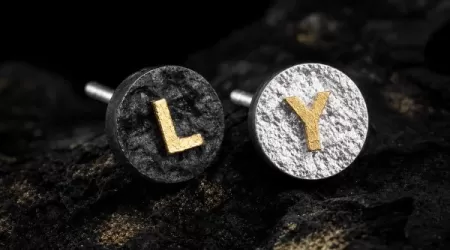
The Personalized Initial Stud Earrings are listed with a 999 fine-silver body, 24K gold inlay, straight post and butterfly backing, and can be selected as a single or pair. Those verified details make them a useful example of the compact-stud format many travelers prefer.
They are not represented as security-approved, detector-proof or guaranteed to remain on at every checkpoint. Their silver and gold descriptions communicate materials, not an aviation clearance. The same boundary applies to pieces in our silver earrings collection and 24K gold-inlay silver earrings collection.
International journeys need the most flexible plan
A journey can involve different countries, airports, terminal operators and equipment. Advice that applied on the outbound leg may not be identical on the return leg. The Australian Department of Home Affairs advises travelers to check current rules and notes that screening officers make the final decision about items at the checkpoint.
Plan for the strictest reasonable step: be willing to remove the earrings, have secure carry-on storage ready and leave enough time for an additional check. That approach is more reliable than trying to predict a detector from metal purity.
Frequently asked questions
Will sterling silver earrings set off an airport metal detector?
They may or may not. Official guidance does not provide a universal guarantee based on 925 or 999 silver. The equipment, earring construction and checkpoint procedure vary. If an alarm occurs, follow the officer's instructions.
Do I need to remove small stud earrings?
Not always. CATSA specifically advises limiting jewelry to small earrings and certain other pieces when using a walk-through metal detector. Other airports may ask passengers to remove metal items. Read local signs and follow staff directions.
Should valuable earrings go in checked baggage?
TSA advises keeping valuable jewelry with you rather than placing it in checked baggage. Use a closed container inside your carry-on and request private screening if appropriate.
Does 24K gold inlay make an earring detector-safe?
No. A gold-inlay description identifies a material component; it is not an aviation-security approval and does not characterize every part of the finished earring.
What if my piercing jewelry cannot be removed?
Tell the screening officer before screening. Do not force or damage the piercing to satisfy an assumption. The local authority determines the screening procedure and may use additional screening.
Bottom line
Small sterling-silver earrings are often compatible with routine airport screening, but only the checkpoint's current instructions control what you must remove. Bulky jewelry should be removed when required, valuables should stay with you, and every traveler should be ready for additional screening. Treat 925, 999 and 24K marks as material information, not a promise that a detector will stay silent.
This article provides general travel-preparation information. Security procedures can change; always follow the current instructions of the relevant airport and screening authority.
Leave a comment