
Direct answer: a useful sterling-silver earring page should identify the metal and the part it describes, the purchase unit, left/right orientation when relevant, dimensions, weight basis, closure, surface treatment, stone identity and treatment status, plus the exact configuration and total price before checkout. A photograph or a “925” label supports evaluation, but neither proves every component or every claim.
Why a field-by-field checklist is more reliable than a persuasive description
Online jewellery pages often mix three different kinds of information: verified specifications, design language and buyer assumptions. The first can be checked; the second can help describe appearance; the third creates most ordering mistakes. “Sterling silver earrings” may leave unanswered whether the post, back, inlay or plating uses the same material. A photograph of two earrings may illustrate two colourways rather than a pair. A model image may communicate scale without supplying a measurable diameter.
The checklist below is not a universal statement of law. Hallmarking, product-safety and distance-selling duties vary by market. It is a practical evidence standard for comparing listings. Official guidance shows why precise language matters: the US Federal Trade Commission advises buyers to look for a silver quality mark and the company mark, while UK hallmarking guidance explains that a complete UK hallmark identifies the sponsor, metal fineness and assay office. The UK also has weight exemptions, so the absence of a full hallmark on a light earring is not automatically proof of a false metal claim.
The nine-field minimum specification
| Field | Minimum useful disclosure | Do not silently assume |
|---|---|---|
| 1. Metal and scope | Fineness plus the components covered | “925” applies to every part |
| 2. Purchase unit | Single, pair or set, written beside the selected price | Two items in a photo means two supplied |
| 3. Orientation | Left ear, right ear, reversible or mirrored pair | An ear climber fits both sides identically |
| 4. Dimensions | Named measurements in millimetres | A model photo is a ruler |
| 5. Weight | Per piece or per pair; whether backs are included | A bare number states the basis |
| 6. Closure | Post, hoop hinge, clip, push back or other mechanism | The rear hardware matches the decorative body |
| 7. Surface and inlay | Oxidation, plating, vermeil, inlay or coating; base metal where relevant | Gold-coloured means solid gold |
| 8. Stones | Species or honest generic term; known treatments and uncertainty | Colour proves identity, natural origin or treatment status |
| 9. Order record | Selected options, quantity, total, lead time and return constraints | The cart preserves every choice correctly |
1. Read a metal claim as a scoped statement
“Sterling silver” conventionally describes a silver alloy of 925 parts per thousand, but the useful question is which component? A listing can describe the decorative body accurately while using a separately specified post, back, hinge, brass inlay or plated detail. The FTC’s consumer guidance distinguishes a quality mark from the maker or company mark. CIBJO’s Precious Metals Blue Book belongs to a wider set of jewellery nomenclature standards designed to keep descriptions scientifically and commercially clear.
Convert the headline into a component sentence: “The body is X; the post is Y; the back is Z; the gold-coloured area is A.” If the page does not supply one of those fields, record it as not stated, not as “probably sterling.” Our companion guide, Are All Parts of 925 Silver Earrings Sterling?, provides the component-by-component method.
2. Make purchase unit, side and option pricing explicit
The product title and gallery cannot establish how many pieces will arrive. A complete option should read like an invoice line: “Left ear — single,” “Right ear — single,” or “Pair — left + right.” The same rule applies to colour combinations and custom characters. The price displayed after selection should match that exact configuration.
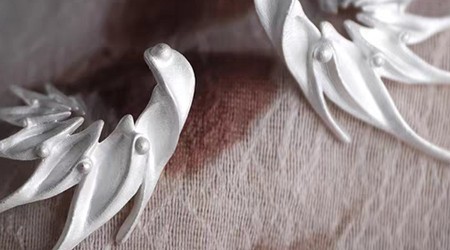
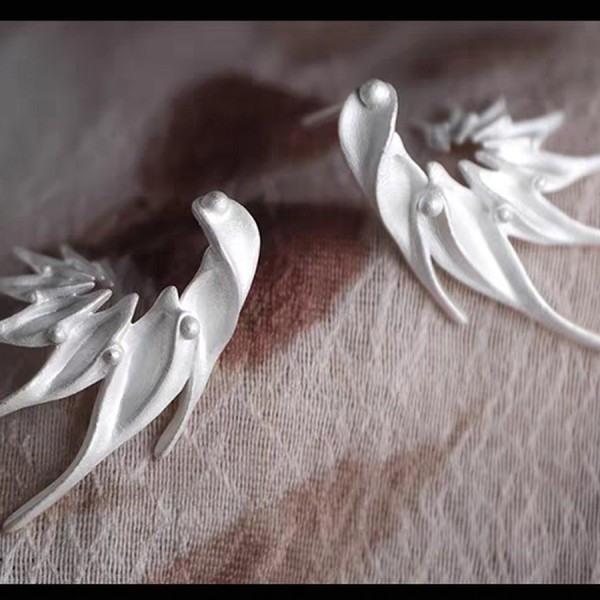
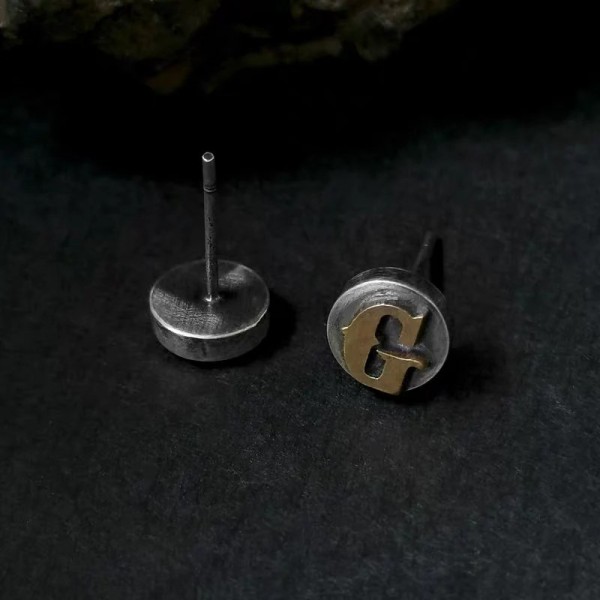
For example, the Silver Bird Ear Climber separates left single, right single and mirrored pair choices. The Custom Letter Stud separates single from pair and then records character type and the requested character. The Cyberpunk Mechanical Stud separates white single, black single and a black-plus-white pair. These are different option grammars; compressing all three into “quantity” would lose information.
3. Treat dimensions as named measurements
Useful dimensions identify the object and the axis: outer diameter, inner diameter, face width, drop, post length or front-to-back depth. “About 18 mm” is incomplete if the page never says what was measured. Weight should say whether it is per single earring or per pair and whether the removable back is included.
Photos still matter, but they answer different questions. A model image shows visual proportion; a millimetre specification allows comparison with an earring already owned. Use both and allow for handmade tolerance. The step-by-step method is in How to Read Earring Dimensions Online.
4. Separate closure and skin-contact hardware from the front
A front photograph rarely shows the entire wearable system. Ask how the earring closes, whether the back is removable, and which material description covers the post or hoop wire. Do not translate “sterling-silver design” into “every contact component is sterling silver.” Likewise, do not infer “nickel-free,” “hypoallergenic,” “safe for sensitive ears” or suitability for a healing piercing without a specific, supportable statement. Those terms require evidence beyond appearance.
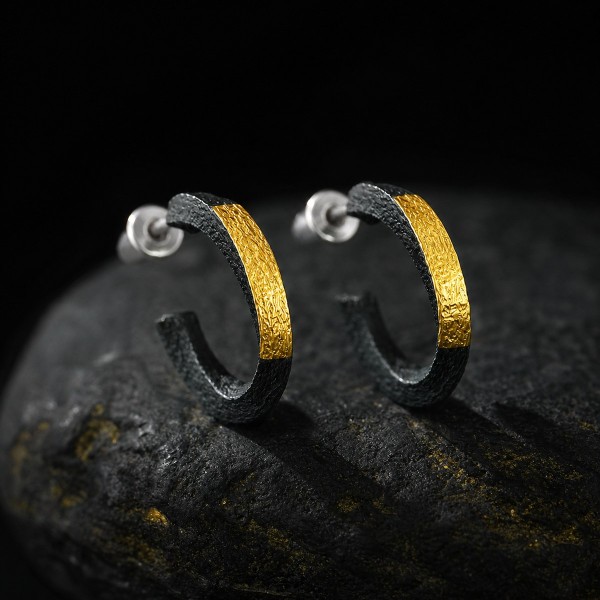
The Black Mobius Hoop demonstrates why component scope is useful: its oxidized fine-silver body, gold inlay and separate back/closure details should be read as different fields rather than one blended material claim.
5. Name colour-producing processes precisely
Gold-coloured details can be solid gold, a bonded layer, plating, vermeil, inlay, foil or a non-gold alloy. Oxidized silver is intentionally darkened at the surface; it is not a different silver fineness. A useful page names the process and, where known, the base material. It should not use “gold” alone in a way that invites the reader to assume solid gold.
UK hallmarking guidance specifically discusses descriptions for gold-plated silver and for combinations of precious and non-precious metals. Our comparison Gold Inlay vs Vermeil vs Gold-Plated Silver explains why these constructions should not be collapsed into one durability or value claim. The Wish Stone Sun Hoop, for example, states its silver base, gold-coloured sun treatment and named dimensions separately.
6. Require cautious gemstone language
Colour and photography cannot establish a gemstone’s species, natural origin or treatment history. A responsible listing should state the stone identity that is actually known, disclose known treatments that affect value or care, and avoid guessing when the supplier record is incomplete. GIA asks laboratory clients to disclose even suspected treatment or synthesis because advanced processes may not be visually obvious. FTC guidance similarly treats disclosure as important when treatment is not permanent, requires special care or significantly affects value.
If a page uses only “multicolour gemstone,” that is less specific but may be more honest than an unsupported species claim. A buyer who requires laboratory-level identification should request a report for the particular stone, not infer certification from a generic product description.
7. Use images as evidence with defined limits
A complete gallery should ideally show the front, rear, closure, profile, scale and meaningful marks. It can reveal construction clues and whether the photographed item matches the option selected. It cannot verify bulk alloy composition, invisible plating thickness or a stone treatment. See Can You Verify Sterling Silver Earrings from Photos? for an evidence ladder and a list of conclusions that images cannot support.

8. Apply the order-summary test before paying
A product page can be accurate in isolation yet still fail at the handoff to the cart. Dynamic option pricing, custom text and directional variants should survive that handoff in human-readable form. Before payment, compare the product-page selection with the cart line rather than checking only the total. For a pair, the record should say which two pieces are included; for a custom item, it should preserve the submitted character; for a colour duo, it should name both colours. If the cart reduces a detailed selection to an ambiguous product title, take a screenshot and ask the seller to confirm the configuration. This is especially important when personalized items cannot be returned after production begins.
- Read the selected option aloud as a complete item: material scope, colour, side and single/pair.
- Confirm the displayed total changes when a pair or upgraded set is selected.
- Save the dimensions, closure, weight basis and production lead time.
- For custom work, verify spelling, capitalization, character count and whether a pair repeats or splits characters.
- Capture the final cart line or confirmation page. If a choice disappears, stop and correct it before payment.
- Read return or cancellation limits for personalized goods and hygiene-sensitive items.
This creates a compact evidence record. It does not guarantee quality, but it prevents an attractive image from silently filling gaps in the specification.
When this checklist is—and is not—enough
It is suitable for comparing ordinary retail listings, checking that options are unambiguous and preparing questions for a seller. It is not an assay, gemstone identification, allergy test, medical recommendation or legal opinion for every jurisdiction. The EU General Product Safety Regulation, for example, sets specific identification and contact-information requirements for online offers in its market; other locations use different rules. Legal compliance should be assessed for the destination market.
If a listing makes a laboratory, hallmark, treatment or safety claim that materially affects the purchase, ask for the underlying record and confirm that it applies to the exact item—not merely to the seller’s product category.
FAQ
Does a “925” stamp prove that every earring part is sterling silver?
No. A mark is useful evidence, but component scope still matters. The post, back, hinge, inlay or coating may be separately described. A photograph also cannot assay the metal.
If two earrings appear in the main image, is the price for a pair?
Not necessarily. The purchase unit must be stated in the selected option and order summary. Galleries often show variants or styling combinations.
Is the absence of a hallmark proof that an earring is not silver?
No. Requirements vary by jurisdiction and may include weight exemptions. UK guidance, for example, states a 7.78 g exemption threshold for silver articles; other countries differ.
What is the most important field for an ear climber?
Orientation plus purchase unit. The page should distinguish left single, right single and a mirrored pair where the design is directional.
Can a product photo confirm a gemstone is natural?
No. Photography cannot reliably establish natural origin or treatment. Look for a supported disclosure or an item-specific laboratory report when that distinction matters.
Sources and review date
- US Federal Trade Commission: Buying Platinum, Gold, and Silver Jewelry
- US Federal Trade Commission: In the Loupe—Advertising Diamonds, Gemstones and Pearls
- British Hallmarking Council: Hallmarking Practical Guidance Summary
- GOV.UK: Hallmarking Requirements and Weight Exemptions
- Gemological Institute of America: Disclosing Treated or Laboratory-Grown Gem Material
- CIBJO: Jewellery Industry Standards and Blue Books
- EUR-Lex: Regulation (EU) 2023/988, including Article 19 on distance sales
Reviewed 22 August 2026. This guide distinguishes verified listing facts from buyer inference; it does not certify any individual article.