Yes—sterling-silver earrings can enter a precious-metal recycling stream, but “the silver is recyclable” does not mean “put the whole earring in a household recycling bin.” A practical outcome depends on who accepts the item, how much recoverable silver it contains, and whether it also includes steel posts, solder, brass or gold inlay, stones, coatings or other components. Reuse or repair is usually the first option; when an earring is genuinely at the end of its useful life, ask a jeweler, precious-metal buyer or refiner whether it accepts that exact construction.
Recyclable Metal, Accepted Item and Recycled Content Are Different Claims
Three ideas are often collapsed into one. Keeping them separate prevents misleading sustainability language:
| Question | What it really asks | Evidence needed |
|---|---|---|
| Is silver recyclable? | Can silver be recovered and refined for another material cycle? | Documented silver-scrap recovery and refining |
| Will someone recycle this earring? | Does a local program, jeweler, buyer or refiner accept this item and its mixed components? | Acceptance rules from the actual destination |
| Is this earring made with recycled silver? | Was recovered material used in the product? | Supplier records, traceability or a credible chain-of-custody claim |
The U.S. Geological Survey reports that silver is recovered from both new and old scrap. Its 2026 Mineral Commodity Summary estimated that approximately 1,000 metric tons of silver were recovered in the United States in 2025, equal to about 11% of apparent consumption. That is strong evidence that silver recycling is real at industrial scale. It is not evidence that every small piece of jewelry reaches a refiner, nor that every “silver” product contains recycled feedstock.
Why a 925 Stamp Does Not Settle the End-of-Life Route
Sterling silver is an alloy represented as 925 parts silver per thousand. A hallmark can help identify the claimed fineness, but it does not describe every part of a finished earring. Our 925 versus 999 silver guide explains the fineness distinction; the separate question here is what else is attached to the silver and how the receiving facility handles it.
A finished earring may combine a silver body with a different post or back, solder, gold or brass inlay, plating, enamel, resin, pearl, stone or adhesive. These additions do not automatically make recovery impossible. They can, however, change sorting, assay, disassembly and economic decisions. A refiner may accept a mixed piece and value only the recoverable precious-metal content. A municipal program may reject small jewelry entirely because it is not designed to sort and recover such items.
The U.S. Environmental Protection Agency advises consumers to check what their local program accepts. EPA also places source reduction and reuse above recycling in its waste-management hierarchy. For a wearable earring, that makes practical sense: repairing a back, replacing a compatible closure, selling, donating or redesigning a piece may preserve more of the finished object before refining becomes necessary.
What Precious-Metal Refining Changes
Recycling jewelry is not simply melting it at home. Professional recovery can involve sorting, testing or assay, controlled melting, separation and refining to reach a known fineness. The London Bullion Market Association defines recycled silver broadly as silver-bearing material that has already entered a prior life cycle and is returned to a refiner or other intermediate processor to begin another one. Its examples include post-consumer products, jewelry, manufacturing scrap and other silver-bearing materials.
That definition also reveals an important boundary: the “origin” of recycled silver is tied to the point where material returns to a refiner or recycler. An unwanted earring sitting in a drawer is reusable material or potential scrap; it has not automatically become verified recycled silver. Collection and processing still have to occur.
Why very small items are a practical challenge
Silver has value, but a single lightweight earring contains little mass. Handling, shipping, testing and settlement costs can exceed the value of one item. Some buyers therefore impose minimum weights, combine lots, or decline low-value pieces. Policies vary, so a buyer’s published rules—or a direct answer from that buyer—matter more than a general recycling symbol.
A Mixed-Material Example from a Real Product Page
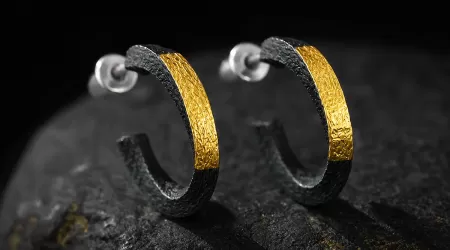
Consider the Mobius black hoop earring. Its current product page identifies an oxidized 999 fine-silver body, 24K gold inlay and an S925 silver push-back closure. This is useful construction information: a future jeweler or refiner can see that the item is not a single uniform alloy.
It does not prove recycled content, a specific recovery yield or automatic acceptance by a recycler. The example shows why buyers should preserve product records and why sellers should disclose body metal, closure material, inlay and finish separately. Our earring product-page checklist provides a field-by-field verification framework.
How to Handle an Unwanted Silver Earring
- Confirm it is genuinely unwanted. If the issue is a lost mate, loose back or bent component, ask whether repair, conversion to a pendant, resale or donation is realistic.
- Keep the pair, backs and records together. Product pages, receipts, hallmark photos and disclosed materials can help a jeweler or buyer assess the item.
- Do not remove stones or inlay blindly. Home disassembly can damage recoverable material, destroy reusable parts or create sharp edges.
- Ask the actual destination. Use a jeweler, precious-metal buyer, mail-in refinery or local specialist that explicitly accepts silver jewelry. Ask about minimum weight, fees, assay and treatment of stones or non-silver parts.
- Do not assume curbside acceptance. Small jewelry can fall through sorting equipment, and local rules differ. Follow the program’s own instructions.
- Record what happened. If environmental claims matter to you, ask for a receipt or settlement statement rather than treating intention as proof of recycling.
How to Evaluate “Recycled Silver” Marketing
The U.S. Federal Trade Commission’s Green Guides address recycled-content claims. In simple terms, marketers should be able to substantiate how much recovered material a product contains and should qualify claims when a product is not entirely made from recycled material. A vague leaf icon, green color or “eco” label is not the same as a documented percentage or a traceable material claim.
The Responsible Jewellery Council’s Chain of Custody standard provides a more formal route for handling and trading silver with traceability and responsible-sourcing controls. Certification is not the only possible evidence, but the standard illustrates what strong evidence looks like: defined eligible material, documented origin, controls and verification. LBMA guidance adds that recycled silver supply chains still require due diligence; “recycled” is not a shortcut around origin and risk checks.
Five questions worth asking a seller
- Is the claim about the whole earring or only its silver component?
- What percentage is recycled, and is it pre-consumer, post-consumer or mixed?
- Does the supplier provide chain-of-custody or batch documentation?
- Are the post, back, solder, inlay, stones and coatings included in the claim?
- Does the seller offer repair, take-back or end-of-life guidance?
These questions align with the evidence-first approach in our guide to verifying hand-finished jewelry claims: separate the observable feature from the manufacturing or sourcing story, then ask what records support that story.
Limits: Recycling Is Not a Complete Sustainability Score
Recycling can conserve mineral resources and divert material from disposal, but it does not answer every environmental or social question. Collection distance, processing energy, refining controls, product durability, repairability and supply-chain due diligence all matter. The strongest buyer conclusion is therefore narrower than “recycled is always sustainable.”
A durable earring worn for years may deliver different value from a short-lived item even if both use the same material input. Likewise, a recycled-content claim does not by itself prove fair labor, low emissions or responsible chemical management. Treat each claim as a separate, testable statement.
Bottom Line
Sterling-silver earrings are potential precious-metal feedstock, and official statistics confirm that silver is recovered from scrap. The practical path is not the household bin: reuse or repair first, preserve material information, then use a jeweler, buyer or refiner that explicitly accepts the item. When shopping, distinguish technical recyclability from documented recycled content and broader responsible-sourcing claims. Browse the silver earrings collection for product-specific material disclosures, and rely on the individual product page—not a category-wide assumption—for construction details.
Authoritative Sources
- U.S. Geological Survey — Mineral Commodity Summaries 2026: Silver
- U.S. EPA — Recycling Basics and Benefits
- U.S. EPA — How Do I Recycle Common Recyclables?
- U.S. EPA — Scrap Metal Recycling Questions
- Federal Trade Commission — 16 CFR §260.13 Recycled Content Claims
- LBMA — Responsible Silver Guidance v2 Definitions
- Responsible Jewellery Council — Chain of Custody Standard
Leave a comment