Short answer: a green mark after wearing an earring is usually a surface deposit from a copper-containing metal reacting with moisture, air or products on the skin. It is not the same thing as allergic contact dermatitis. It also does not, by itself, prove that an earring is fake—or that it is genuine sterling silver. The colour, the symptoms, the construction of the earring and the metal touching the piercing all need to be considered separately.
This evidence-led guide explains what a green stain can and cannot tell you, how silver tarnish differs from copper-coloured residue, when itching or swelling points to a possible allergy, and how to inspect an earring without making a diagnosis from colour alone. If you are comparing materials first, start with our 925 vs 999 silver earring guide.
Three different events are often called “turning green”
People use the phrase for at least three different observations:
- A removable green or blue-green mark on the skin. This can be a transferred copper-containing corrosion product. It is a material deposit, not automatically an inflammatory skin reaction.
- Green material on the earring itself. This suggests that a copper-containing component or exposed base metal has reacted at the surface. The source might be an alloy, solder, decorative brass, or a base metal exposed after plating wears.
- Red, itchy, swollen, blistered or weeping skin. Those are symptoms, not a colour-transfer problem. They can occur with allergic contact dermatitis, irritation, friction or infection and should not be dismissed as ordinary tarnish.
The distinction matters because each event calls for a different response. A stain may wash away. A damaged finish needs inspection. A symptomatic piercing may need the jewelry removed and assessment by a qualified piercer, dermatologist or other healthcare professional.
What copper chemistry can explain
The Royal Society of Chemistry explains that copper jewelry can react with oxygen and sweat to form compounds with a green tinge that can rub onto skin. Salt water, sulfur-containing pollutants and skin chemistry can produce different copper compounds, so the exact surface chemistry is more complicated than the popular shortcut “copper plus sweat equals one specific green compound.” The defensible conclusion is narrower: copper-containing surfaces can produce coloured corrosion products under moist, reactive conditions.
That mechanism can be relevant to sterling silver because sterling is an alloy rather than pure silver. The U.S. Federal Trade Commission states that an item described as “sterling silver” or “solid silver” should contain at least 925 parts pure silver per thousand. The remaining fraction is other metal, but a 925 mark alone does not identify every alloying metal, solder, post, backing or decorative component in the finished earring.
What a green mark proves: very little by itself. It is consistent with contact with a copper-containing surface, but it does not identify the complete alloy, authenticate a hallmark or establish an allergy.
Why silver tarnish is usually dark, not green
Silver has its own surface reaction. The Canadian Conservation Institute reports that silver exposed to sulfur-containing gases discolours and darkens as a surface layer of tarnish forms; dark tarnish consists mainly of silver sulfide. Thin layers can show intermediate colours before becoming dark.
This is why “the silver turned black” and “my skin turned green” should not be treated as interchangeable claims. A darkened silver surface may be silver tarnish. A green transferred residue points more strongly toward copper-containing material somewhere in the contact system. Mixed-metal earrings can show both processes, and an intentionally oxidized finish can be dark by design.
Cleaning also needs to match the construction. The Canadian Conservation Institute warns that polishing removes some material and may damage plating, gilding, inlays and deliberately patinated areas. For an oxidized or mixed-finish design, use the maker’s instructions rather than an aggressive dip. Our guide to caring for oxidized silver earrings explains that distinction in practical terms.
Green stain versus metal allergy
| Observation | More consistent with | What it does not establish |
|---|---|---|
| Green or blue-green colour that transfers to otherwise comfortable skin | A surface deposit from a copper-containing material | It does not prove the item is fake, safe or allergen-free. |
| Dark grey or black change on a silver surface | Silver tarnish, often involving sulfur compounds | It does not by itself identify the alloy or indicate an allergy. |
| Intense itching, redness, blistering or a persistent dry thickened patch | Possible allergic contact dermatitis | Colour alone cannot identify the responsible metal. |
| Pain, heat, spreading redness, pus, crusting or a damaged piercing | Possible infection, injury or severe irritation | This should not be managed as a cosmetic stain. |
DermNet identifies nickel and cobalt as leading causes of jewelry allergy. It describes typical nickel dermatitis as intensely itchy skin that may become red and blistered acutely or dry, thickened and pigmented over time. DermNet also notes that not every reaction beneath jewelry is allergic: friction, trapped soap and water, dirt, non-metal components and infection can produce other problems.
A 2025 retrospective study from Tokushima University Hospital adds useful—but limited—evidence. Among 1,085 patients referred to a specialist dental metal-allergy clinic, a history of inflammation from pierced earrings was associated with a higher rate of positive metal patch tests. Because this was a selected clinic population, the percentages must not be used as the prevalence of metal allergy among all earring wearers. The study supports taking inflammation seriously; it does not make a green stain a diagnostic test.
Why the post, backing and solder matter
The visible front is not the only skin-contact component. An earring may combine a silver face with a separate post, hinge, solder, backing, plated accent or base-metal finding. A “925” description of the main body does not automatically document every one of those parts.
European nickel controls illustrate why release matters more than appearance. European Chemicals Agency guidance on the REACH nickel restriction discusses release limits for articles in prolonged skin contact and a stricter limit for post assemblies inserted into pierced ears or other pierced parts of the body. A silver-coloured surface therefore is not evidence that an item releases no nickel. For a person with a confirmed nickel allergy, documented material and release information is more useful than colour or a generic “hypoallergenic” label.
A six-step check when an earring leaves a green mark
- Remove the earring and inspect the skin. If there is itching, pain, swelling, blistering, heat, discharge or broken tissue, stop treating the issue as simple colour transfer.
- Wash the mark gently. Note whether the colour comes away without scrubbing and whether symptoms remain after the deposit is gone.
- Inspect every contact surface. Look at the post, hinge, hook, backing and solder points—not only the decorative face. Check for exposed yellow or reddish metal, flaking plating, roughness and green residue.
- Review the actual material description. “Silver tone,” “silver plated,” “925 sterling silver” and “999 fine silver” describe different things. Ask the seller what the post and backing are made from if that information is missing.
- Consider exposure. Sweat, humidity, swimming, bathing, perfume, cosmetics and cleaning products can change a metal surface or trap irritants against the skin.
- Escalate persistent symptoms. Patch testing performed by a clinician—not a skin stain—is the established way to investigate allergic contact dermatitis. Seek medical care promptly for signs of infection or significant tissue damage.
What 925 and 999 can—and cannot—predict
A 999 fine-silver body contains more silver and less alloying metal than a 925 sterling-silver body. That compositional difference can change hardness, finishing choices and the amount of non-silver metal in the main component. It still does not certify the complete earring as allergy-proof, because posts, backs, solder and decorative elements may differ.
For a verified 925 example, the Wish Stone Sun Hoop is described as an oxidized S925 sterling-silver structure with a gold-tone electroplated sun detail. Its dark recesses are intentional, so an abrasive polish or silver dip could remove the designed contrast or affect the plated accent.
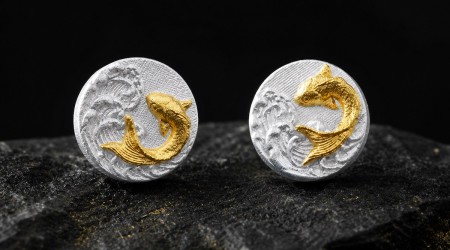
For a verified fine-silver example, the Koi Fish Stud is described as a 999 fine-silver face with raised 24K gold inlay, a straight post and a push-back closure. The page does not claim that every component is suitable for every metal-sensitive wearer. That is the correct evidence boundary: describe what is documented and ask for more detail when the specific contact component matters.
You can compare the wider range of documented constructions in the silver earrings collection. If your main concern is irritation rather than colour transfer, read the separate evidence review, Are Sterling Silver Earrings Good for Sensitive Ears?
Claims this evidence does not support
- A green mark does not authenticate sterling silver.
- A 925 stamp does not prove that every component is nickel-free.
- No silver grade is universally “hypoallergenic.”
- Tarnish resistance is not the same property as allergy risk.
- A temporary stain should not be used to rule out a separate rash, injury or infection.
- Home observations cannot replace clinical patch testing when allergic contact dermatitis is suspected.
Conclusion
When earrings turn skin green, begin with observation rather than a verdict. A removable green deposit is compatible with copper-containing surface chemistry. Dark silver tarnish is usually a different sulfur-related process. Itching, redness, blistering, swelling or discharge moves the question from appearance to skin health. Material labels, construction details and the condition of the post and backing are more informative than colour alone.
The safest buying standard is equally straightforward: require precise material descriptions, avoid universal comfort or allergy promises, and match care to the actual finish. Evidence can explain the possibilities; it cannot turn one green mark into a complete assay or diagnosis.
Authoritative sources and evidence limits
- U.S. Federal Trade Commission — Buying Platinum, Gold, and Silver Jewelry: consumer definitions and marking guidance for sterling silver and precious-metal products.
- Royal Society of Chemistry — Why does copper jewellery turn your skin green?: accessible explanation of copper surface reactions and transferred green compounds.
- Canadian Conservation Institute — Understanding how silver objects tarnish: sulfur exposure and silver-tarnish chemistry.
- Canadian Conservation Institute — Silver: Care and Tarnish Removal: construction-sensitive cleaning limits and the material loss caused by polishing.
- DermNet — Jewellery allergy and DermNet — Nickel allergy: clinical distinctions among allergic dermatitis, irritation and other reactions.
- European Chemicals Agency — Nickel restriction and prolonged skin contact: regulatory context for nickel release from skin-contact articles and pierced-post assemblies.
- Tajima et al., Scientific Reports (2025) — pierced earrings and metal allergy in a specialist-clinic population: observational association, not general-population prevalence or proof of causation.
Editorial note: This article distinguishes documented material chemistry from clinical diagnosis. It is general educational information and is not a substitute for individualized medical assessment.
Leave a comment