Do not put silver earrings in an ultrasonic cleaner just because they are marked 925 or 999. The decision depends on the entire earring: stones and their treatments, settings, surface finishes, joins and the cleaning solution. If any of these are unknown, keep the earrings out of the machine until the maker or a qualified jeweler has assessed them.
This is a guide to deciding whether machine cleaning is appropriate, not a universal cleaning recipe. A cleaner advertised for jewelry does not establish compatibility with every item you own.
What ultrasonic cleaning does—and what it does not establish
GIA explains that ultrasonic equipment uses sound waves in liquid to dislodge dirt from difficult-to-reach areas. Its general guidance warns that vibration can loosen stones and that some solutions can damage delicate gems or finishes. A successful-looking cleaning cycle is therefore not proof that the setting and surface remain unchanged. See GIA's ultrasonic-cleaner guidance.
Separate three questions: Is the material suitable? Is the assembled piece in sound condition? Is this particular machine-and-solution procedure approved for it? A yes to the first question is not a yes to all three. This guide makes no claim that a household jewelry cleaner sterilizes earrings or makes jewelry suitable for a new piercing.
A material-by-material decision framework
Opal: choose a non-machine care route
GIA's opal care guide identifies heat and sudden temperature changes as fracture risks and recommends warm, soapy water for cleaning. It also notes that opals can receive treatments. That is not permission to soak every assembled opal earring: the construction and any other materials still need their own assessment. For an item sold as an opal doublet or triplet, do not assume the same handling as an unassembled stone.
Ruby: the treatment matters
The name ruby alone is insufficient. GIA's ruby-specific care guide says ultrasonic cleaning is usually safe for untreated, heat-treated and lattice-diffusion-treated stones, while fracture-filled, cavity-filled or dyed material should be cleaned only with a damp cloth. This is more specific than the broad caution about heat-treated gems in its general ultrasonic article. It remains guidance about the stone, not an automatic approval of a particular earring setting.
Diamond: hardness does not approve the mounting
GIA's diamond cleaning guidance warns about loose mountings, touching stone edges, inclusions and fracture filling. The practical lesson is that resistance to scratching and suitability for machine cleaning are different questions. Diamond examples here illustrate the decision process; they are not a claim that a pictured Skullearring product contains diamond.
Plain, oxidized or mixed-metal silver
For metal objects, the Canadian Conservation Institute recommends examining construction and looking for gilding or inlays before treatment. Its silver care note distinguishes washing away residues from removing tarnish and explains that polishing can remove silver and leave fine scratches. This museum guidance supports careful assessment; it is not an ultrasonic approval for modern earrings.
An intentionally dark finish is part of the design you may want to preserve. Do not treat every dark recess as unwanted dirt. If the actual question is how to preserve that finish, use the separate oxidized-silver care guide rather than escalating to a stronger machine cycle.
How this applies to 24K gold-inlay initial studs
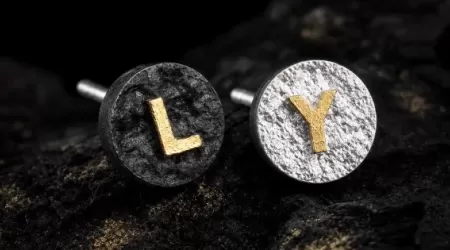
The personalized initial stud product is described as 999 fine silver with 24K gold inlay. Those specifications identify the advertised materials; they do not certify ultrasonic compatibility. Do not infer an approved cleaning time, solution or temperature from the purity numbers or the product photograph.
When asking about care, identify the exact model and whether the finish has changed or the item has been repaired. Ask for instructions for the assembled stud, including the letter detail and back, rather than instructions for silver in general. The same purchasing discipline applies across the silver earrings collection.
A short checklist before any machine cycle
- Identify the complete item. Record the model, metals, stones, disclosed treatments and finish. Mark unknowns as unknown; do not guess from color.
- Check its condition. A loose stone, damaged post or uncertain repair is a reason for professional inspection, not a reason to try cleaning first.
- Get item-specific instructions. Ask whether ultrasonic cleaning is permitted for this exact construction. If permitted, follow both those instructions and the equipment guidance; this article supplies no substitute settings.
- Choose restraint when information is missing. Postpone machine cleaning. Ask the maker what limited surface cleaning is appropriate instead of experimenting with heat or concentrated solutions.
- Inspect afterward. If cleaning has been approved and performed, check the appearance and security of components before wearing the earrings again. A changed or loose part needs assessment.
Evidence limits and the takeaway
The sources above are institutional gem-care and conservation guidance, not tests of every Skullearring design or household cleaner. They support a conditional decision, not a promise that all silver is safe or that all machine cleaning is harmful. The most useful rule is to approve the complete earring and the procedure together. Until that information is available, do not use the metal stamp as a shortcut.
Leave a comment