Short answer: Medusa earrings can refer to a documented ancient image—the Gorgon's face, or gorgoneion—that appeared on buildings, armor, vessels and jewelry. In some Greek and Roman contexts it was used as an apotropaic image intended to repel danger. A modern wearer may instead choose Medusa for its confrontational gaze, snake imagery, art history or personal meaning. That history does not prove that an earring physically protects its wearer or produces confidence, healing, luck or energy.
What is a gorgoneion?
A gorgoneion is the isolated head or face of a Gorgon, most often identified with Medusa. The Metropolitan Museum of Art's study of Medusa in ancient Greek art records the motif across architecture, pottery, metalwork, jewelry and armor. It was recognizable not only through snakes but also through a direct, frontal gaze that confronts the viewer.
The word matters because a piece of Medusa jewelry is not necessarily illustrating the whole narrative of Perseus. It may use only the face, snakes or outward stare as a compact visual sign. Describing the motif accurately is more useful than assigning it one universal spiritual meaning.
Evidence at a glance
| Question | Evidence level | Careful conclusion |
|---|---|---|
| Was Medusa used in ancient jewelry? | Strong museum-object evidence | Yes. Surviving pendants and museum scholarship document the motif in personal ornament. |
| Could the Gorgon face have a protective role? | Strong contextual evidence for particular ancient settings | Yes, as an apotropaic image intended to repel danger; this is a historical interpretation, not a measurable product effect. |
| Did Medusa always look the same? | Contradicted by the art record | No. Representations changed from grotesque and monstrous to more humanized or beautiful forms. |
| Does every Medusa earring have one fixed meaning? | Not supported | No. Object, period, maker and wearer change the context. |
| Do Medusa earrings cause protection, confidence or healing? | No reliable causal evidence in the reviewed sources | Treat these as personal belief or marketing unless supported by appropriate evidence. |
The ancient story behind the image
In the mythic tradition, Medusa is one of the Gorgons and the only mortal sister. A surviving account in Apollodorus, preserved by the Tufts University Perseus Digital Library, describes Perseus approaching while the Gorgons slept, viewing Medusa indirectly in a reflective shield and later giving her head to Athena.
This is one influential literary version, not a complete statement of every ancient account. Greek and Roman writers and artists changed details across time. A responsible interpretation should therefore avoid presenting one modern retelling as the only original myth.
Why the Medusa face was placed on armor and buildings
The Met explains that gorgoneia appeared on temple decoration, shields, helmets, greaves and Athena's aegis. Their threatening face could serve an apotropaic role: a fearsome image was used to confront or repel another threat. The Getty's catalogue of a Roman mosaic floor with Medusa likewise describes the Gorgon head as a popular protective device in Greek art, while noting that Roman examples could also be decorative.
"Protective" here describes an ancient cultural function or belief. It does not establish that a modern earring prevents injury, illness, bad luck or other harm. Historical evidence can verify how an image was used without verifying a supernatural effect.
Medusa changed from monster to humanized figure
There is no single timeless Medusa face. The Met records early Archaic images with wide eyes, sharp teeth, a protruding tongue and sometimes a beard. Classical and Hellenistic artists increasingly humanized the face while retaining the frontal gaze, wild hair, wings or snakes. The Getty mosaic catalogue records a similar movement toward a clearly female and sometimes beautiful Roman Medusa.
This visual change is important for jewelry. A fierce mask, a composed face and a snake-only design may all point toward the Medusa tradition, yet they produce different modern impressions. Calling all three "protection symbols" would erase much of the historical and design evidence.
Direct evidence that the motif entered jewelry
The Met holds a Greek Cypriot gold pendant in the form of a gorgoneion, dated to about 450 BCE. Its record describes enamel details and fine granulation. The British Museum also catalogs a pendant-like object carrying a Medusa head.
These objects show that wearing the Gorgon face is not a purely modern fashion invention. They do not prove that every wearer shared the same intention, and they do not make a contemporary silver snake stud a replica of an ancient pendant.
A mirror makes the meaning more complicated
The Getty preserves a South Italian bronze mirror decorated with Medusa, dated about 500–480 BCE. A mirror is especially suggestive because reflected vision is central to the Perseus story, but the museum invites interpretation rather than declaring one exclusive reason for the design.
This is a useful model for reading earrings. Begin with what is visible and documented, then identify where interpretation starts. A frontal face, snakes, a circular setting and a reflective metal surface can all shape meaning without giving the object a single mandatory message.
What Medusa earrings can mean today
Modern meaning is often personal. A wearer might choose the image for one or more of these reasons:
- Art history: a connection to Greek, Roman or later Western representations.
- Confrontation: the direct outward gaze and refusal to look away.
- Danger and beauty: the long visual shift between monstrous and humanized forms.
- Snake imagery: an interest in serpentine design independent of the whole Medusa narrative.
- Personal reclamation: a modern, individual reading of power, survival or identity.
The last category is valid as personal expression, but it should be labeled that way. A personal or contemporary interpretation is not automatically an ancient universal meaning.
Medusa, snakes and the limits of overlap
Medusa imagery and snake symbolism intersect, but they are not interchangeable. Snakes have separate histories in many cultures, religions and artistic systems. The broader evidence-based guide to snake earrings meaning covers that wider field. This article stays with the Greek and Roman Gorgon tradition.
For shopping, the Snake Earrings collection groups designs by visible serpentine form. A category label describes the design family; it does not assign one belief to every product or buyer.
Applying the framework to Skullearring's blue-topaz snake studs
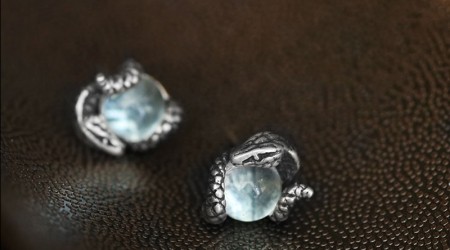
The live product record for the blue topaz snake stud earrings in 925 sterling silver verifies a coiled-snake setting, stud format, the catalog's blue-topaz identification and model SED-02. The design can support a personal Medusa interpretation because of its serpent form and product history, but the listing does not establish that it reproduces a specific ancient artifact.
The current record does not verify whether the blue stone is natural or laboratory-created, whether it was treated, its origin, carat weight, dimensions or an independent laboratory report. This article does not infer those facts from color or photographs. Ask for any specification essential to your purchase.
How to evaluate a Medusa-inspired earring
- Identify the motif: full face, gorgoneion, snakes, wings or only a general serpent form.
- Separate history from modern interpretation: ask which claim is documented and which is personal.
- Verify the metal: confirm whether the listing states 925 sterling silver, 999 fine silver, gold inlay, plating or another construction.
- Verify stones: ask for identity, treatment, dimensions and laboratory documentation where relevant.
- Check quantity and fit: confirm one earring versus a pair, post style, dimensions and weight.
- Read care and return terms: symbolism cannot substitute for product specifications.
What the evidence does not support
The museum, archaeological and literary sources reviewed here do not establish that wearing Medusa earrings:
- creates a physical shield or prevents danger;
- heals illness or changes bodily energy;
- guarantees courage, confidence or emotional recovery;
- attracts wealth, luck or romantic outcomes; or
- has one meaning shared by every culture and wearer.
Ancient apotropaic use is historically important. It should be reported as an ancient function or belief, not converted into a modern performance claim.
Frequently asked questions
Do Medusa earrings symbolize protection?
They can reference an ancient apotropaic tradition in which the Gorgon face was used to repel danger. That historical association does not prove that a modern earring provides literal protection.
Are Medusa and snake earrings the same?
No. Medusa is a specific figure in Greek mythology and art. A snake earring may have no Medusa reference at all, while a Medusa image can include a face, gaze, wings and other attributes in addition to snakes.
Were Gorgon images actually worn as jewelry?
Yes. Museum collections include ancient pendants with the Gorgon face, and The Met documents Medusa imagery on earrings, pendants and rings. The meaning of any specific object still depends on its context.
Does Medusa have one feminist meaning?
No single interpretation covers every ancient object or modern wearer. Feminist and reclamation readings can be meaningful contemporary interpretations, but they should not be mislabeled as the only ancient meaning.
What should I verify before buying Medusa earrings?
Verify the metal, quantity, dimensions, weight, closure, gemstone identity and treatment, care instructions and return terms. Treat symbolic language separately from those product facts.
Limitations
This article is an evidence review and buying framework, not a complete history of every Medusa tradition. Museum objects document particular places, periods and materials; they cannot prove what every ancient wearer believed. Literary versions differ. Modern meanings are often personal. None of the cited institutions endorses Skullearring or its products.
Conclusion
Medusa earrings can connect a modern design to the ancient gorgoneion, a confrontational face that moved across buildings, armor, domestic objects and jewelry. In some ancient contexts the image was apotropaic; in others it became decorative, humanized or newly interpreted. The most responsible modern answer separates that documented history from personal symbolism and from unsupported claims about protection or other effects.
Sources
- The Metropolitan Museum of Art — Medusa in Ancient Greek Art
- The Metropolitan Museum of Art — Gold Pendant in the Form of a Gorgoneion
- J. Paul Getty Museum — Mosaic Floor with Head of Medusa
- J. Paul Getty Museum — Hand Mirror Decorated with Medusa
- British Museum — Pendant / Seal with Head of Medusa
- Tufts University Perseus Digital Library — Apollodorus, Library 2.4
- Uffizi Galleries — Caravaggio and the 17th Century
What is gorgoneion jewellery?
Gorgoneion jewellery uses the isolated face or head of a Gorgon—most often Medusa—as the ornament. Museum evidence documents the motif in ancient personal adornment and other objects. The term identifies the image; it does not prove that every modern piece has the same protective, spiritual or personal meaning.
Leave a comment