Can you wear earrings in a passport photo? Often yes, but the answer depends on the authority issuing the passport and on what the earrings do in the image. The United States explicitly allows jewellery and facial piercings when they do not hide the face. Australia permits usual jewellery or piercings only when they do not obscure the face and adds that rings or studs must not create reflections. Other authorities emphasize a fully visible face, clear eyes, even lighting and no glare or shadows rather than giving every earring a blanket approval.
The practical rule is simple: check the current instructions for your passport authority, then remove the earrings if they cover any facial feature, cast a shadow, create a bright reflection or make the photographer doubt compliance. This page compares government guidance retrieved on 19 September 2026. It cannot guarantee that a particular photo or earring will be accepted.
Passport-photo earring rules at a glance
| Authority | What the official page says | Practical earring decision |
|---|---|---|
| United States | Jewellery and facial piercings can remain if they do not hide the face. | Keep them only when the full face stays visible; remove headphones or wireless hands-free devices. |
| Australia | Usual jewellery or piercings must not obscure the face, and rings or studs must not create reflections. | Remove reflective or face-obscuring pieces before the photograph. |
| United Kingdom | The face and eyes must be visible, without face-covering objects, shadows, glare or reflections. | No blanket earring approval is stated; use visibility and lighting as the decision test. |
| Canada | Face edges must be visible, with uniform lighting and no shadows, glare or flash reflections. | No blanket earring approval is stated; remove a piece that compromises those requirements. |
| New Zealand | The face must be fully visible; glare, reflection and image alteration are restricted. | Use a compliant, undistorted image and remove jewellery that interferes. |
These are passport-photo summaries, not rules for visas, residence cards, driving licences or workplace identification. Those documents can have different instructions.
United States: jewellery is allowed when it does not hide the face
The U.S. Department of State directly says that jewellery and facial piercings may be worn as long as they do not hide the face. Its page also requires the full face to be visible and free of blocking shadows. That makes the rule conditional, not an approval of every size, position or finish.
The same page separates jewellery from headphones and wireless hands-free devices, which are not allowed in or on the ears. Do not assume that an earbud qualifies as an earring because it occupies a similar location. See the U.S. Department of State passport-photo rules.
Australia: watch both obstruction and reflection
The Australian Passport Office is more specific about jewellery. If you usually wear jewellery or have a piercing, it must not obscure any part of the face, particularly around the eyes, mouth and nose. The guidance also says there must be no reflection from rings or studs.
A tiny stud is not automatically reflection-free. A polished or gold-coloured detail can catch a lamp or flash depending on angle. Review the actual photograph rather than judging only from the earring's size, and follow the photographer's direction. See the Australian Passport Office photo guidelines.
UK, Canada and New Zealand: apply the visibility test
GOV.UK requires a clear, unaltered image with the subject facing forward, eyes visible and nothing covering the face. It also warns about glare, reflection and shadows. The public page does not create a separate universal rule declaring all earrings acceptable. Read the UK digital passport-photo rules.
Canada requires the face and shoulders to be centred and squared to the camera, the edges of the face visible, and the lighting free of shadows, glare and flash reflections. It also rejects edited images, including AI changes. Those requirements provide the useful test for an earring even though the page does not explicitly approve every jewellery style. Read the Canadian passport-photo requirements.
New Zealand likewise requires a fully visible face, warns against glare or reflection, rejects selfies and prohibits filters, edits and AI tools that change appearance. See New Zealand Passports photo guidance. None of these pages supports a claim that a product sold online is automatically “passport approved.”
When removing earrings is the lower-risk choice
- The earring covers part of the face: this can include a large hoop, long drop or facial piercing positioned across a feature.
- It creates a bright highlight: polished metal, gemstones or inlay may reflect the studio light.
- It casts a visible shadow: the authority may reject uneven or obscuring facial lighting.
- It is actually an electronic device: earbuds and wireless hands-free devices are treated separately from ordinary jewellery.
- The photographer or application service asks for removal: they can assess the image being submitted, while a retailer cannot.
If you remove an earring, do not digitally erase it from the image or reconstruct an ear with an editing tool. Government pages repeatedly require an unaltered photograph. Retake the photo instead.
Small studs can still fail because of light
“Small” and “compliant” are not synonyms. A stud can leave the face unobstructed yet still create a specular reflection. Conversely, a visible earring is not necessarily a problem if the authority allows jewellery and the full face remains clear. The submitted image—not a marketing label—controls the decision.
Before submission, inspect the photograph at normal size for a white hotspot beside the ear, a shadow across the cheek or jaw, a covered facial edge and any apparent distortion. Do not retouch those problems. Change the lighting, angle or jewellery and take a new photograph according to the authority's instructions.
A real style example, without an acceptance claim
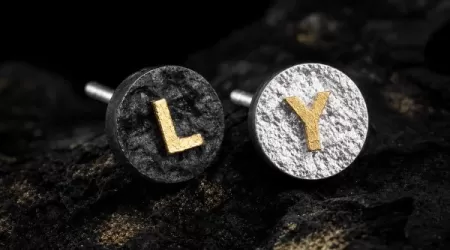
Our Personalized Initial Stud Earrings are described on the product page as 999 fine silver discs with 24K gold letter inlay. The currently listed letters are L, Z, N, W, M, Y, C, X, H, S, J, G, O and Q, rather than a verified full alphabet. They can be considered as a style example for a personalized stud, but they are not certified by a passport authority.
The listing does not currently verify dimensions, weight, post material, back material or reflection performance. Do not infer photo compliance from the word “stud” or from the product image. For a separate explanation of photographing reflective inlay honestly, read our 24K gold-inlay photography guide. For ordering details, use the custom initial earring checklist.
A five-step passport-photo check
- Open the current photo instructions from the authority issuing your passport.
- Tell the photographer which authority and application route you are using.
- Take a test image with the jewellery in place.
- Check face visibility, facial edges, shadows and reflections at normal viewing size.
- If any requirement is uncertain, remove the jewellery and retake the photo rather than editing it.
Keep the official page open until submission because rules and digital-upload processes can change. A photo-shop check can reduce avoidable errors, but final acceptance belongs to the passport authority.
Conclusion
You can often wear earrings in a passport photo, but there is no worldwide unconditional rule. The United States expressly allows jewellery that does not hide the face; Australia adds a no-reflection condition for rings and studs. UK, Canadian and New Zealand guidance focuses on a fully visible, evenly lit and unaltered face. When an earring obstructs, reflects, casts a shadow or creates uncertainty, removing it and retaking the photograph is the clearer choice.
This comparison is informational and was checked on 19 September 2026. Always follow the live instructions for your issuing authority and application type.
Leave a comment