SYMBOLISM & DESIGN · EVIDENCE-REVIEWED 20 JULY 2026
Quick answer
Snake earrings do not have one universal meaning. Museum objects and historical sources connect serpents with ideas such as protection, renewal, sovereignty or eternity in specific cultures and periods, while a modern wearer may choose the form for entirely personal reasons.
The short answer: snake earrings do not have one universal meaning. In different places and periods, serpent jewelry has been connected with healing, eternity, protection, status, romance, danger, good luck or personal identity. Those meanings belong to particular cultural and historical contexts; wearing a snake earring does not make any promised effect occur. The most accurate modern meaning is the one a wearer chooses after understanding the motif's layered history.
Does a snake earring have a fixed meaning?
No. A symbol is not a universal dictionary entry. A coiled serpent in a Classical Greek silver bracelet, a circular snake in a nineteenth-century British brooch and a striking serpent in a Mexica lip ornament come from different systems of belief, power and dress. They share an animal form, but not necessarily an identical message.
This matters because many modern jewelry guides flatten the serpent into a short list—“rebirth, wisdom, protection”—without showing where each interpretation comes from. A stronger reading asks four questions: Which culture? Which date? Which object? Which source makes the interpretation? If those questions cannot be answered, the meaning is better described as a contemporary personal association rather than an established historical fact.
| Claim | What the evidence can support | What it cannot prove |
|---|---|---|
| “Snakes mean transformation.” | Snakes biologically shed an outer skin, and modern wearers often use that visible cycle as a metaphor for change. | That every historical snake jewel represented rebirth. |
| “Snake jewelry is protective.” | Some cultures and objects gave serpents protective or guardian roles. | That an earring physically protects its wearer. |
| “The serpent is a healing symbol.” | The Met notes healing associations with snakes in Greek culture. | That silver snake earrings treat infection, pain or illness. |
| “A circular snake means eternity.” | British Museum curatorial notes identify a circular snake brooch as a symbol of eternity; ouroboros forms also appear in historic jewelry designs. | That every coiled or circular snake was intended as an ouroboros. |
| “Snake jewelry means romance.” | Serpent jewelry became fashionable in the 1840s, and the V&A records Prince Albert's serpent engagement ring for Queen Victoria. | That romance is the primary meaning in all periods or cultures. |
A documented history of the serpent in jewelry
Classical Greek silver: the animal becomes the terminal
A pair of Greek silver bracelets in The Metropolitan Museum of Art dates to the late sixth–fifth century BCE and ends in carefully formed snakes' heads. The animal is not merely stamped onto a flat surface: the bracelet itself becomes a serpent-like curve. This is an important design idea for modern jewelry. The snake's long body naturally translates into a hoop, coil, hook or line that follows the body of the wearer.
The object proves that snake-headed silver adornment existed in Classical Greece. It does not come with a surviving statement from its original wearer. We should therefore resist assigning a single private emotion to it.
Roman and Ptolemaic contexts: movement across regions
The Met's first-century CE gold snake bracelet from Egypt adds useful historical caution. Its curatorial record explains that snake jewelry was not traditionally Egyptian before the Ptolemaic period; animal-ended bracelets appeared in Western Asia, spread to Greece and later reached Egypt. The museum notes healing associations in Greek culture while acknowledging that other associations may also have existed.
This movement matters. Symbols travel through trade, conquest, fashion and workshop practice. When a serpent form appears in a new region, its meaning may be adopted, revised or appreciated simply because its shape works beautifully as jewelry.
Body jewelry and power: a Mexica serpent labret
A fifteenth- to early-sixteenth-century Mexica gold labret in The Met shows a serpent ready to strike. A labret is worn through a piercing below the lower lip, not in the ear. The museum explains that this form of jewelry drew attention to the mouth as a locus of power. This is a valuable reminder that placement changes meaning: the same animal near the mouth, wrist, neck or ear participates in a different relationship with the body.
It would be inaccurate to borrow the labret's political and ceremonial meaning and apply it wholesale to a modern commercial earring. Its value here is comparative: it demonstrates how specifically a serpent ornament can be tied to the identity, status and bodily location of its original wearer.
The ouroboros in jewelry design
The ouroboros is a serpent shown consuming its own tail, making a closed loop. A V&A jewelry-design album made by Arnold Lulls between about 1585 and 1640 includes designs for a pendant and earrings with loops in the form of a snake swallowing its tail. A later British Museum brooch, dated about 1800–1830, forms a snake into a circle; the museum's catalogue identifies this circular snake as a symbol of eternity.
Shape is the key evidence. A simple coil is not automatically an ouroboros. Look for the head meeting or taking the tail. If that visual relationship is absent, “circular serpent” is more accurate than confidently calling the piece an eternity symbol.
Victorian romance—and the danger of treating one fashion as universal
The Victoria and Albert Museum records that snake motifs were especially fashionable in the 1840s and that Prince Albert gave Queen Victoria an emerald ring in the shape of a serpent for their engagement. Royal visibility helped connect the serpent with romantic jewelry in nineteenth-century Britain.
This is real historical context, but it is one context. A modern snake earring may reference Victorian romance, an older archaeological form, contemporary gothic style, the movement of the animal, or no symbolism at all. “I like the design” is a complete and legitimate reason to wear it.
Modern jewelry: engineering and personal narrative
The British Museum's 1974 Elsa Peretti snake necklace shows how modern meaning can begin with an individual encounter. Its curatorial record says the idea came from a rattlesnake tail given to Peretti as a good-luck charm. The finished necklace uses 191 moving parts and requires multiple specialist operations to preserve a fluid, flexible body.
Here, symbolism and engineering are inseparable. The personal charm explains the starting idea; the construction makes the snake appear alive in motion. For contemporary earrings, texture, articulation, orientation and the relationship between head and tail can communicate as much as a written symbolic label.
Six meanings people may choose today
1. Change or renewal
Snakes undergo ecdysis, shedding an outer layer of skin. The U.S. National Park Service describes this biological process as growth-related skin replacement, not as a spiritual event. Transformation is therefore a metaphor a wearer may choose; it should not be presented as a scientifically proven power of the jewelry.
2. Continuity or eternity
This reading is strongest when the design is a true ouroboros or clearly closed serpent circle. It can be used to mark a long relationship, a recurring life pattern or continuity after change. The visible construction should support the interpretation.
3. Alertness, danger or self-possession
A raised head, open mouth or forward-facing snake creates visual tension. Modern wearers may read that posture as vigilance or boundary-setting. This is a design interpretation, not evidence that the object provides protection.
4. Healing as a historical reference
Serpents occur in historical healing iconography, and Greek snake associations are documented by museums. But jewelry is not medicine. A snake earring must never be sold as preventing infection, reducing pain or improving a piercing.
5. Romance or commitment
Victorian serpent fashion gives a documented route to romantic meaning, especially for looped or gem-set forms. It is appropriate as a historically informed gift interpretation, not as a universal rule.
6. Personal identity without inherited symbolism
A wearer may choose a snake because they study reptiles, like dark sculptural silver, identify with a particular fictional or mythic character, or simply prefer the line of the animal. Personal meaning does not become less valid because it is recent.
How snake anatomy becomes earring design
Snake earrings are not simply miniature pictures. Designers can use the animal's anatomy to solve the geometry of an earring:
- Coil: compresses the body into a compact stud and can frame a stone or central void.
- S-curve: creates directional movement and works well for a single statement earring or an asymmetric pair.
- Head terminal: gives a hoop, hook or line a clear visual endpoint, echoing ancient animal-headed bracelets.
- Scale texture: catches light on bright silver or holds darkness in an oxidized finish.
- Stone centre or eyes: establishes hierarchy; the stone may dominate while the serpent acts as a setting.
- Head-to-tail circle: supports an ouroboros reading only when the closed relationship is actually visible.
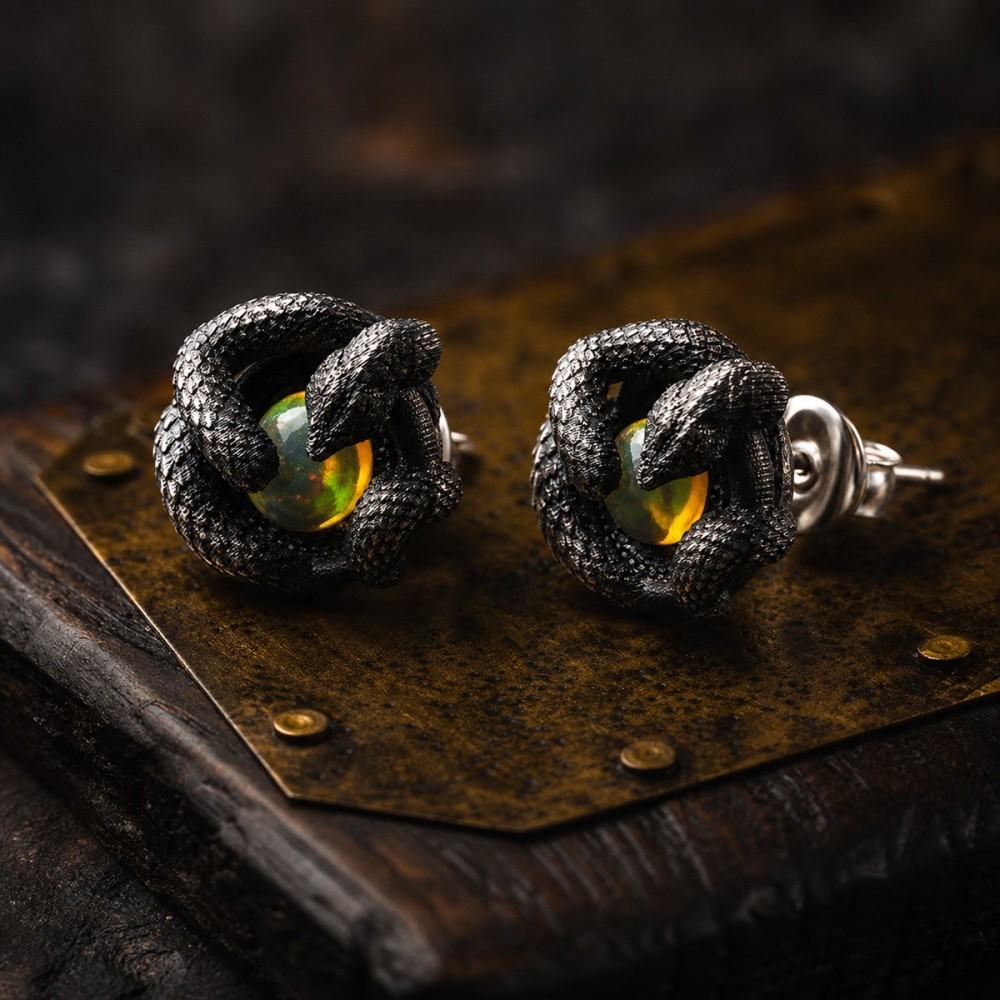
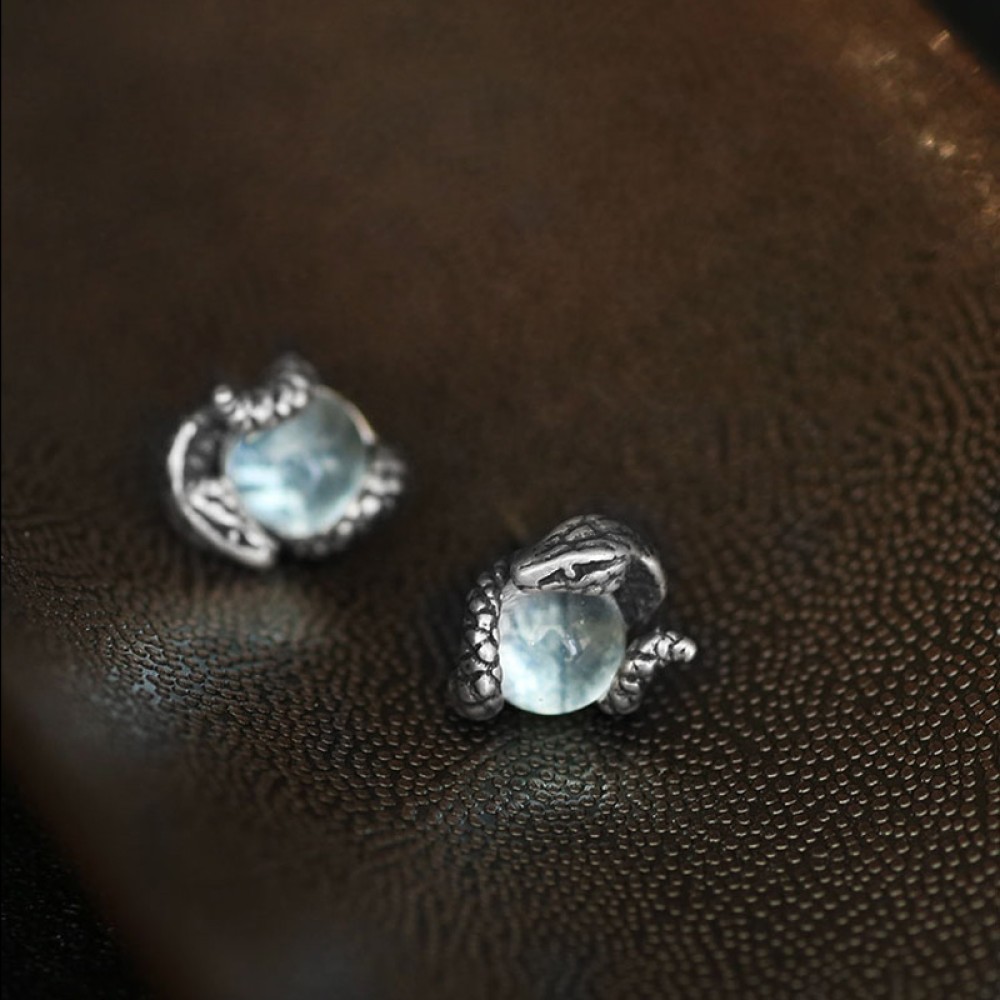
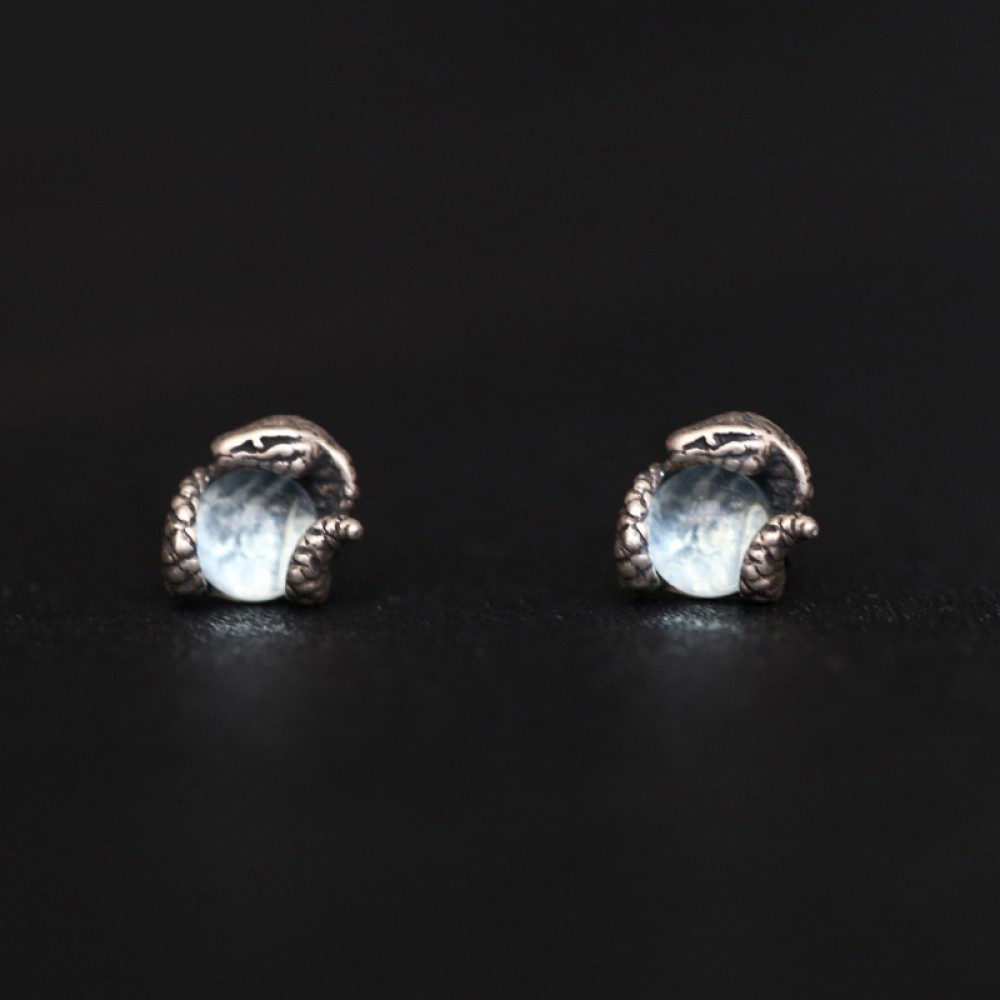
On Skullearring's natural-opal snake studs, multiple textured serpent bodies create a dark nest around the cabochon. On the 925 silver blue-topaz snake studs, the composition is more open and the pale stone becomes the centre. These are product observations based on visible construction, not claims about what opal or topaz will do for the wearer.
How to choose snake earrings without buying a story
- Start with material facts. Confirm 925 sterling or 999 fine silver, the post material, surface oxidation, stones and what is included. Use our 925 vs 999 silver guide if the fineness language is unfamiliar.
- Read the silhouette at normal distance. A motif that is obvious in a macro photograph may read as an abstract dark form on the ear. Both readings can be desirable.
- Check whether it is a single or pair. Directional snakes can work especially well asymmetrically. Our single-or-pair styling guide provides a practical framework.
- Inspect the side view and closure. Projection, post angle and back are comfort questions. Symbolism cannot compensate for poor fit.
- Choose your meaning after the form. If eternity matters, look for a real head-to-tail circle. If change matters, a visibly layered or emerging form may feel more relevant. If you want no symbolic commitment, choose by texture and proportion.
- Plan the care routine. Dark recesses may be intentional oxidation. Do not polish them away; follow the oxidized silver care guide.
Cultural context and responsible interpretation
Serpent images exist in many living religious and cultural traditions. Similar-looking snakes can carry different names, narratives and levels of sacred importance. Avoid labelling a commercial earring as a specific deity, protective emblem or Indigenous symbol unless the design and maker provide a documented connection.
The safest description begins with what can be observed: “a coiled snake,” “a head-to-tail serpent,” “a snake framing a stone,” or “an oxidized silver serpent motif.” Historical comparisons should be presented as comparisons, not claims of direct descent. This respects both the source culture and the intelligence of the buyer.
The gorgoneion is a separate but closely related Greek and Roman image tradition. For the evidence boundary between documented ancient use and modern personal interpretation, read our guide to Medusa earrings meaning.
Frequently asked questions
Do snake earrings mean evil?
Not inherently. Serpents have negative, positive and ambiguous roles across different traditions. A modern earring does not acquire one universal moral meaning simply by depicting a snake.
Do snake earrings mean rebirth?
They can, if the wearer chooses that metaphor. The association is visually understandable because snakes shed skin, but it should not be projected onto every historical serpent jewel.
Are snake earrings a protection symbol?
Some historical traditions used serpents in protective or guardian contexts. A commercial earring can reference that history but cannot be shown to provide physical or spiritual protection.
What does an ouroboros earring mean?
An ouroboros—a serpent consuming its tail—has been used as a closed-cycle or eternity image. Confirm that the design actually shows head meeting tail rather than assuming any circular snake is an ouroboros.
Can snake earrings be worn by anyone?
Style has no required gender. Choose by scale, closure, material, personal context and whether the piercing is fully healed. Browse the verified snake earrings collection or the wider silver earrings collection by construction rather than by a gender rule.
Conclusion: meaning should be sourced, not assigned
Snake jewelry has survived because the animal's body works as design and because its meanings remain unsettled. Museum records show serpent forms moving across regions, periods and types of body adornment. They also show why a single slogan is inadequate. A snake earring can carry a historically informed meaning, a private meaning or no symbolic meaning beyond admiration for the form.
The responsible choice is not to ask “What must this snake mean?” but “Which interpretation is supported by this shape, this history and my own reason for wearing it?”