Initial jewelry has no single fixed meaning. A letter can refer to the wearer, someone they love, a family connection or a private memory. Historical objects show that letters also served identification, ceremonial and commemorative purposes. The meaning depends on whose initials appear, where they appear and what the accompanying evidence says—not simply on the letter itself.
This guide uses five museum records to separate documented history from personal interpretation. The examples are rings, brooches and lockets: they provide context for wearing letters, not proof that modern initial earrings descend directly from one ancient design.
Initials, monograms and names: useful distinctions
For this guide, an initial is a letter standing for a name; a monogram is a designed combination of letters, often joined or overlapping. A written name is more explicit. These are working distinctions for reading jewelry, not a claim that every catalog or culture uses the terms identically.
A pair of earrings displaying two separate letters does not automatically form an intertwined monogram. Nor does a letter identify its owner without other evidence. The same initial may refer to different people, a chosen name or a word meaningful only to the wearer.
Five historical examples—and what they actually establish
1. A monogram could have a practical identifying role
The Metropolitan Museum of Art catalogs a seventh-century Frankish electrum signet ring with a monogram, made in northern France. Its interpretation explains that some early medieval rings were decorative, while others acted as personal seals on official documents. Names, monograms and Christian symbols could appear on signets.
The relevant distinction is between decoration and function. A letter-bearing object need not have been a romantic gift. This particular record does not establish a universal meaning for all initial jewelry, and a modern decorative stud should not be described as a working seal.
2. Even a museum reading can remain uncertain
The Walters Art Museum's Monogram Ring, accession 54.2264, is bronze that was formerly gilded. Its catalog tentatively dates it to the seventh century and reads the monogram as I N, also with a question mark, beside a cross.
Those qualifications matter. A confident story about an identified owner would exceed the evidence. For an inherited piece, keep uncertain letters and dates uncertain until provenance or specialist study resolves them.
3. Letters on a gift can belong to people other than its wearer
The V&A's research on bridesmaids' brooches describes a William Burges design associated with the 1864 wedding of John Paul Seddon and Margaret Barber. A surviving brooch has JPS and M on its back. In this setting, the couple's initials identify the wedding relationship, rather than necessarily naming the bridesmaid who received it.
That example cautions against assuming that every letter names the wearer. It also shows why the location of an inscription matters: a message on the back may be less publicly visible than the decorative front.
4. A locket can combine several forms of personal reference
Historic New England's Locket with Daguerreotype, cataloged circa 1847, combines a portrait and inscriptions. The record identifies the subject as Lucy Maria Bowen and explains HCB as the initials of her husband, Henry Chandler Bowen.
Here, the collection record supplies the relationship; the letters alone do not. A portrait, name and initials can refer to different people within one object. For a modern gift, a short explanation from the giver can preserve context that the jewelry itself cannot communicate.
5. The owner's initials and a memorial inscription can be different
The Historic Odessa Foundation records a mourning locket with intertwined MCW initials belonging to Mary Corbit Warner. The front identifies her, while inscriptions inside commemorate relatives. The foundation describes additions made at different times.
This is a specific memorial object, not evidence that all monograms signify mourning. Its value for interpretation is the distinction between the person wearing or owning a piece and the people remembered through it.
A practical framework for choosing personal meaning
- Self-reference: choose a letter connected to your own name or identity if that is what you want to express.
- Relationship: another person's initial can be a private reference, but ask whether they are comfortable with the association when that matters.
- Remembrance: you may assign a commemorative meaning without claiming that the design carries a universal memorial code.
- Visual preference: liking the shape of a letter is also a valid reason. You do not need to invent a historical explanation.
These are contemporary choices, not historical rules or promised emotional effects. The most useful question is: “What do I want this letter to refer to?” A second question—“Do I want other people to understand it?”—helps distinguish a public name reference from a deliberately private symbol.
Applying the distinction to initial stud earrings
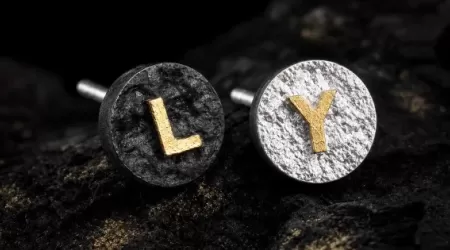
Skullearring's personalized initial studs in 999 fine silver with 24K gold inlay are a contemporary product example. The product page describes an uppercase gold letter on a silver disc, with single-stud and pair options. For a pair, the available fields allow matching or different letters. The current selectable range is limited; do not assume every alphabet character is offered.
The precious-metal description tells you about the stated construction, not the meaning of the initial. The photographed letters are not evidence of an antique origin, museum endorsement or protective power. The silver earrings collection provides other modern design contexts.
Once the personal reference is clear, use our separate guide to letter choice, direction and proofing for the order details. For a present, the custom-initial gift checklist covers specification questions. Those guides address ordering; this one explains interpretation.
Conclusion: preserve the context, not an invented rule
The strongest historical claims come from identifiable objects and their documented inscriptions. The strongest statement about your own initial earrings comes from your chosen intention. Keep the two separate: historical examples broaden the possibilities, but they do not dictate what your letters must mean.
Evidence limits: these five records are selected examples, not a complete world history of letter jewelry or a survey of present-day wearers. No claim is made that one letter guarantees love, luck, protection or any health benefit. Sources are linked beside the claims they support; product observations were checked on 14 September 2026.
Leave a comment