Short answer: lotus earrings do not have one universal meaning. In documented Buddhist art, the lotus can signify purity or spiritual perfection; in Hindu art it can be associated with beauty, divinity, fertility or prosperity; in Chinese decorative art it can carry wordplay about continuity; and in ancient Egyptian objects it can evoke new life and creation. A modern wearer may personally choose ideas such as resilience, renewal or growth, but lotus earrings do not cause luck, healing, protection, fertility or financial success.
First, what counts as a lotus?
Botanical and art-historical language do not always line up. The Royal Botanic Gardens, Kew identifies the Asian sacred lotus as Nelumbo nucifera and explains that it is not a water lily. Kew notes visible differences, including the lotus's cone-shaped central receptacle, and records the plant's long cultural importance in Asia. See Kew's sacred lotus profile.
Historical museum catalogues may use the word lotus for flowers in different regions and periods, including ancient Egyptian blue-lotus imagery. This guide therefore preserves each institution's terminology instead of pretending that every object represents the same species or belief system.
Evidence at a glance
| Documented context | What the evidence supports | What it does not prove |
|---|---|---|
| Buddhist art | Purity, spiritual perfection and associations with enlightened beings in specific objects and traditions. | That every lotus earring is Buddhist or guarantees enlightenment. |
| Hindu art | Beauty, divinity, fertility or prosperity when the lotus appears with particular deities such as Krishna or Lakshmi. | That the motif itself produces wealth or fertility. |
| Chinese decorative art | Specific visual and linguistic associations, including wordplay in an eighteenth-century print. | One fixed Chinese meaning for all lotus designs. |
| Ancient Egyptian material culture | New life and creation in a documented lotiform vessel. | That Asian sacred-lotus meanings and Egyptian flower imagery are interchangeable. |
| Modern jewelry | A wearer can choose a personal interpretation informed by history. | Medical, supernatural, financial or reproductive effects. |
Lotus meaning in Buddhist art
The best-supported broad association is purity, but it still needs a stated context. The Smithsonian National Museum of Asian Art describes a Korean roof tile whose lotus design represents purity in Buddhism. The museum also explains that the motif became popular in both religious and secular architecture during Korea's Three Kingdoms period. That is evidence of a historically widespread motif, not proof that every lotus object was used for worship.
The Metropolitan Museum of Art's educational publication on South and Southeast Asian art calls the lotus a sign of spiritual perfection. It explains the visual analogy: a blossom rises from muddy water, just as a devotee seeks transformation. The same source notes that stylized lotus petals can form a pedestal for spiritual figures. Read the Met's art-historical guide.
These records make purity and spiritual development defensible interpretations for a wearer who knowingly chooses them. They do not turn a retail earring into a sacred object, and they do not show that wearing the design changes a person's spiritual state.
Lotus meaning in Hindu art
In South Asian Hindu imagery, meaning depends on the figure, pose and surrounding objects. The Smithsonian's record for Krishna Fluting says that lotuses in South Asia can symbolize purity, beauty and divinity. The painting uses lotus forms in several places, so the interpretation belongs to an iconographic program rather than to a flower viewed in isolation.
The British Museum's catalogue for a painting of Gajalakshmi connects Lakshmi and the lotus with fertility and prosperity. The goddess holds lotus blooms and sits on another. This supports those associations for that deity and artwork. It does not establish that lotus earrings increase money, improve fertility or confer a blessing.
Chinese lotus imagery and wordplay
Chinese decorative meanings can rely on sound as well as appearance. A Qing-dynasty Lotus Flower print in the British Museum combines a lotus, bird and seed pod. The museum explains wordplay between the Chinese words for lotus and succession, and between seed and son, producing a wish for successive sons in that particular image.
That catalogue entry is valuable precisely because it is specific. The message arises from a combination of language and depicted details. A simplified flower stud without the same composition cannot automatically inherit the full wish. A modern wearer may still value continuity, family or renewal as personal readings, but should label them as interpretation rather than universal translation.
Ancient Egypt: new life and creation
The British Museum catalogues an eighteenth-dynasty lotiform goblet shaped to imitate a blue lotus. Its curatorial record associates the flower with new life and a creation account in which the sun god appeared from a flower on the primordial waters.
This is a documented Egyptian context, not a generic "rebirth" label for all lotus jewelry. It also should not be merged carelessly with Asian sacred-lotus botany or Buddhist symbolism. Comparing contexts reveals how widely aquatic flower forms were used while preserving important differences.
Compassion, benefit and another Buddhist example
The Cleveland Museum of Art's Avalokitesvara Padmapani once held a lotus that the museum connects with benefits arising from acts of loving kindness. Because Avalokitesvara is identified as a bodhisattva of compassion, the flower participates in a specific religious figure's attributes.
A wearer may choose compassion or kindness as a personal reminder. The evidence supports the historical association in this sculpture; it does not show that the jewelry itself protects, heals or changes behavior.
Why resilience and renewal are reasonable modern readings
The Smithsonian's visual introduction to the lotus form describes a plant whose stalk grows through mud and water while the blossom rests above the surface. It records hope, rebirth, resilience and enlightenment among meanings found across cultures. This physical growth pattern helps explain why modern wearers often choose resilience or renewal.
The careful conclusion is "the wearer associates the lotus with resilience," not "lotus earrings make the wearer resilient." Symbols communicate ideas; they are not mechanisms that produce outcomes.
A context-first method for interpreting lotus earrings
- Identify the actual design. A naturalistic blossom, closed bud, deity attribute and stylized petal rosette do not necessarily carry the same message.
- Name the source context. Say "in this Buddhist artwork" or "in this Qing print" instead of claiming that an entire continent agrees.
- Separate evidence from personal meaning. Museum records document earlier objects; a present-day wearer's reason can be individual.
- Do not convert association into efficacy. Historical links with prosperity, fertility or protection do not prove that jewelry causes those outcomes.
- Keep product facts separate. Material, dimensions, closure and quantity must come from the product page, not from symbolism.
Applying the framework to a real lotus earring
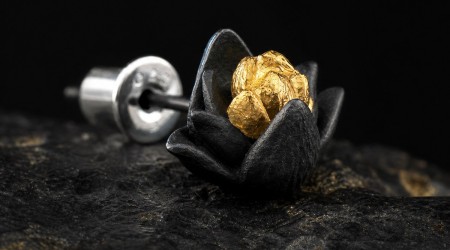
Skullearring's lotus flower stud earrings in 999 fine silver with 24K gold detail use layered, oxidized petals around a raised gold-colored center. The verified product page states an approximate 9–10 mm face, a straight post with butterfly back, and single-or-pair purchase options. Those are product facts; cultural meaning remains contextual and personal.
For shopping by material and form, browse the silver earrings collection. To understand construction language, compare gold inlay, vermeil and gold-plated silver. For a second evidence-led motif study, read what koi fish earrings mean in East Asian art contexts.
Limitations
Museum catalogue records describe particular works, not a universal dictionary. Meanings vary by species, language, region, religion, period, artist, patron and viewer. A flower may be decorative in one object and doctrinal in another. This article does not claim museum endorsement of a modern product and does not infer medical or supernatural effects.
Frequently asked questions
Do lotus earrings always mean purity?
No. Purity is well documented in specific Buddhist and South Asian contexts, but lotus imagery can also relate to divinity, compassion, fertility, prosperity, continuity, new life, creation or simple decoration.
Are lotus earrings automatically Buddhist jewelry?
No. The lotus is important in Buddhist art, but the motif also appears in Hindu, Chinese, Egyptian and secular contexts. A modern product is not automatically a religious object.
Are lotus and water lily the same plant?
No. Kew classifies sacred lotus as Nelumbo nucifera and distinguishes it from water lilies. Historical art labels may still use "lotus" differently, so each source's terminology matters.
Do lotus earrings bring luck, healing or protection?
No reliable evidence shows that wearing a lotus motif causes luck, healing, protection, prosperity, fertility or spiritual advancement. Those claims should be treated as belief or marketing, not demonstrated effects.
Conclusion
Lotus earrings can reasonably represent purity, spiritual growth, beauty, compassion, continuity, renewal or resilience when the interpretation is tied to evidence or stated as personal. The most accurate answer is plural and contextual: there is no single worldwide lotus meaning, and the jewelry does not produce the outcomes it may symbolize.
Sources
- Royal Botanic Gardens, Kew - Nelumbo nucifera
- Smithsonian National Museum of Asian Art - Lotus
- Smithsonian National Museum of Asian Art - Korean lotus roof tile
- Smithsonian National Museum of Asian Art - Krishna Fluting
- The Metropolitan Museum of Art - The Art of South and Southeast Asia
- British Museum - Qing-dynasty Lotus Flower print
- British Museum - Gajalakshmi
- British Museum - ancient Egyptian lotiform goblet
- Cleveland Museum of Art - Avalokitesvara Padmapani
Leave a comment