Short answer: koi fish earrings do not have one universal meaning. In documented Chinese, Korean and Japanese art, carp can appear as observed animals, auspicious paired fish, companions of legendary figures, or determined swimmers associated with persistence and ascent. A modern wearer may choose ideas such as perseverance, change or personal progress—but earrings do not create luck, wealth or success.
What “koi” means in this guide
Koi are ornamental forms of common carp. Museum catalogues may use koi or the broader word carp, depending on the object and its cataloguing history. This guide keeps the museum’s terminology for each work and does not assume that every carp image carries the same message.
Evidence at a glance
| Documented context | What the evidence supports | What it does not prove |
|---|---|---|
| Carp swimming or resting in water | Carp were established subjects in Japanese painting and printmaking. | That every image is a coded promise of prosperity. |
| Carp ascending a waterfall | An ascent motif appears in museum collections and can support a perseverance reading. | That wearing the motif guarantees achievement. |
| Dragon and carp | In one Met catalogue record, carp represent persistence and strength of character. | One fixed meaning across all countries and periods. |
| Paired fish | One Met record explicitly calls a pair of fish auspicious. | That two fish always mean romance or fertility. |
Carp as a real artistic subject
The simplest interpretation is often overlooked: artists studied carp because their bodies, scales and movement make compelling subjects. The Met catalogues Keisai Eisen’s Edo-period print Koi. Its record establishes the subject without assigning a sweeping spiritual promise.
The Met’s record for Carp and Cherry Blossom Petals in a Stream says carp had been popular in Japanese painting since medieval times and discusses the development of realistic underwater depiction. That evidence supports an aesthetic reading: a koi earring can simply express appreciation for aquatic form, movement and Japanese visual culture.
Why the waterfall matters
Museum collections repeatedly preserve the image of carp moving against falling water. The Met catalogues both Carp Trying to Swim up a Waterfall and Shibata Zeshin’s A Carp Ascending a Waterfall. The British Museum also holds Hokusai’s print of two carp leaping up a waterfall.
These objects make perseverance and ascent a defensible modern interpretation. The careful wording matters: the image can represent determined movement to a wearer; it cannot cause success.
Carp, strength and transformation
A Korean Dragon and carp roundel in the Met collection provides unusually direct catalogue language: dragons symbolize power and good fortune, while carp represent persistence and strength of character. This is strong evidence for that specific object and cultural setting, not a license to label every koi design identically.
Similarly, the British Museum’s Kintarō Captures the Carp shows the legendary strong boy wrestling a giant carp. Here the fish participates in a narrative of physical force and heroic struggle rather than serving as a generic “wealth symbol.”
Paired carp and auspicious imagery
The Met describes Carp and Waterweeds as an auspicious image of a pair of fish and connects the poem above it to the Daoist immortal Qingao. This supports an auspicious reading for that work. It does not prove that any pair of koi earrings has one mandatory romantic, marital or fertility meaning.
A responsible way to interpret koi earrings
- Start with the actual design. A swimming fish, an ascending fish and a paired composition suggest different visual stories.
- Name the context. Say “in this museum record” or “in this East Asian artwork,” rather than claiming an entire culture agrees.
- Separate history from personal meaning. Museum evidence documents earlier uses; your reason for wearing the motif can be individual.
- Avoid efficacy claims. Symbolism can communicate a value, but jewelry does not guarantee luck, protection, money or achievement.
Applying the framework to a real product
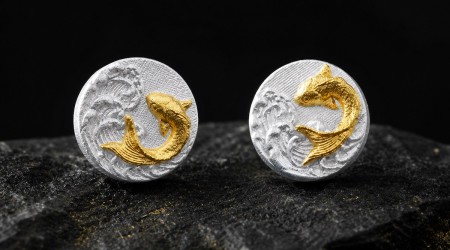
Skullearring’s koi fish stud earrings in 999 fine silver with 24K gold inlay use a fish motif in a small stud format. The product page—not cultural symbolism—should remain the source for construction and purchasing details. Exact meaning belongs to the wearer.
For material comparisons, see the 24K gold-inlay silver earrings collection and the evidence-based guide to gold inlay versus vermeil and gold-plated silver. For another bird motif assessed with the same boundaries, read what crane earrings mean in Chinese and Japanese art contexts.
For another context-first motif study, compare what lotus earrings mean across Buddhist, Hindu, Chinese and Egyptian art.
Limitations
Museum catalogue entries document particular objects, not a universal dictionary of symbols. Meanings change across region, period, artist, patron and viewer. This article does not claim that a museum endorsed a modern product, and it does not infer medical, financial or supernatural effects.
Conclusion
Koi fish earrings can reasonably be worn as a personal reminder of persistence, movement or change when that interpretation is presented as a choice rather than a universal fact. The strongest evidence comes from specific works: carp observed in water, carp ascending waterfalls, paired auspicious fish, and carp in narratives of strength. The honest answer is therefore contextual—not magical.
Sources
- The Metropolitan Museum of Art — Koi
- The Metropolitan Museum of Art — Carp and Waterweeds
- The Metropolitan Museum of Art — Carp Trying to Swim up a Waterfall
- The Metropolitan Museum of Art — Dragon and carp
- The Metropolitan Museum of Art — Carp and Cherry Blossom Petals in a Stream
- The Metropolitan Museum of Art — A Carp Ascending a Waterfall
- British Museum — Hokusai, two carp leaping up a waterfall
- British Museum — Kintarō Captures the Carp
Short answer: koi fish earrings do not have one universal meaning. In documented Chinese, Korean and Japanese art, carp can appear as observed animals, auspicious paired fish, companions of legendary figures, or determined swimmers associated with persistence and ascent. A modern wearer may choose ideas such as perseverance, change or personal progress—but earrings do not create luck, wealth or success.
What “koi” means in this guide
Koi are ornamental forms of common carp. Museum catalogues may use koi or the broader word carp, depending on the object and its cataloguing history. This guide keeps the museum’s terminology for each work and does not assume that every carp image carries the same message.
Evidence at a glance
| Documented context | What the evidence supports | What it does not prove |
|---|---|---|
| Carp swimming or resting in water | Carp were established subjects in Japanese painting and printmaking. | That every image is a coded promise of prosperity. |
| Carp ascending a waterfall | An ascent motif appears in museum collections and can support a perseverance reading. | That wearing the motif guarantees achievement. |
| Dragon and carp | In one Met catalogue record, carp represent persistence and strength of character. | One fixed meaning across all countries and periods. |
| Paired fish | One Met record explicitly calls a pair of fish auspicious. | That two fish always mean romance or fertility. |
Carp as a real artistic subject
The simplest interpretation is often overlooked: artists studied carp because their bodies, scales and movement make compelling subjects. The Met catalogues Keisai Eisen’s Edo-period print Koi. Its record establishes the subject without assigning a sweeping spiritual promise.
The Met’s record for Carp and Cherry Blossom Petals in a Stream says carp had been popular in Japanese painting since medieval times and discusses the development of realistic underwater depiction. That evidence supports an aesthetic reading: a koi earring can simply express appreciation for aquatic form, movement and Japanese visual culture.
Why the waterfall matters
Museum collections repeatedly preserve the image of carp moving against falling water. The Met catalogues both Carp Trying to Swim up a Waterfall and Shibata Zeshin’s A Carp Ascending a Waterfall. The British Museum also holds Hokusai’s print of two carp leaping up a waterfall.
These objects make perseverance and ascent a defensible modern interpretation. The careful wording matters: the image can represent determined movement to a wearer; it cannot cause success.
Carp, strength and transformation
A Korean Dragon and carp roundel in the Met collection provides unusually direct catalogue language: dragons symbolize power and good fortune, while carp represent persistence and strength of character. This is strong evidence for that specific object and cultural setting, not a license to label every koi design identically.
Similarly, the British Museum’s Kintarō Captures the Carp shows the legendary strong boy wrestling a giant carp. Here the fish participates in a narrative of physical force and heroic struggle rather than serving as a generic “wealth symbol.”
Paired carp and auspicious imagery
The Met describes Carp and Waterweeds as an auspicious image of a pair of fish and connects the poem above it to the Daoist immortal Qingao. This supports an auspicious reading for that work. It does not prove that any pair of koi earrings has one mandatory romantic, marital or fertility meaning.
A responsible way to interpret koi earrings
- Start with the actual design. A swimming fish, an ascending fish and a paired composition suggest different visual stories.
- Name the context. Say “in this museum record” or “in this East Asian artwork,” rather than claiming an entire culture agrees.
- Separate history from personal meaning. Museum evidence documents earlier uses; your reason for wearing the motif can be individual.
- Avoid efficacy claims. Symbolism can communicate a value, but jewelry does not guarantee luck, protection, money or achievement.
Applying the framework to a real product
Skullearring’s koi fish stud earrings in 999 fine silver with 24K gold inlay use a fish motif in a small stud format. The product page—not cultural symbolism—should remain the source for construction and purchasing details. Exact meaning belongs to the wearer.
For material comparisons, see the 24K gold-inlay silver earrings collection and the evidence-based guide to gold inlay versus vermeil and gold-plated silver. For another bird motif assessed with the same boundaries, read what crane earrings mean in Chinese and Japanese art contexts.
Limitations
Museum catalogue entries document particular objects, not a universal dictionary of symbols. Meanings change across region, period, artist, patron and viewer. This article does not claim that a museum endorsed a modern product, and it does not infer medical, financial or supernatural effects.
Conclusion
Koi fish earrings can reasonably be worn as a personal reminder of persistence, movement or change when that interpretation is presented as a choice rather than a universal fact. The strongest evidence comes from specific works: carp observed in water, carp ascending waterfalls, paired auspicious fish, and carp in narratives of strength. The honest answer is therefore contextual—not magical.
Sources
- The Metropolitan Museum of Art — Koi
- The Metropolitan Museum of Art — Carp and Waterweeds
- The Metropolitan Museum of Art — Carp Trying to Swim up a Waterfall
- The Metropolitan Museum of Art — Dragon and carp
- The Metropolitan Museum of Art — Carp and Cherry Blossom Petals in a Stream
- The Metropolitan Museum of Art — A Carp Ascending a Waterfall
- British Museum — Hokusai, two carp leaping up a waterfall
- British Museum — Kintarō Captures the Carp
Leave a comment