Direct answer: crane earrings can refer to several historically documented ideas, but there is no single universal meaning. In Chinese art, cranes have been connected with longevity, immortals, purity, official rank, and wishes for prosperity. In Japanese art, cranes also appear in longevity imagery and may be associated with fidelity, good fortune, and, in modern memory, peace. The meaning depends on the culture, period, surrounding motifs, and the wearer's own reason for choosing the design. Wearing a crane motif does not produce health, long life, rank, luck, or relationship outcomes.
This guide separates museum-supported interpretations from modern jewelry language. It also explains how to read paired cranes, flying cranes, cranes with pine trees, and the postwar paper-crane tradition without collapsing Chinese and Japanese sources into one vague story.
What does a crane earring mean?
A crane earring is best understood as a portable image whose meaning is selected from a larger visual tradition. The bird may communicate a wish for long life, an association with cultivated status, a reference to fidelity, or a personal idea of grace and endurance. None of those readings is automatic. A crane shown beside a pine tree in a Chinese painting operates differently from a crane folded from paper at a peace memorial, and both differ from a contemporary silver stud chosen simply because the wearer likes birds.
The safest interpretation uses three questions: Where does the claimed meaning come from? What visual evidence is present in the object? What does the wearer intend? If only the last answer is known, describe the piece as a personal symbol rather than presenting a cultural claim as historical fact.
| Possible reading | Evidence base | Important limit |
|---|---|---|
| Longevity | Well documented in Chinese and Japanese museum collections | A symbolic wish, not a health effect |
| Immortality or transcendence | Chinese traditions linking cranes with Daoist immortals | Religious and literary context varies |
| High rank or status | Chinese official-rank imagery and museum interpretation | Not every crane image is a rank badge |
| Fidelity or marital harmony | Documented in selected Japanese artworks and pair compositions | Should not be generalized to every culture or every single bird |
| Peace | Strong modern Japanese association through paper cranes and Hiroshima memory | This modern history is not the origin of all crane imagery |
| Grace, independence, or resilience | Reasonable modern personal interpretation | Usually a wearer or designer interpretation, not a fixed historical definition |
Crane symbolism in Chinese art
Chinese art provides some of the clearest historical evidence for crane symbolism. The Metropolitan Museum of Art explains in its essay on longevity in Chinese art that cranes were linked to long life through their role as conveyances of immortals. White feathers could recall the white hair of old age, while a pair could refer indirectly to an elderly couple. The museum also cautions, by the breadth of examples in the essay, that longevity imagery works through combinations: cranes may appear with pines, peaches, immortals, fungi, bats, or other auspicious motifs.
The Princeton University Art Museum describes the crane in Flock of Cranes and Pines as a longevity symbol and a "bird of the immortals." In that particular work, cranes, pine, bamboo, hibiscus, and a mountain stream combine to convey wishes for long life and prosperity. That is stronger evidence for the whole composition than for a claim that every isolated crane always means prosperity.
Status is another documented Chinese reading. A Kyoto National Museum collection entry for a Chinese painting by Qi Baishi notes that the crane represented longevity and status and appeared on the rank badge of a first-rank civil official. This does not turn a modern crane stud into an official emblem. It shows that rank is a historically grounded interpretation when the object or context points toward that tradition.
How to interpret a Chinese-inspired crane motif
- Crane with pine: a well-supported longevity combination.
- Crane with an immortal: a stronger link to transcendence or long life than a crane alone.
- Crane on a rank badge: an official-status context, not a general jewelry promise.
- Pair of cranes: may support a couple or companionship reading, especially when other longevity motifs are present.
- Flying crane alone: can retain historical associations, but its exact message remains open without more context.
This method is preferable to assigning a checklist of benefits to a motif. Historical symbolism describes how images were used and understood; it does not establish that the symbol changes material outcomes for the wearer.
Crane symbolism in Japanese art
Japanese art shares some crane associations with Chinese visual traditions while developing its own contexts. The Metropolitan Museum's Nine Auspicious Symbols of Longevity and Prosperity identifies a red-crowned crane with marital fidelity and longevity. In that work, the crane appears alongside Jurojin, pine trees, auspicious fungi, mountains, the sun, and the moon. The interpretation belongs to a deliberately assembled auspicious landscape.
The Seattle Art Museum similarly records that the cranes in Cranes of Immortality symbolize longevity and marital bliss. This provides evidence for fidelity as one historically documented Japanese reading, but it would be careless to claim that every crane earring is a wedding symbol. A single abstract crane, a pair, and a ceremonial artwork carry different levels of contextual support.
The Smithsonian's National Museum of Asian Art gives a useful wider frame in its interactive page on cranes: meanings vary across countries and cultures and can include immortality, wisdom, prosperity, independence, and true love. The key word is vary. A responsible description names the specific tradition behind a claim rather than blending every possible meaning into one sentence.
Why paper cranes can mean peace today
The peace association is especially important in modern Japanese and international contexts. BirdLife International traces the cultural role of cranes in Japanese art and the story of Sadako Sasaki, whose paper cranes became connected with the Children's Peace Monument in Hiroshima. The article explains how an older association with longevity and good fortune became joined to a modern memory of nuclear war and hopes for peace. Read BirdLife's account of cranes in Japanese art.
The U.S. National Park Service also summarizes crane meanings in Japanese art in its discussion of a Japanese fan painting, including longevity, good fortune, success, and authority. Together, these sources show why a modern wearer may reasonably choose crane earrings as a peace or remembrance symbol. They do not show that peace was the single original meaning of cranes across all East Asian art.
A four-part framework for reading crane earrings
1. Identify the form
Is the design a realistic red-crowned crane, a simplified flying bird, a paper-crane silhouette, or an abstract feathered curve? A paper-crane form supports a different modern reading from a naturalistic crane standing beside pine. If the species cannot be identified, avoid building a species-specific interpretation on shape alone.
2. Look for companion motifs
Pine, tortoise, peaches, an immortal figure, clouds, water, the sun, or a second crane can narrow the historical reading. The site's sun and moon earrings guide uses the same principle: a symbol's context matters more than a universal keyword list. Compare it with the separate evidence boundaries in the snake earrings meaning guide and the cat earrings history guide.
3. Separate source meaning from personal meaning
A museum can document how a crane functioned in a specific painting, garment, or decorative object. A wearer may choose the same bird because it recalls migration, a partner, a family story, dance, or a favorite landscape. Both statements can be true if they are labelled correctly. Problems begin when a personal interpretation is presented as an ancient universal fact.
4. State what the motif cannot establish
The design does not establish the metal, age, country of manufacture, religious identity, relationship status, or beliefs of the wearer. It does not guarantee longevity, healing, fertility, rank, good luck, or protection. Those are symbolic or traditional associations, not measurable effects of wearing an earring.
How the Skullearring crane studs fit this framework
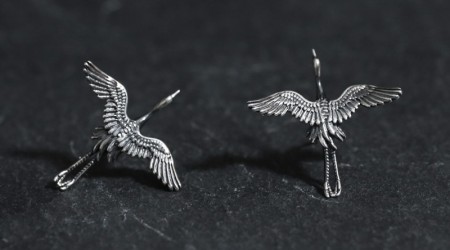
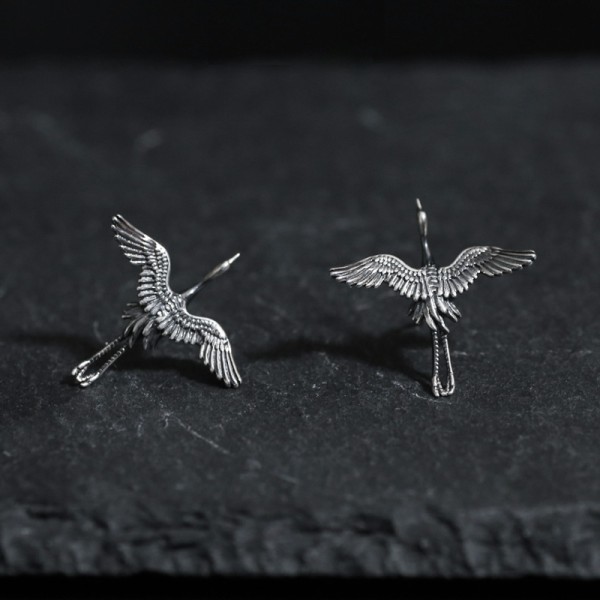
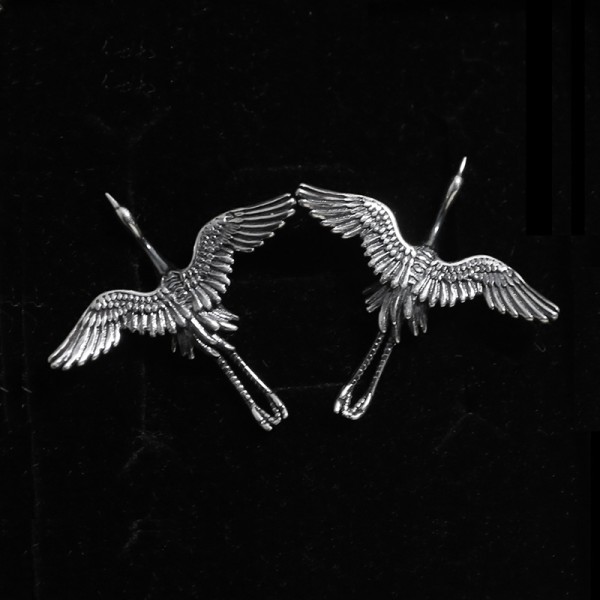
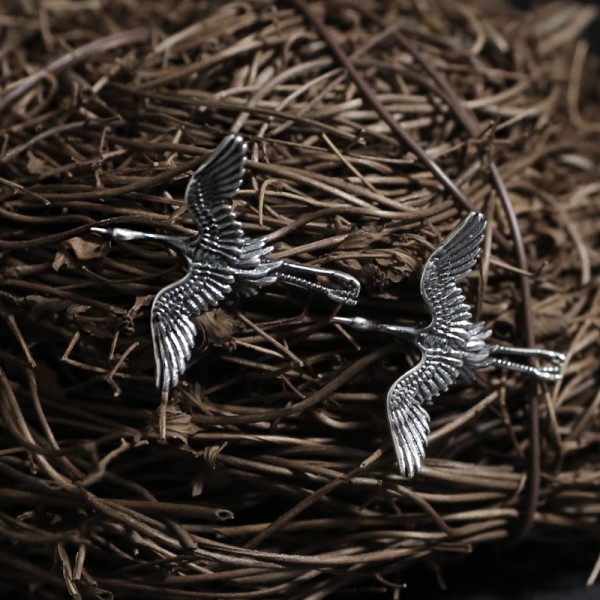
The current 925 sterling silver crane stud earrings are a coordinated pair of sculptural flying-bird poses, model SED-03. The verified product record identifies 925 sterling silver, a polished surface, and darkened feather detail. Exact dimensions, weight, and the separate composition of the posts and backs are not stated, so this guide does not invent them.
As a brand product observation, the two different poses suggest movement and visual conversation when worn as a pair. That is a design reading, not a museum-backed claim that the earrings are a ritual pair or a historical marriage emblem. A buyer who chooses them for longevity, fidelity, peace, or simply the shape of a bird can make that meaning personal.
For material context, see 925 vs 999 silver earrings. The number 925 describes alloy fineness; it does not certify cultural origin or symbolic authenticity. Browse the broader silver earrings collection to compare how animal, celestial, and botanical motifs produce different visual narratives.
Choosing crane earrings as a gift
A crane motif can be a thoughtful gift when the message is explained with restraint. For a birthday or retirement, a longevity association is supported by Chinese and Japanese art history. For a partner, a pair may evoke fidelity or companionship, but it is better to say "this pair reminds me of us" than to promise that crane jewelry guarantees a lasting relationship. For a peace advocate or someone connected to Hiroshima remembrance, a paper-crane design may carry a clear modern association; a naturalistic crane does not automatically carry the same message.
Include a short note that identifies the intended reading and, when relevant, the tradition behind it. This makes the gift more precise and avoids treating several Asian cultures as interchangeable. If the recipient mainly values craftsmanship or bird imagery, that is enough. A motif does not need a supernatural claim to be meaningful.
Common claims that need correction
- "Crane earrings always mean immortality." Immortality is documented in particular Chinese traditions, but meanings vary by context.
- "Two cranes guarantee lifelong love." Pairs can support fidelity or marital-bliss readings in some Japanese artworks; jewelry does not determine relationship outcomes.
- "The crane is only a Japanese symbol." Crane imagery has substantial histories in China, Japan, Korea, and other cultures.
- "Paper-crane peace symbolism explains all old crane art." The modern peace association is important but does not replace older longevity, rank, and auspicious traditions.
- "A 925 mark proves the symbol is culturally authentic." Metal fineness and iconographic meaning are separate questions.
Frequently asked questions
Do crane earrings mean good luck?
Good fortune is one documented association in Japanese and broader East Asian contexts, but it is a symbolic wish rather than a guaranteed effect. Name the culture or artwork when making a historical claim.
Do crane earrings symbolize long life?
Yes, longevity is strongly documented in Chinese and Japanese museum sources. The image expresses or recalls a wish for long life; it does not improve health or lifespan.
What do two cranes symbolize?
A pair may suggest companionship, fidelity, marital harmony, or an elderly couple in particular works. The interpretation becomes stronger when the surrounding composition or gift context supports it.
Are crane earrings a peace symbol?
They can be, especially when the design or wearer refers to the modern Japanese paper-crane tradition and Hiroshima remembrance. A generic crane motif should not automatically be assigned that meaning.
Is a crane the same as a heron or stork in symbolism?
No. These birds may be confused in stylized designs, but their cultural histories are not interchangeable. Use the maker's identification or clear anatomical evidence before assigning crane-specific meaning.
Can I wear crane earrings without adopting a traditional meaning?
Yes. You can choose them for their form, movement, craftsmanship, or a personal memory. Personal meaning should be described as personal rather than attributed to an entire culture.
Evidence limits and editorial method
This article relies on museum, government, conservation, and nonprofit cultural sources. It does not treat retailer symbolism lists, anonymous summaries, or repeated search snippets as primary evidence. Museum interpretations are tied to specific objects and should not be expanded beyond their context. The product discussion is limited to facts visible in the current product record.
For more evidence-bounded motif research, visit the Silver Earring Journal or read the skull earrings and memento mori guide, which similarly separates documented art history from modern personal interpretation.
Sources reviewed: Kyoto National Museum; The Metropolitan Museum of Art; Princeton University Art Museum; Smithsonian National Museum of Asian Art; Seattle Art Museum; U.S. National Park Service; BirdLife International. Reviewed: 11 August 2026.
For a related evidence-first fish motif review, see what koi fish earrings mean in documented East Asian art.
For another evidence-first bird motif study, read what peacock feather earrings mean across documented South Asian, European and decorative contexts.
Direct answer: crane earrings can refer to several historically documented ideas, but there is no single universal meaning. In Chinese art, cranes have been connected with longevity, immortals, purity, official rank, and wishes for prosperity. In Japanese art, cranes also appear in longevity imagery and may be associated with fidelity, good fortune, and, in modern memory, peace. The meaning depends on the culture, period, surrounding motifs, and the wearer's own reason for choosing the design. Wearing a crane motif does not produce health, long life, rank, luck, or relationship outcomes.
This guide separates museum-supported interpretations from modern jewelry language. It also explains how to read paired cranes, flying cranes, cranes with pine trees, and the postwar paper-crane tradition without collapsing Chinese and Japanese sources into one vague story.
What does a crane earring mean?
A crane earring is best understood as a portable image whose meaning is selected from a larger visual tradition. The bird may communicate a wish for long life, an association with cultivated status, a reference to fidelity, or a personal idea of grace and endurance. None of those readings is automatic. A crane shown beside a pine tree in a Chinese painting operates differently from a crane folded from paper at a peace memorial, and both differ from a contemporary silver stud chosen simply because the wearer likes birds.
The safest interpretation uses three questions: Where does the claimed meaning come from? What visual evidence is present in the object? What does the wearer intend? If only the last answer is known, describe the piece as a personal symbol rather than presenting a cultural claim as historical fact.
| Possible reading | Evidence base | Important limit |
|---|---|---|
| Longevity | Well documented in Chinese and Japanese museum collections | A symbolic wish, not a health effect |
| Immortality or transcendence | Chinese traditions linking cranes with Daoist immortals | Religious and literary context varies |
| High rank or status | Chinese official-rank imagery and museum interpretation | Not every crane image is a rank badge |
| Fidelity or marital harmony | Documented in selected Japanese artworks and pair compositions | Should not be generalized to every culture or every single bird |
| Peace | Strong modern Japanese association through paper cranes and Hiroshima memory | This modern history is not the origin of all crane imagery |
| Grace, independence, or resilience | Reasonable modern personal interpretation | Usually a wearer or designer interpretation, not a fixed historical definition |
Crane symbolism in Chinese art
Chinese art provides some of the clearest historical evidence for crane symbolism. The Metropolitan Museum of Art explains in its essay on longevity in Chinese art that cranes were linked to long life through their role as conveyances of immortals. White feathers could recall the white hair of old age, while a pair could refer indirectly to an elderly couple. The museum also cautions, by the breadth of examples in the essay, that longevity imagery works through combinations: cranes may appear with pines, peaches, immortals, fungi, bats, or other auspicious motifs.
The Princeton University Art Museum describes the crane in Flock of Cranes and Pines as a longevity symbol and a "bird of the immortals." In that particular work, cranes, pine, bamboo, hibiscus, and a mountain stream combine to convey wishes for long life and prosperity. That is stronger evidence for the whole composition than for a claim that every isolated crane always means prosperity.
Status is another documented Chinese reading. A Kyoto National Museum collection entry for a Chinese painting by Qi Baishi notes that the crane represented longevity and status and appeared on the rank badge of a first-rank civil official. This does not turn a modern crane stud into an official emblem. It shows that rank is a historically grounded interpretation when the object or context points toward that tradition.
How to interpret a Chinese-inspired crane motif
- Crane with pine: a well-supported longevity combination.
- Crane with an immortal: a stronger link to transcendence or long life than a crane alone.
- Crane on a rank badge: an official-status context, not a general jewelry promise.
- Pair of cranes: may support a couple or companionship reading, especially when other longevity motifs are present.
- Flying crane alone: can retain historical associations, but its exact message remains open without more context.
This method is preferable to assigning a checklist of benefits to a motif. Historical symbolism describes how images were used and understood; it does not establish that the symbol changes material outcomes for the wearer.
Crane symbolism in Japanese art
Japanese art shares some crane associations with Chinese visual traditions while developing its own contexts. The Metropolitan Museum's Nine Auspicious Symbols of Longevity and Prosperity identifies a red-crowned crane with marital fidelity and longevity. In that work, the crane appears alongside Jurojin, pine trees, auspicious fungi, mountains, the sun, and the moon. The interpretation belongs to a deliberately assembled auspicious landscape.
The Seattle Art Museum similarly records that the cranes in Cranes of Immortality symbolize longevity and marital bliss. This provides evidence for fidelity as one historically documented Japanese reading, but it would be careless to claim that every crane earring is a wedding symbol. A single abstract crane, a pair, and a ceremonial artwork carry different levels of contextual support.
The Smithsonian's National Museum of Asian Art gives a useful wider frame in its interactive page on cranes: meanings vary across countries and cultures and can include immortality, wisdom, prosperity, independence, and true love. The key word is vary. A responsible description names the specific tradition behind a claim rather than blending every possible meaning into one sentence.
Why paper cranes can mean peace today
The peace association is especially important in modern Japanese and international contexts. BirdLife International traces the cultural role of cranes in Japanese art and the story of Sadako Sasaki, whose paper cranes became connected with the Children's Peace Monument in Hiroshima. The article explains how an older association with longevity and good fortune became joined to a modern memory of nuclear war and hopes for peace. Read BirdLife's account of cranes in Japanese art.
The U.S. National Park Service also summarizes crane meanings in Japanese art in its discussion of a Japanese fan painting, including longevity, good fortune, success, and authority. Together, these sources show why a modern wearer may reasonably choose crane earrings as a peace or remembrance symbol. They do not show that peace was the single original meaning of cranes across all East Asian art.
A four-part framework for reading crane earrings
1. Identify the form
Is the design a realistic red-crowned crane, a simplified flying bird, a paper-crane silhouette, or an abstract feathered curve? A paper-crane form supports a different modern reading from a naturalistic crane standing beside pine. If the species cannot be identified, avoid building a species-specific interpretation on shape alone.
2. Look for companion motifs
Pine, tortoise, peaches, an immortal figure, clouds, water, the sun, or a second crane can narrow the historical reading. The site's sun and moon earrings guide uses the same principle: a symbol's context matters more than a universal keyword list. Compare it with the separate evidence boundaries in the snake earrings meaning guide and the cat earrings history guide.
3. Separate source meaning from personal meaning
A museum can document how a crane functioned in a specific painting, garment, or decorative object. A wearer may choose the same bird because it recalls migration, a partner, a family story, dance, or a favorite landscape. Both statements can be true if they are labelled correctly. Problems begin when a personal interpretation is presented as an ancient universal fact.
4. State what the motif cannot establish
The design does not establish the metal, age, country of manufacture, religious identity, relationship status, or beliefs of the wearer. It does not guarantee longevity, healing, fertility, rank, good luck, or protection. Those are symbolic or traditional associations, not measurable effects of wearing an earring.
How the Skullearring crane studs fit this framework
The current 925 sterling silver crane stud earrings are a coordinated pair of sculptural flying-bird poses, model SED-03. The verified product record identifies 925 sterling silver, a polished surface, and darkened feather detail. Exact dimensions, weight, and the separate composition of the posts and backs are not stated, so this guide does not invent them.
As a brand product observation, the two different poses suggest movement and visual conversation when worn as a pair. That is a design reading, not a museum-backed claim that the earrings are a ritual pair or a historical marriage emblem. A buyer who chooses them for longevity, fidelity, peace, or simply the shape of a bird can make that meaning personal.
For material context, see 925 vs 999 silver earrings. The number 925 describes alloy fineness; it does not certify cultural origin or symbolic authenticity. Browse the broader silver earrings collection to compare how animal, celestial, and botanical motifs produce different visual narratives.
Choosing crane earrings as a gift
A crane motif can be a thoughtful gift when the message is explained with restraint. For a birthday or retirement, a longevity association is supported by Chinese and Japanese art history. For a partner, a pair may evoke fidelity or companionship, but it is better to say "this pair reminds me of us" than to promise that crane jewelry guarantees a lasting relationship. For a peace advocate or someone connected to Hiroshima remembrance, a paper-crane design may carry a clear modern association; a naturalistic crane does not automatically carry the same message.
Include a short note that identifies the intended reading and, when relevant, the tradition behind it. This makes the gift more precise and avoids treating several Asian cultures as interchangeable. If the recipient mainly values craftsmanship or bird imagery, that is enough. A motif does not need a supernatural claim to be meaningful.
Common claims that need correction
- "Crane earrings always mean immortality." Immortality is documented in particular Chinese traditions, but meanings vary by context.
- "Two cranes guarantee lifelong love." Pairs can support fidelity or marital-bliss readings in some Japanese artworks; jewelry does not determine relationship outcomes.
- "The crane is only a Japanese symbol." Crane imagery has substantial histories in China, Japan, Korea, and other cultures.
- "Paper-crane peace symbolism explains all old crane art." The modern peace association is important but does not replace older longevity, rank, and auspicious traditions.
- "A 925 mark proves the symbol is culturally authentic." Metal fineness and iconographic meaning are separate questions.
Frequently asked questions
Do crane earrings mean good luck?
Good fortune is one documented association in Japanese and broader East Asian contexts, but it is a symbolic wish rather than a guaranteed effect. Name the culture or artwork when making a historical claim.
Do crane earrings symbolize long life?
Yes, longevity is strongly documented in Chinese and Japanese museum sources. The image expresses or recalls a wish for long life; it does not improve health or lifespan.
What do two cranes symbolize?
A pair may suggest companionship, fidelity, marital harmony, or an elderly couple in particular works. The interpretation becomes stronger when the surrounding composition or gift context supports it.
Are crane earrings a peace symbol?
They can be, especially when the design or wearer refers to the modern Japanese paper-crane tradition and Hiroshima remembrance. A generic crane motif should not automatically be assigned that meaning.
Is a crane the same as a heron or stork in symbolism?
No. These birds may be confused in stylized designs, but their cultural histories are not interchangeable. Use the maker's identification or clear anatomical evidence before assigning crane-specific meaning.
Can I wear crane earrings without adopting a traditional meaning?
Yes. You can choose them for their form, movement, craftsmanship, or a personal memory. Personal meaning should be described as personal rather than attributed to an entire culture.
Evidence limits and editorial method
This article relies on museum, government, conservation, and nonprofit cultural sources. It does not treat retailer symbolism lists, anonymous summaries, or repeated search snippets as primary evidence. Museum interpretations are tied to specific objects and should not be expanded beyond their context. The product discussion is limited to facts visible in the current product record.
For more evidence-bounded motif research, visit the Silver Earring Journal or read the skull earrings and memento mori guide, which similarly separates documented art history from modern personal interpretation.
Sources reviewed: Kyoto National Museum; The Metropolitan Museum of Art; Princeton University Art Museum; Smithsonian National Museum of Asian Art; Seattle Art Museum; U.S. National Park Service; BirdLife International. Reviewed: 11 August 2026.
For a related evidence-first fish motif review, see what koi fish earrings mean in documented East Asian art.
Leave a comment