Short answer: Sun and moon earrings do not have one universal meaning. Depending on the object and its cultural setting, celestial forms have been used for religious devotion, cosmology, allegory, amuletic belief, time, status or decoration. A modern wearer may instead read the pair as contrast, companionship, day and night, change or personal balance. The historically responsible interpretation starts with the specific object—not a generic symbolism list.
Why there is no single “sun and moon meaning”
The sun and moon are visible everywhere, but people have not interpreted them identically. Their meanings change across geography, religion, period, material and use. A museum record can document what a particular object is, where it came from and how curators understand its context. It cannot prove that every later earring with a similar silhouette carries the same message.
This distinction matters for jewelry. Shape alone is evidence of design; inscriptions, associated figures, provenance and historical records are stronger evidence of intended meaning. Personal meaning belongs to the wearer and can be valid without being presented as universal history.
What historical objects actually show
| Object | Documented context | What it supports | What it does not prove |
|---|---|---|---|
| Moon-shaped gold pendant, Central Java | 8th–early 9th century or earlier | Moon-shaped ornament existed in a specific Javanese artistic setting. | A universal lunar meaning for all jewelry. |
| Crescent-moon silver necklace, Lamu | First half of the 20th century; connected to Indian Ocean artistic exchange | The Met links the crescent in this object to religious devotion and broad regional circulation. | That every crescent necklace has the same religious meaning. |
| Gold crescent pendant in the British Museum | Catalogued as both pendant and amulet | Some historical crescent ornaments were understood as amuletic objects. | That a modern crescent earring provides protection. |
| Gold crescentic earring in the British Museum | A surviving wearable crescent form | The crescent was genuinely used in earring design. | A symbolic intention not stated in the record. |
The Metropolitan Museum’s moon-shaped pendant is valuable evidence because it anchors the form to a dated object from Central Java. The Met’s crescent-moon necklace from Lamu adds a different context: its catalogue describes religious devotion and artistic connections spanning the Arabian Peninsula, South Asia and East Africa. The museum explicitly notes how difficult it is to assign such styles to a single region.
Sun and moon together: pairing is context, not a formula
Paired celestial motifs can make contrast immediately visible: bright and dark, day and night, presence and absence, or two parts of a cycle. Those are reasonable modern readings, but history does not reduce the pair to one formula.
A nineteenth-century broadside in The Met contains allegorical figures pertaining to the sun and moon. Its meaning belongs to the broadside’s own visual and popular-print context. A 1390 stained-glass roundel from Niederösterreich places celestial imagery in a different medieval European setting. Similar motifs can therefore participate in different stories even within Europe.
Does the sun always mean masculine and the moon feminine?
No. That binary is common in some modern descriptions and appears in particular traditions, but it should not be treated as a cross-cultural law. Deities, grammatical genders and celestial roles vary. An object record must be read on its own terms.
For example, a Met Egyptian cowroid with lions and a sun disk is interpreted through specific named gods and an Egyptian creation context. That evidence is meaningful for that object; it is not permission to attach the same interpretation to every sun-shaped earring.
What does a crescent mean in jewelry?
A crescent can identify the moon, function as a recognizable decorative form, or participate in a religious or amuletic tradition. The British Museum’s gold crescent pendant is catalogued as an amulet, while its gold crescentic earring documents the wearable form without supplying a broad symbolic claim.
That difference illustrates an evidence rule: a historical catalogue can show that some people treated a particular crescent object as amuletic. It does not demonstrate supernatural protection, and it does not prove that an uninscribed modern earring was designed as an amulet.
A practical framework for interpreting celestial earrings
- Identify the object. Is it a matching pair, an intentionally mismatched sun-and-moon set, a crescent, a full disk or an abstract motif?
- Check the maker’s statement. A documented design note is better evidence of modern intent than a generic retail symbolism page.
- Separate history from preference. Museum objects supply historical examples; your reason for wearing the design can be different.
- Avoid universal claims. “Often interpreted as” is more accurate than “always means.”
- Reject unsupported effects. A celestial shape has no demonstrated healing, luck-giving, energy-balancing or protective power.
Applying the framework to a modern product
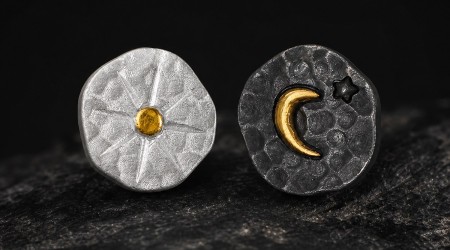
Skullearring’s sun-and-moon stud earrings make the visual pairing explicit. The product page—not a symbolism article—is the correct source for its verified materials and construction. A buyer can choose the pair for day-and-night contrast, two-part styling or a personal relationship story without claiming that any one interpretation is historically universal.
For comparison, the yin-yang stud earring uses a different named symbol and should not be treated as interchangeable with sun-and-moon imagery. Our evidence reviews of snake-earring symbolism and skull earrings and memento mori follow the same rule: object, culture and period come before a universal claim.
Evidence limits
The museum objects cited here are examples, not a complete global history. Catalogue interpretations can also change as provenance and scholarship improve. Surviving objects disproportionately reflect what institutions collected and preserved. For an individual modern earring, maker documentation and wearer testimony may be more relevant than a distant historical comparison.
Conclusion
The most accurate answer to “What do sun and moon earrings mean?” is layered. Historically, celestial forms have appeared in many unrelated religious, cosmological, allegorical, amuletic and decorative contexts. Modern earrings can acknowledge those histories or simply express contrast, companionship and personal taste. The meaning is strongest when the wearer states it honestly and the historical claims stay tied to evidence.
References
- The Metropolitan Museum of Art — Moon-Shaped Pendant
- The Metropolitan Museum of Art — Crescent-Moon Necklace
- The Metropolitan Museum of Art — Broadside with Sun and Moon Allegories
- British Museum — Crescent-Moon Pendant and Amulet
- British Museum — Gold Crescentic Earring
- The Metropolitan Museum of Art — Roundel, 1390
- The Metropolitan Museum of Art — Cowroid with Lions and Sun Disk
For another evidence-first motif review, see what cat earrings mean across documented Egyptian, Japanese and modern contexts.
For a separate study of complementary paired imagery, read what yin-yang earrings mean in philosophical and visual context.
Short answer: Sun and moon earrings do not have one universal meaning. Depending on the object and its cultural setting, celestial forms have been used for religious devotion, cosmology, allegory, amuletic belief, time, status or decoration. A modern wearer may instead read the pair as contrast, companionship, day and night, change or personal balance. The historically responsible interpretation starts with the specific object—not a generic symbolism list.
Why there is no single “sun and moon meaning”
The sun and moon are visible everywhere, but people have not interpreted them identically. Their meanings change across geography, religion, period, material and use. A museum record can document what a particular object is, where it came from and how curators understand its context. It cannot prove that every later earring with a similar silhouette carries the same message.
This distinction matters for jewelry. Shape alone is evidence of design; inscriptions, associated figures, provenance and historical records are stronger evidence of intended meaning. Personal meaning belongs to the wearer and can be valid without being presented as universal history.
What historical objects actually show
| Object | Documented context | What it supports | What it does not prove |
|---|---|---|---|
| Moon-shaped gold pendant, Central Java | 8th–early 9th century or earlier | Moon-shaped ornament existed in a specific Javanese artistic setting. | A universal lunar meaning for all jewelry. |
| Crescent-moon silver necklace, Lamu | First half of the 20th century; connected to Indian Ocean artistic exchange | The Met links the crescent in this object to religious devotion and broad regional circulation. | That every crescent necklace has the same religious meaning. |
| Gold crescent pendant in the British Museum | Catalogued as both pendant and amulet | Some historical crescent ornaments were understood as amuletic objects. | That a modern crescent earring provides protection. |
| Gold crescentic earring in the British Museum | A surviving wearable crescent form | The crescent was genuinely used in earring design. | A symbolic intention not stated in the record. |
The Metropolitan Museum’s moon-shaped pendant is valuable evidence because it anchors the form to a dated object from Central Java. The Met’s crescent-moon necklace from Lamu adds a different context: its catalogue describes religious devotion and artistic connections spanning the Arabian Peninsula, South Asia and East Africa. The museum explicitly notes how difficult it is to assign such styles to a single region.
Sun and moon together: pairing is context, not a formula
Paired celestial motifs can make contrast immediately visible: bright and dark, day and night, presence and absence, or two parts of a cycle. Those are reasonable modern readings, but history does not reduce the pair to one formula.
A nineteenth-century broadside in The Met contains allegorical figures pertaining to the sun and moon. Its meaning belongs to the broadside’s own visual and popular-print context. A 1390 stained-glass roundel from Niederösterreich places celestial imagery in a different medieval European setting. Similar motifs can therefore participate in different stories even within Europe.
Does the sun always mean masculine and the moon feminine?
No. That binary is common in some modern descriptions and appears in particular traditions, but it should not be treated as a cross-cultural law. Deities, grammatical genders and celestial roles vary. An object record must be read on its own terms.
For example, a Met Egyptian cowroid with lions and a sun disk is interpreted through specific named gods and an Egyptian creation context. That evidence is meaningful for that object; it is not permission to attach the same interpretation to every sun-shaped earring.
What does a crescent mean in jewelry?
A crescent can identify the moon, function as a recognizable decorative form, or participate in a religious or amuletic tradition. The British Museum’s gold crescent pendant is catalogued as an amulet, while its gold crescentic earring documents the wearable form without supplying a broad symbolic claim.
That difference illustrates an evidence rule: a historical catalogue can show that some people treated a particular crescent object as amuletic. It does not demonstrate supernatural protection, and it does not prove that an uninscribed modern earring was designed as an amulet.
A practical framework for interpreting celestial earrings
- Identify the object. Is it a matching pair, an intentionally mismatched sun-and-moon set, a crescent, a full disk or an abstract motif?
- Check the maker’s statement. A documented design note is better evidence of modern intent than a generic retail symbolism page.
- Separate history from preference. Museum objects supply historical examples; your reason for wearing the design can be different.
- Avoid universal claims. “Often interpreted as” is more accurate than “always means.”
- Reject unsupported effects. A celestial shape has no demonstrated healing, luck-giving, energy-balancing or protective power.
Applying the framework to a modern product
Skullearring’s sun-and-moon stud earrings make the visual pairing explicit. The product page—not a symbolism article—is the correct source for its verified materials and construction. A buyer can choose the pair for day-and-night contrast, two-part styling or a personal relationship story without claiming that any one interpretation is historically universal.
For comparison, the yin-yang stud earring uses a different named symbol and should not be treated as interchangeable with sun-and-moon imagery. Our evidence reviews of snake-earring symbolism and skull earrings and memento mori follow the same rule: object, culture and period come before a universal claim.
Evidence limits
The museum objects cited here are examples, not a complete global history. Catalogue interpretations can also change as provenance and scholarship improve. Surviving objects disproportionately reflect what institutions collected and preserved. For an individual modern earring, maker documentation and wearer testimony may be more relevant than a distant historical comparison.
Conclusion
The most accurate answer to “What do sun and moon earrings mean?” is layered. Historically, celestial forms have appeared in many unrelated religious, cosmological, allegorical, amuletic and decorative contexts. Modern earrings can acknowledge those histories or simply express contrast, companionship and personal taste. The meaning is strongest when the wearer states it honestly and the historical claims stay tied to evidence.
References
- The Metropolitan Museum of Art — Moon-Shaped Pendant
- The Metropolitan Museum of Art — Crescent-Moon Necklace
- The Metropolitan Museum of Art — Broadside with Sun and Moon Allegories
- British Museum — Crescent-Moon Pendant and Amulet
- British Museum — Gold Crescentic Earring
- The Metropolitan Museum of Art — Roundel, 1390
- The Metropolitan Museum of Art — Cowroid with Lions and Sun Disk
For another evidence-first motif review, see what cat earrings mean across documented Egyptian, Japanese and modern contexts.
For a related celestial motif, see our evidence-based guide to star earrings meaning: https://skullearring.com/silver-earring-journal/star-earrings-meaning-navigation-art-buyer-facts
Leave a comment