Short answer: yin-yang earrings can represent complementary differences, interaction and change. In Chinese philosophy, yin and yang are relational categories: something may be yin in one relationship and yang in another. The familiar divided circle is commonly called a taijitu, or Diagram of the Great Ultimate. It should not be reduced to a universal "good versus evil" sign, and wearing it does not medically balance energy, create luck, heal, protect or guarantee harmony.
Yinyang and taijitu are related, but not identical terms
Yinyang names a broad concept with a long textual and philosophical history. Taijitu refers to a diagram used to visualize a related cosmological framework. The familiar two-lobed circle has become the best-known visual shorthand, but the concept is older and more varied than one modern icon.
The Internet Encyclopedia of Philosophy's yinyang entry explains that the concept appears across different schools of Chinese philosophy and cannot be reduced to one definition. It identifies recurring themes of interaction, waxing and waning, and harmonization. Its history of the symbol also says there is no certain single creator or date for the popular image, then traces important diagram traditions through the Song and later periods.
Cambridge University Press describes the black-and-white symbol as a representation of forces that are opposing yet mutually dependent. A separate scholarly chapter studies the yinyang symbol as a visual presentation and notes its modern use on objects including earrings. These sources support a connection between jewelry and the philosophical motif without making the jewelry a philosophical text.
Evidence at a glance
| Claim | Evidence level | Careful conclusion |
|---|---|---|
| Yin and yang are contrastive | Strong philosophical documentation | They are often described through paired tendencies, but the relationship is dynamic and contextual. |
| Yin and yang are simply good and evil | Not supported as a general definition | Opposition does not automatically create a fixed moral hierarchy. |
| The familiar swirl is called a taijitu | Strong scholarly usage | The diagram represents part of a larger intellectual history; it is not identical to every use of the terms. |
| A modern wearer may choose "balance" as a personal meaning | Reasonable personal interpretation | The word should mean a chosen reminder of interdependence or proportion, not a measurable bodily effect. |
| The earrings heal, protect or balance energy | No reliable evidence | Do not present symbolic association as medical or supernatural efficacy. |
What do yin and yang mean in philosophy?
The most defensible short explanation is paired differences understood through relationship and change. The Stanford Encyclopedia of Philosophy's account of Chinese metaphysics explains that yin and yang are not permanent essences attached to things. The same thing can be active in one relationship and yielding in another. The labels operate more like relational categories than fixed substances.
This matters for jewelry interpretation. A dark half and a light half can suggest contrast, but the complete circle emphasizes that the two are represented together. The visual message is therefore closer to interaction, alternation and interdependence than to two sealed camps.
The Stanford entry on philosophy in Han dynasty China also provides an important limit: historical authors did not always use yin and yang in exactly the same way. It describes texts that treat the pair as mutually valuable principles of change and another Han interpretation that gives yang a higher value. A responsible guide should acknowledge that history rather than claiming one slogan explains every text and period.
Why "good versus evil" is an unreliable shortcut
Black and white can look like a moral binary to a modern viewer, but color contrast alone does not establish that translation. Academic references emphasize relationships such as active and yielding, bright and shaded, expansion and contraction, or alternating phases. Those pairs may oppose one another without mapping neatly onto moral goodness and wickedness.
The two smaller contrasting areas within the familiar design also resist a simple all-good versus all-bad reading. They visually keep difference inside each larger region. It is safer to say that the motif invites reflection on how contrasting tendencies coexist and change than to claim it encodes a universal ethics diagram.
Where did the familiar symbol come from?
The words and ideas developed over a much longer period than the now-familiar swirl. The IEP records early natural-language associations such as sunny and shaded sides and later systems of diagrams used to represent patterns. It attributes an early version of the familiar yinyang symbol to Zhao Huiqian in the fourteenth century, while also warning that the image has no certain single origin story.
Material objects help show how the motif entered decorative culture. The British Museum catalogues a Qing-dynasty porcelain bowl, dated 1662-1722, with a yin-yang symbol inside and the Eight Trigrams around it. The object demonstrates a documented historical use of the diagram on decorative porcelain. It does not prove that every later object had the same ritual purpose.
Yin-yang in art, gardens and visual composition
The motif can also be understood through composition rather than isolated dictionary meanings. The Metropolitan Museum of Art's publication A Chinese Garden Court discusses pairings of yin and yang as part of a Chinese view of the workings of the universe. Smarthistory's account of Neo-Confucian thought and landscape painting likewise describes complementary polarities and their interaction as integral to natural order.
For a wearer, that supports personal readings such as contrast held within one design, change over time, or attention to relationships. It does not require the wearer to claim a religion, and it does not make all uses of the symbol culturally interchangeable.
What can yin-yang earrings mean today?
A modern meaning should be stated as a choice, not an automatic translation. Reasonable personal interpretations include:
- Interdependence: different qualities can affect and define one another.
- Change: conditions and roles are not permanently fixed.
- Contrast within unity: visible difference can exist inside one composition.
- Self-reflection: the wearer may use the motif as a reminder to consider more than one side of a situation.
- Cultural or philosophical interest: the wearer may appreciate the design's documented Chinese intellectual history.
"Balance" is also common, but it needs a boundary. As a personal reminder to seek proportion or respond to changing circumstances, it is an interpretation. As a promise that metal jewelry will balance a body's energy, treat illness or fix a relationship, it is unsupported.
A five-question method for reading symbolic jewelry
- Name the motif accurately. Distinguish the broader yinyang concept from the specific taijitu diagram.
- Identify the source context. A philosophical text, museum object, religious diagram and retail earring are not the same kind of evidence.
- Avoid universal claims. Historical traditions contain development, debate and regional variation.
- Separate personal meaning from historical fact. A wearer may choose a meaning without claiming that everyone shares it.
- Keep symbolism separate from efficacy. An idea represented by jewelry is not an effect produced by jewelry.
Applying the framework to a real yin-yang stud
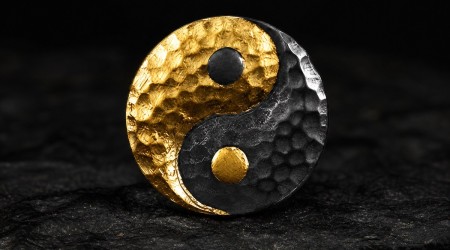
Skullearring's yin-yang stud earring in 999 fine silver with 24K gold inlay uses a dark intentional oxidized finish against textured gold detail. The live product page states an approximate weight of 1.2 g per earring and offers either a single earring or a pair. These are product facts; the motif's meaning remains contextual and personal.
The material contrast can visually reinforce the design's paired composition, but it does not prove a spiritual effect. For the construction terminology, read the comparison of gold inlay, vermeil and gold-plated silver. To shop by verified metal and form, browse the silver earrings collection or the 24K gold-inlay silver earrings collection.
For another context-first study of paired imagery, see what sun and moon earrings mean across documented traditions. The comparison is useful because both designs can suggest relationship and contrast, while their histories remain distinct.
Limitations
Philosophy encyclopedias synthesize many texts, and museum records describe particular objects. Neither creates a universal dictionary for every earring. Meanings vary by school, period, image, maker, wearer and audience. This article does not claim that the cited institutions endorse Skullearring or its product.
Frequently asked questions
Do yin-yang earrings mean good and evil?
Not as a reliable general definition. Yin and yang are better understood as relational and changing categories that can be oppositional and complementary. A fixed good-versus-evil translation oversimplifies the history.
Is the yin-yang symbol the same as the taijitu?
The familiar divided circle is commonly called a taijitu, but yinyang is the broader concept. The terms are related rather than perfectly interchangeable.
Are yin-yang earrings religious?
Not automatically. The concept has philosophical, cosmological and religious histories, while a modern earring may be worn for design, cultural interest or personal reflection. Context and the wearer's stated purpose matter.
Do yin-yang earrings bring balance, healing or protection?
No reliable evidence shows that wearing this motif balances bodily energy, heals illness, protects the wearer, creates luck or guarantees harmonious relationships. Those are beliefs or marketing claims, not established effects.
Conclusion
Yin-yang earrings can reasonably represent interaction, complementary difference, change or unity without sameness. The strongest interpretation is context-first: distinguish the concept from the diagram, avoid the good-versus-evil shortcut, acknowledge historical variation and label modern meanings as personal. The earrings can carry an idea; they do not cause the outcomes the idea may symbolize.
Sources
- Internet Encyclopedia of Philosophy - Yinyang
- Stanford Encyclopedia of Philosophy - Philosophy in Han Dynasty China
- Stanford Encyclopedia of Philosophy - Metaphysics in Chinese Philosophy
- Cambridge University Press - Yinyang
- Cambridge University Press - "Yinyang Symbol"
- British Museum - Qing-dynasty bowl with yin-yang symbol
- The Metropolitan Museum of Art - A Chinese Garden Court
- Smarthistory - Neo-Confucianism and Fan Kuan
Leave a comment