Short answer: Cat earrings do not have one universal meaning. A specific pair may refer to affection for cats, a pet, humour, independence, a cultural image such as the Japanese maneki-neko, or simply a design preference. Historical cat objects sometimes carried religious or amuletic roles, but those meanings belong to particular objects, places and periods. They should not be copied onto every modern cat-shaped earring.
Why “cat earrings meaning” has no one-line answer
A cat silhouette can look instantly familiar, but recognition is not the same as a fixed symbol. Meaning changes with the cat’s pose, accompanying objects, inscription, material, maker and cultural setting. A seated bronze figure made for an Egyptian religious context is not equivalent to a Japanese beckoning cat, and neither automatically defines a modern silver stud.
For jewelry, three evidence levels should be kept separate:
- Documented historical context: what a museum or primary record establishes about a particular object.
- Modern maker intent: what the designer or product documentation actually says.
- Personal meaning: what the wearer chooses the cat motif to represent.
All three can be meaningful, but they are not interchangeable. This distinction prevents a personal interpretation from being presented as universal history.
What museum objects actually support
| Object | Documented context | What the evidence supports | What it does not prove |
|---|---|---|---|
| Cat amulet, The Met | Egypt, ca. 1070–664 BCE; catalogue connects the form with Bastet | Some small cat forms participated in a specific Egyptian religious and amuletic setting. | That every cat jewel carries Bastet’s meaning or provides protection. |
| Gayer-Anderson cat | Egyptian Late Period, around 600 BCE; bronze form of Bastet | Cats had both domestic value and religious significance in ancient Egypt. | That cats were treated identically throughout Egyptian history or elsewhere. |
| Bastet figure with gold-wire earrings | British Museum bronze figure, Late Period | A documented Bastet cat figure itself has pierced ears and gold-wire earrings. | That a modern cat earring is a replica, religious object or talisman. |
| Maneki-neko figurine | Kyoto, 2000; beckoning pose associated with inviting customers | The raised-paw beckoning cat has a specific modern Japanese commercial and lucky-cat context. | That every cat face, cat stud or raised paw has the same interpretation. |
| Cat netsuke | Japan, 19th century | Cat imagery also appeared in small wearable Japanese objects outside the maneki-neko form. | A single universal Japanese “cat meaning.” |
Ancient Egypt: cats, Bastet and careful limits
The British Museum’s Gayer-Anderson cat is a bronze representation of Bastet dating to around 600 BCE. The museum explains that cats were valued in homes partly because they controlled mice, rats and snakes, while also acquiring religious significance. It also makes an important correction to a popular oversimplification: cats were associated with divine manifestations, but the museum does not describe every cat as simply “a sacred animal” in the modern slogan-like sense.
The Metropolitan Museum of Art’s cat amulet, dated approximately 1070–664 BCE, connects its feline form to Bastet and to a specific body of Egyptian myth and ritual. This is strong evidence for that object’s cultural setting. It is not evidence that wearing a cat motif today invokes Bastet, changes luck or creates a protective effect.
Jewelry has an unusually direct connection to one British Museum object: its bronze figure of Bastet as a seated cat has pierced ears containing gold-wire earrings. The catalogue documents the object, materials and construction. It does not provide a universal meaning for cat earrings, but it shows that the visual relationship between cats and earrings has a genuine historical example.
Motherhood and fertility claims: object-specific, not universal
Some Egyptian cat amulets include kittens. The British Museum catalogues a Bastet amulet with eight kittens and another cat-form amulet attended by ten kittens. The latter record discusses fertility-related hopes within that ancient context.
That evidence should be handled narrowly. It supports the interpretation of particular Egyptian amulets and their documented religious setting. It does not mean that all cat jewelry symbolizes motherhood, fertility or femininity. It certainly does not establish any physical, medical or fertility effect. A modern cat stud without kittens, inscriptions or maker documentation should not inherit those claims merely because its outline is feline.
Japan: when is a cat actually a maneki-neko?
The British Museum’s maneki-neko is a ceramic beckoning cat made in Kyoto in 2000. Its raised paw imitates a Japanese beckoning gesture, and the museum notes that such figures are often placed near shops to encourage customers to enter. The record also warns indirectly against rigid formulas: paw position and colour vary, and their interpretations are typical rather than universal.
A cat motif qualifies as maneki-neko through recognizable form and context, not simply because it is a cat. An ordinary cat face, anatomical cat profile or pet portrait is not automatically a lucky cat. Saying otherwise turns a specific cultural form into a generic marketing claim.
Japanese cat imagery is broader than beckoning cats. The Met’s nineteenth-century cat netsuke documents a small cat sculpture made to function with traditional dress. The Smithsonian Libraries record for Divine Felines: The Cat in Japanese Art summarizes a much wider range: domestic companions, lucky cats, humour, supernatural stories and artistic subjects. Japan therefore supplies multiple cat contexts, not one fixed meaning.
What cat earrings can mean today
For a contemporary wearer, the most defensible meanings usually come from personal intent:
- Affection for a pet or for cats generally. A recognizable cat face can work as a quiet statement of identity or companionship.
- Memory. A cat motif may commemorate a particular animal, provided that meaning comes from the wearer rather than a historical claim.
- Humour or playfulness. Cat expressions and silhouettes can make small-scale jewelry visually witty.
- Independence or curiosity. These are reasonable modern associations when described as personal readings, not universal symbolism.
- A specific cultural reference. This is appropriate when the design clearly depicts a documented form such as maneki-neko and the context is named accurately.
No cat-shaped earring has demonstrated powers to attract wealth, protect health, increase intuition, heal grief or change energy. Historical amulets document belief and use; they do not scientifically prove the claimed effect.
A five-question interpretation test
- What is actually depicted? A cat face, whole cat, cat with kittens and beckoning cat are different designs.
- Is there an inscription or named cultural form? Specific evidence is stronger than resemblance.
- What does the maker document? Product information can establish material and design intent, but should not invent history.
- Is the claim historical or personal? “I wear it to remember my cat” is different from “cats have always meant protection.”
- Does the claim promise an effect? Luck, healing and protection claims require evidence that a motif alone does not provide.
Applying the framework to a Skullearring product
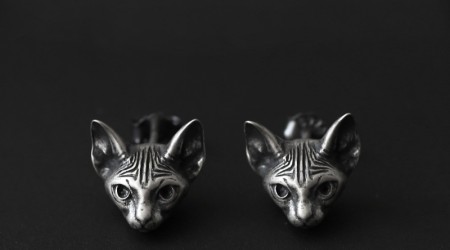
Skullearring’s sterling silver cat stud earrings use detailed Sphynx-cat faces. The product page is the correct source for its verified 925 sterling silver material, stud format and product presentation. The design is not described as a maneki-neko, Bastet amulet or supernatural object, so this article does not assign those meanings to it.
A buyer can choose the pair as a cat-lover gift, a reference to a Sphynx cat, or a personal style detail. Readers comparing materials and formats can browse the broader silver earrings collection. For the same evidence-first approach to other motifs, see our reviews of skull earrings and memento mori and sun-and-moon earring meanings.
Evidence limits
The objects cited here are examples, not a complete global history of cats in jewelry. Museum collections reflect survival, excavation, collecting practices and changing scholarship. Catalogue interpretations may be revised. The ancient Egyptian and Japanese records demonstrate multiple specific uses, but they cannot define an undocumented modern earring.
Conclusion
The most accurate answer is that cat earrings mean what their documented design and wearer context support. Ancient Egyptian cat objects can refer to Bastet and particular amuletic traditions; a recognizable maneki-neko can refer to a Japanese beckoning-cat tradition; other cat forms may be decorative, humorous or personal. A modern wearer does not need a universal legend to make the motif meaningful—honest personal meaning is stronger than an invented historical claim.
References
- The Metropolitan Museum of Art — Cat Amulet
- British Museum — The Gayer-Anderson Cat
- British Museum — Bronze Figure of Bastet with Gold-Wire Earrings
- British Museum — Bastet Amulet with Eight Kittens
- British Museum — Cat-Form Bastet Amulet with Ten Kittens
- British Museum — Maneki-neko (Beckoning Cat)
- The Metropolitan Museum of Art — Netsuke of Cat
- Smithsonian Libraries and Archives — Divine Felines
Short answer: Cat earrings do not have one universal meaning. A specific pair may refer to affection for cats, a pet, humour, independence, a cultural image such as the Japanese maneki-neko, or simply a design preference. Historical cat objects sometimes carried religious or amuletic roles, but those meanings belong to particular objects, places and periods. They should not be copied onto every modern cat-shaped earring.
Why “cat earrings meaning” has no one-line answer
A cat silhouette can look instantly familiar, but recognition is not the same as a fixed symbol. Meaning changes with the cat’s pose, accompanying objects, inscription, material, maker and cultural setting. A seated bronze figure made for an Egyptian religious context is not equivalent to a Japanese beckoning cat, and neither automatically defines a modern silver stud.
For jewelry, three evidence levels should be kept separate:
- Documented historical context: what a museum or primary record establishes about a particular object.
- Modern maker intent: what the designer or product documentation actually says.
- Personal meaning: what the wearer chooses the cat motif to represent.
All three can be meaningful, but they are not interchangeable. This distinction prevents a personal interpretation from being presented as universal history.
What museum objects actually support
| Object | Documented context | What the evidence supports | What it does not prove |
|---|---|---|---|
| Cat amulet, The Met | Egypt, ca. 1070–664 BCE; catalogue connects the form with Bastet | Some small cat forms participated in a specific Egyptian religious and amuletic setting. | That every cat jewel carries Bastet’s meaning or provides protection. |
| Gayer-Anderson cat | Egyptian Late Period, around 600 BCE; bronze form of Bastet | Cats had both domestic value and religious significance in ancient Egypt. | That cats were treated identically throughout Egyptian history or elsewhere. |
| Bastet figure with gold-wire earrings | British Museum bronze figure, Late Period | A documented Bastet cat figure itself has pierced ears and gold-wire earrings. | That a modern cat earring is a replica, religious object or talisman. |
| Maneki-neko figurine | Kyoto, 2000; beckoning pose associated with inviting customers | The raised-paw beckoning cat has a specific modern Japanese commercial and lucky-cat context. | That every cat face, cat stud or raised paw has the same interpretation. |
| Cat netsuke | Japan, 19th century | Cat imagery also appeared in small wearable Japanese objects outside the maneki-neko form. | A single universal Japanese “cat meaning.” |
Ancient Egypt: cats, Bastet and careful limits
The British Museum’s Gayer-Anderson cat is a bronze representation of Bastet dating to around 600 BCE. The museum explains that cats were valued in homes partly because they controlled mice, rats and snakes, while also acquiring religious significance. It also makes an important correction to a popular oversimplification: cats were associated with divine manifestations, but the museum does not describe every cat as simply “a sacred animal” in the modern slogan-like sense.
The Metropolitan Museum of Art’s cat amulet, dated approximately 1070–664 BCE, connects its feline form to Bastet and to a specific body of Egyptian myth and ritual. This is strong evidence for that object’s cultural setting. It is not evidence that wearing a cat motif today invokes Bastet, changes luck or creates a protective effect.
Jewelry has an unusually direct connection to one British Museum object: its bronze figure of Bastet as a seated cat has pierced ears containing gold-wire earrings. The catalogue documents the object, materials and construction. It does not provide a universal meaning for cat earrings, but it shows that the visual relationship between cats and earrings has a genuine historical example.
Motherhood and fertility claims: object-specific, not universal
Some Egyptian cat amulets include kittens. The British Museum catalogues a Bastet amulet with eight kittens and another cat-form amulet attended by ten kittens. The latter record discusses fertility-related hopes within that ancient context.
That evidence should be handled narrowly. It supports the interpretation of particular Egyptian amulets and their documented religious setting. It does not mean that all cat jewelry symbolizes motherhood, fertility or femininity. It certainly does not establish any physical, medical or fertility effect. A modern cat stud without kittens, inscriptions or maker documentation should not inherit those claims merely because its outline is feline.
Japan: when is a cat actually a maneki-neko?
The British Museum’s maneki-neko is a ceramic beckoning cat made in Kyoto in 2000. Its raised paw imitates a Japanese beckoning gesture, and the museum notes that such figures are often placed near shops to encourage customers to enter. The record also warns indirectly against rigid formulas: paw position and colour vary, and their interpretations are typical rather than universal.
A cat motif qualifies as maneki-neko through recognizable form and context, not simply because it is a cat. An ordinary cat face, anatomical cat profile or pet portrait is not automatically a lucky cat. Saying otherwise turns a specific cultural form into a generic marketing claim.
Japanese cat imagery is broader than beckoning cats. The Met’s nineteenth-century cat netsuke documents a small cat sculpture made to function with traditional dress. The Smithsonian Libraries record for Divine Felines: The Cat in Japanese Art summarizes a much wider range: domestic companions, lucky cats, humour, supernatural stories and artistic subjects. Japan therefore supplies multiple cat contexts, not one fixed meaning.
What cat earrings can mean today
For a contemporary wearer, the most defensible meanings usually come from personal intent:
- Affection for a pet or for cats generally. A recognizable cat face can work as a quiet statement of identity or companionship.
- Memory. A cat motif may commemorate a particular animal, provided that meaning comes from the wearer rather than a historical claim.
- Humour or playfulness. Cat expressions and silhouettes can make small-scale jewelry visually witty.
- Independence or curiosity. These are reasonable modern associations when described as personal readings, not universal symbolism.
- A specific cultural reference. This is appropriate when the design clearly depicts a documented form such as maneki-neko and the context is named accurately.
No cat-shaped earring has demonstrated powers to attract wealth, protect health, increase intuition, heal grief or change energy. Historical amulets document belief and use; they do not scientifically prove the claimed effect.
A five-question interpretation test
- What is actually depicted? A cat face, whole cat, cat with kittens and beckoning cat are different designs.
- Is there an inscription or named cultural form? Specific evidence is stronger than resemblance.
- What does the maker document? Product information can establish material and design intent, but should not invent history.
- Is the claim historical or personal? “I wear it to remember my cat” is different from “cats have always meant protection.”
- Does the claim promise an effect? Luck, healing and protection claims require evidence that a motif alone does not provide.
Applying the framework to a Skullearring product
Skullearring’s sterling silver cat stud earrings use detailed Sphynx-cat faces. The product page is the correct source for its verified 925 sterling silver material, stud format and product presentation. The design is not described as a maneki-neko, Bastet amulet or supernatural object, so this article does not assign those meanings to it.
A buyer can choose the pair as a cat-lover gift, a reference to a Sphynx cat, or a personal style detail. Readers comparing materials and formats can browse the broader silver earrings collection. For the same evidence-first approach to other motifs, see our reviews of skull earrings and memento mori and sun-and-moon earring meanings.
Evidence limits
The objects cited here are examples, not a complete global history of cats in jewelry. Museum collections reflect survival, excavation, collecting practices and changing scholarship. Catalogue interpretations may be revised. The ancient Egyptian and Japanese records demonstrate multiple specific uses, but they cannot define an undocumented modern earring.
Conclusion
The most accurate answer is that cat earrings mean what their documented design and wearer context support. Ancient Egyptian cat objects can refer to Bastet and particular amuletic traditions; a recognizable maneki-neko can refer to a Japanese beckoning-cat tradition; other cat forms may be decorative, humorous or personal. A modern wearer does not need a universal legend to make the motif meaningful—honest personal meaning is stronger than an invented historical claim.
References
- The Metropolitan Museum of Art — Cat Amulet
- British Museum — The Gayer-Anderson Cat
- British Museum — Bronze Figure of Bastet with Gold-Wire Earrings
- British Museum — Bastet Amulet with Eight Kittens
- British Museum — Cat-Form Bastet Amulet with Ten Kittens
- British Museum — Maneki-neko (Beckoning Cat)
- The Metropolitan Museum of Art — Netsuke of Cat
- Smithsonian Libraries and Archives — Divine Felines
<p><strong>Short answer:</strong> Cat earrings do not have one universal meaning. A specific pair may refer to affection for cats, a pet, humour, independence, a cultural image such as the Japanese <em>maneki-neko</em>, or simply a design preference. Historical cat objects sometimes carried religious or amuletic roles, but those meanings belong to particular objects, places and periods. They should not be copied onto every modern cat-shaped earring.</p>
<h2>Why “cat earrings meaning” has no one-line answer</h2>
<p>A cat silhouette can look instantly familiar, but recognition is not the same as a fixed symbol. Meaning changes with the cat’s pose, accompanying objects, inscription, material, maker and cultural setting. A seated bronze figure made for an Egyptian religious context is not equivalent to a Japanese beckoning cat, and neither automatically defines a modern silver stud.</p>
<p>For jewelry, three evidence levels should be kept separate:</p>
<ol>
<li><strong>Documented historical context:</strong> what a museum or primary record establishes about a particular object.</li>
<li><strong>Modern maker intent:</strong> what the designer or product documentation actually says.</li>
<li><strong>Personal meaning:</strong> what the wearer chooses the cat motif to represent.</li>
</ol>
<p>All three can be meaningful, but they are not interchangeable. This distinction prevents a personal interpretation from being presented as universal history.</p>
<h2>What museum objects actually support</h2>
<table>
<thead><tr><th>Object</th><th>Documented context</th><th>What the evidence supports</th><th>What it does not prove</th></tr></thead>
<tbody>
<tr><td>Cat amulet, The Met</td><td>Egypt, ca. 1070–664 BCE; catalogue connects the form with Bastet</td><td>Some small cat forms participated in a specific Egyptian religious and amuletic setting.</td><td>That every cat jewel carries Bastet’s meaning or provides protection.</td></tr>
<tr><td>Gayer-Anderson cat</td><td>Egyptian Late Period, around 600 BCE; bronze form of Bastet</td><td>Cats had both domestic value and religious significance in ancient Egypt.</td><td>That cats were treated identically throughout Egyptian history or elsewhere.</td></tr>
<tr><td>Bastet figure with gold-wire earrings</td><td>British Museum bronze figure, Late Period</td><td>A documented Bastet cat figure itself has pierced ears and gold-wire earrings.</td><td>That a modern cat earring is a replica, religious object or talisman.</td></tr>
<tr><td>Maneki-neko figurine</td><td>Kyoto, 2000; beckoning pose associated with inviting customers</td><td>The raised-paw beckoning cat has a specific modern Japanese commercial and lucky-cat context.</td><td>That every cat face, cat stud or raised paw has the same interpretation.</td></tr>
<tr><td>Cat netsuke</td><td>Japan, 19th century</td><td>Cat imagery also appeared in small wearable Japanese objects outside the maneki-neko form.</td><td>A single universal Japanese “cat meaning.”</td></tr>
</tbody>
</table>
<h2>Ancient Egypt: cats, Bastet and careful limits</h2>
<p>The <a href="https://www.britishmuseum.org/collection/animals/gayer-anderson-cat" rel="noopener" target="_blank">British Museum’s Gayer-Anderson cat</a> is a bronze representation of Bastet dating to around 600 BCE. The museum explains that cats were valued in homes partly because they controlled mice, rats and snakes, while also acquiring religious significance. It also makes an important correction to a popular oversimplification: cats were associated with divine manifestations, but the museum does not describe every cat as simply “a sacred animal” in the modern slogan-like sense.</p>
<p>The <a href="https://www.metmuseum.org/en/art/collection/search/553799" rel="noopener" target="_blank">Metropolitan Museum of Art’s cat amulet</a>, dated approximately 1070–664 BCE, connects its feline form to Bastet and to a specific body of Egyptian myth and ritual. This is strong evidence for that object’s cultural setting. It is not evidence that wearing a cat motif today invokes Bastet, changes luck or creates a protective effect.</p>
<p>Jewelry has an unusually direct connection to one British Museum object: its <a href="https://www.britishmuseum.org/collection/object/Y_EA58517" rel="noopener" target="_blank">bronze figure of Bastet as a seated cat</a> has pierced ears containing gold-wire earrings. The catalogue documents the object, materials and construction. It does not provide a universal meaning for cat earrings, but it shows that the visual relationship between cats and earrings has a genuine historical example.</p>
<h2>Motherhood and fertility claims: object-specific, not universal</h2>
<p>Some Egyptian cat amulets include kittens. The British Museum catalogues a <a href="https://www.britishmuseum.org/collection/object/Y_EA27191" rel="noopener" target="_blank">Bastet amulet with eight kittens</a> and another <a href="https://www.britishmuseum.org/collection/object/Y_EA26239" rel="noopener" target="_blank">cat-form amulet attended by ten kittens</a>. The latter record discusses fertility-related hopes within that ancient context.</p>
<p>That evidence should be handled narrowly. It supports the interpretation of particular Egyptian amulets and their documented religious setting. It does not mean that all cat jewelry symbolizes motherhood, fertility or femininity. It certainly does not establish any physical, medical or fertility effect. A modern cat stud without kittens, inscriptions or maker documentation should not inherit those claims merely because its outline is feline.</p>
<h2>Japan: when is a cat actually a maneki-neko?</h2>
<p>The <a href="https://www.britishmuseum.org/collection/object/A_As2001-16-25-a-b" rel="noopener" target="_blank">British Museum’s maneki-neko</a> is a ceramic beckoning cat made in Kyoto in 2000. Its raised paw imitates a Japanese beckoning gesture, and the museum notes that such figures are often placed near shops to encourage customers to enter. The record also warns indirectly against rigid formulas: paw position and colour vary, and their interpretations are typical rather than universal.</p>
<p>A cat motif qualifies as maneki-neko through recognizable form and context, not simply because it is a cat. An ordinary cat face, anatomical cat profile or pet portrait is not automatically a lucky cat. Saying otherwise turns a specific cultural form into a generic marketing claim.</p>
<p>Japanese cat imagery is broader than beckoning cats. The Met’s <a href="https://www.metmuseum.org/art/collection/search/59775" rel="noopener" target="_blank">nineteenth-century cat netsuke</a> documents a small cat sculpture made to function with traditional dress. The Smithsonian Libraries record for <a href="https://www.si.edu/object/divine-felines-cat-japanese-art-rhiannon-paget%3Asiris_sil_1168567" rel="noopener" target="_blank"><em>Divine Felines: The Cat in Japanese Art</em></a> summarizes a much wider range: domestic companions, lucky cats, humour, supernatural stories and artistic subjects. Japan therefore supplies multiple cat contexts, not one fixed meaning.</p>
<h2>What cat earrings can mean today</h2>
<p>For a contemporary wearer, the most defensible meanings usually come from personal intent:</p>
<ul>
<li><strong>Affection for a pet or for cats generally.</strong> A recognizable cat face can work as a quiet statement of identity or companionship.</li>
<li><strong>Memory.</strong> A cat motif may commemorate a particular animal, provided that meaning comes from the wearer rather than a historical claim.</li>
<li><strong>Humour or playfulness.</strong> Cat expressions and silhouettes can make small-scale jewelry visually witty.</li>
<li><strong>Independence or curiosity.</strong> These are reasonable modern associations when described as personal readings, not universal symbolism.</li>
<li><strong>A specific cultural reference.</strong> This is appropriate when the design clearly depicts a documented form such as maneki-neko and the context is named accurately.</li>
</ul>
<p>No cat-shaped earring has demonstrated powers to attract wealth, protect health, increase intuition, heal grief or change energy. Historical amulets document belief and use; they do not scientifically prove the claimed effect.</p>
<h2>A five-question interpretation test</h2>
<ol>
<li><strong>What is actually depicted?</strong> A cat face, whole cat, cat with kittens and beckoning cat are different designs.</li>
<li><strong>Is there an inscription or named cultural form?</strong> Specific evidence is stronger than resemblance.</li>
<li><strong>What does the maker document?</strong> Product information can establish material and design intent, but should not invent history.</li>
<li><strong>Is the claim historical or personal?</strong> “I wear it to remember my cat” is different from “cats have always meant protection.”</li>
<li><strong>Does the claim promise an effect?</strong> Luck, healing and protection claims require evidence that a motif alone does not provide.</li>
</ol>
<h2>Applying the framework to a Skullearring product</h2>
<p>Skullearring’s <a href="https://skullearring.com/cat-stud-earrings-925-silver-cat-earrings-for-women">sterling silver cat stud earrings</a> use detailed Sphynx-cat faces. The product page is the correct source for its verified 925 sterling silver material, stud format and product presentation. The design is not described as a maneki-neko, Bastet amulet or supernatural object, so this article does not assign those meanings to it.</p>
<p>A buyer can choose the pair as a cat-lover gift, a reference to a Sphynx cat, or a personal style detail. Readers comparing materials and formats can browse the broader <a href="https://skullearring.com/silver-earrings">silver earrings collection</a>. For the same evidence-first approach to other motifs, see our reviews of <a href="https://skullearring.com/silver-earring-journal/skull-earrings-meaning-memento-mori-vanitas">skull earrings and memento mori</a> and <a href="https://skullearring.com/silver-earring-journal/sun-moon-earrings-meaning-history-symbolism">sun-and-moon earring meanings</a>.</p>
<h2>Evidence limits</h2>
<p>The objects cited here are examples, not a complete global history of cats in jewelry. Museum collections reflect survival, excavation, collecting practices and changing scholarship. Catalogue interpretations may be revised. The ancient Egyptian and Japanese records demonstrate multiple specific uses, but they cannot define an undocumented modern earring.</p>
<h2>Conclusion</h2>
<p>The most accurate answer is that cat earrings mean what their documented design and wearer context support. Ancient Egyptian cat objects can refer to Bastet and particular amuletic traditions; a recognizable maneki-neko can refer to a Japanese beckoning-cat tradition; other cat forms may be decorative, humorous or personal. A modern wearer does not need a universal legend to make the motif meaningful—honest personal meaning is stronger than an invented historical claim.</p>
<h2>References</h2>
<ul>
<li><a href="https://www.metmuseum.org/en/art/collection/search/553799" rel="noopener" target="_blank">The Metropolitan Museum of Art — Cat Amulet</a></li>
<li><a href="https://www.britishmuseum.org/collection/animals/gayer-anderson-cat" rel="noopener" target="_blank">British Museum — The Gayer-Anderson Cat</a></li>
<li><a href="https://www.britishmuseum.org/collection/object/Y_EA58517" rel="noopener" target="_blank">British Museum — Bronze Figure of Bastet with Gold-Wire Earrings</a></li>
<li><a href="https://www.britishmuseum.org/collection/object/Y_EA27191" rel="noopener" target="_blank">British Museum — Bastet Amulet with Eight Kittens</a></li>
<li><a href="https://www.britishmuseum.org/collection/object/Y_EA26239" rel="noopener" target="_blank">British Museum — Cat-Form Bastet Amulet with Ten Kittens</a></li>
<li><a href="https://www.britishmuseum.org/collection/object/A_As2001-16-25-a-b" rel="noopener" target="_blank">British Museum — Maneki-neko (Beckoning Cat)</a></li>
<li><a href="https://www.metmuseum.org/art/collection/search/59775" rel="noopener" target="_blank">The Metropolitan Museum of Art — Netsuke of Cat</a></li>
<li><a href="https://www.si.edu/object/divine-felines-cat-japanese-art-rhiannon-paget%3Asiris_sil_1168567" rel="noopener" target="_blank">Smithsonian Libraries and Archives — Divine Felines</a></li>
</ul>
Related Products
Leave a comment