Direct answer: A Möbius earring does not carry one universal historical meaning. The reliable starting point is mathematical: a true Möbius strip is made by giving a band a half-twist and joining its ends, producing one continuous side and one boundary edge. Designers and wearers often use that continuous form as a modern metaphor for continuity, connection, an open-ended journey or change. Those readings can be meaningful, but they are interpretations—not scientific properties, ancient facts or promises of luck, protection, healing or “energy.”
That distinction matters when shopping. A listing may show a literal closed Möbius band, a visual infinity loop, a twisted hoop or simply a curve inspired by the idea. The name describes design inspiration; it does not by itself verify metal purity, construction, size, weight, closure or how many earrings are included.
What is a Möbius strip?
The simplest demonstration uses paper. Take a rectangular strip, turn one end through 180 degrees, and join the two ends. The result is not an ordinary cylinder. The National High Magnetic Field Laboratory explains that a Möbius strip has one side and one edge: a line drawn continuously along its middle returns to its starting point after passing through what initially looked like both sides.
This is a property of topology—the branch of mathematics concerned with continuity and the relationships of surfaces. It is not the same as saying that every twisted oval, figure-eight pendant or open hoop is mathematically a Möbius strip. A true strip is a continuous joined surface. Jewelry often translates the visual idea into wearable form, and practical requirements such as an opening, post, hinge or clasp can change the topology.
| Label | What it can reasonably describe | What it does not prove |
|---|---|---|
| True Möbius strip | A joined band with a half-twist, one continuous side and one boundary edge | Metal, size, comfort, durability or symbolism |
| Möbius-inspired | A design that borrows the twist, flow or continuous-loop appearance | That the finished piece is a closed topological strip |
| Infinity-inspired | A visual metaphor for continuation or recurrence | Historical origin, spiritual effect or mathematical equivalence |
| Open hoop | A wearable C-shaped form with an opening and a fastening system | That it is literally endless or that both earrings are included |
Who discovered the form?
The familiar name points to the German mathematician and astronomer August Ferdinand Möbius. The University of St Andrews MacTutor history records that Möbius investigated one-sided surfaces in work connected with an 1858 geometry problem. It also gives an important correction to the simplified story: Johann Benedict Listing has precedence by discovery and publication criteria. The National MagLab likewise describes Möbius and Listing as independent discoverers in 1858.
So “Möbius” is a conventional mathematical name, not proof that Möbius invented every twisted-loop design and not evidence of an ancient jewelry tradition. The form’s documented history belongs to nineteenth-century mathematics; the meanings attached to modern jewelry came later and vary by maker and wearer.
Why does the Möbius form appear in art?
A continuous surface is visually compelling because it unsettles ordinary expectations about inside and outside. Museums provide concrete examples of artists using that idea without requiring a universal symbolic reading.
- The National Gallery of Art records M.C. Escher’s 1963 woodcut Mobius Strip II. Its ants travel around a continuous twisted surface, making the topology visible.
- The Smithsonian Institution catalogues Robert R. Wilson’s 1974 Mobius Strip sculpture, made from stainless-steel cords on a tubular steel form.
- Harvard’s Collection of Historical Scientific Instruments documents Wilson’s 1978 bronze Topological III, a related three-dimensional analog whose rotating triangular cross-section creates one continuous surface.
These records establish a real mathematics-to-art lineage. They do not establish that every Möbius earring means eternal love, fate, protection or spiritual balance. Each work and each jewelry design needs its own context.
What can Möbius earrings mean today?
Continuity
Because a path can continue around the strip without encountering a conventional “other side,” continuity is a natural modern metaphor. A wearer might connect it with sustained learning, a long relationship, repeated practice or a project that evolves rather than simply ending.
Connection without a simple inside and outside
The joined surface can suggest that categories which look separate are connected. That interpretation can work for a partnership, a mixed cultural background, a change of career or the relationship between mathematics and art. It is a personal reading, not a theorem.
A new chapter or open-ended path
Designers sometimes use the flowing loop as a milestone metaphor—for graduation, promotion or a new stage of life. An open hoop can add another visual idea: the path is still being made. Again, this is design language, not a guarantee that wearing the object changes an outcome.
Personal meaning
The most defensible answer may be the wearer’s own. A mathematically trained buyer may value the topology; an artist may value the continuous line; another person may simply like the asymmetry. None of those requires inventing an ancient legend.
How to read a Möbius earring listing
Treat the motif name as the beginning of verification, not the end. A useful listing should answer five separate questions.
- Is the form literal or inspired? Look for a closed twisted band, an open C-shaped hoop, a figure-eight, or another sculptural interpretation. Product photographs from several angles help.
- What is each component made from? “Silver earring” may not describe every post, back, inlay or coating. The U.S. Jewelry Guides in 16 CFR 23.5 state that “sterling silver” requires at least 925 parts per thousand silver and that silver-coated products need qualification.
- Is the gold inlaid or plated? These are different constructions. Use the dedicated guide to gold inlay, vermeil and gold-plated silver rather than assuming that every gold-colored panel is the same.
- What are the closure and wearing dimensions? A post-and-back open hoop behaves differently from a hinged clicker or continuous sleeper. Confirm weight and the exact measurement basis.
- Is the price for one or two? A model photo may show a pair even when the default purchase unit is one. The single-earring or pair guide explains what to verify before checkout.
The Federal Trade Commission’s consumer advice on precious-metal jewelry explains that 925 indicates 925 parts per thousand silver and that 24K denotes pure gold in the karat system. Those definitions help interpret a listing, but they do not authenticate a specific piece from a photograph.
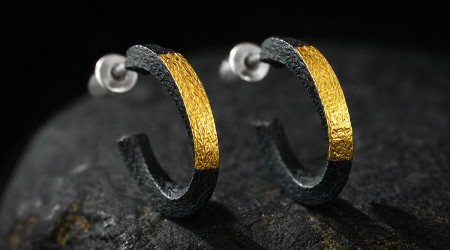
Verified product example: BJ-207
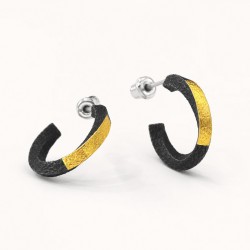
Skullearring’s Möbius-inspired black hoop, model BJ-207, is a useful example precisely because the page distinguishes design story from product specification.
| Field | Verified live-page statement | Boundary |
|---|---|---|
| Form | Möbius-inspired open C-shaped small hoop | It is not described as a literal closed Möbius strip |
| Body metal | Oxidized 999 fine silver | The body is not described as 925 sterling silver |
| Gold detail | 24K gold inlay | The page says inlay, not plating |
| Back | Straight post with separate S925 silver push-back closure | The back is a distinct 925 component |
| Weight | Approximately 1.9 g, excluding the back | This is the listed basis, not a universal weight for the design |
| Purchase unit | Single earring or Pair (2 Earrings) | The buyer must select the desired option |
The page frames the design as an “open path” connected with learning, progress and moving beyond familiar boundaries. That is the workshop’s stated interpretation. Readers may adopt it, reject it or give the form a different personal meaning; it should not be retold as an ancient or universal belief.
For the construction context, see what 24K gold inlay means. For the blackened surface, use the guide to satin, polished and oxidized silver finishes. The broader silver earrings collection provides other verified forms for comparison.
Care follows construction, not symbolism
A meaningful motif does not change the physical needs of the materials. For this example, the live page advises dry, separate storage; avoiding perfume, chlorine, salt water, harsh chemicals and abrasive cleaners; and wiping gently with a soft, dry jewelry cloth. It also warns against aggressive polishing of the oxidized silver or textured 24K gold panel because that can change the intended finish.
Do not transfer that routine blindly to every Möbius-labelled earring. A plated, stone-set, glued, hollow, enamelled or differently finished design may require other care. Confirm the materials and follow the product-specific instructions.
Frequently asked questions
Is a Möbius symbol the same as the infinity symbol?
No. They can look related and both can inspire continuity metaphors, but they are not interchangeable definitions. The infinity symbol is a mathematical notation; a Möbius strip is a one-sided surface made by joining a half-twisted band.
Does a Möbius earring mean eternal love?
It can mean that to a giver or wearer, but no authoritative source establishes eternal love as the form’s universal or ancient jewelry meaning. Label it as personal or modern gift symbolism.
Does “Möbius” verify the metal?
No. It describes a design idea. Verify body metal, posts, backs, inlay or plating, surface finish and any stones separately.
Is every twisted hoop a true Möbius strip?
No. A mathematically faithful strip must be joined after a half-twist. Many wearable designs are open or only visually inspired by the flow of the surface.
Can a Möbius earring have a different metal back?
Yes. Finished earrings can combine parts. The BJ-207 example lists a 999 fine-silver body and a separate S925 silver push-back. Read the component fields rather than extending one metal claim to the whole assembly.
Conclusion
The strongest meaning of a Möbius earring begins with a verifiable idea: a one-sided mathematical surface that has moved into modern art and design. Continuity, connection and an open-ended journey are reasonable present-day interpretations, but they are not universal history or supernatural effects. When buying, keep metaphor and specification in separate columns. Confirm whether the form is literal or inspired, then verify every material, closure, weight and purchase-unit field that matters.
Sources
- University of St Andrews: August Ferdinand Möbius
- National MagLab: Möbius Strip
- Smithsonian Institution: Mobius Strip sculpture
- National Gallery of Art: M.C. Escher’s Mobius Strip II
- Harvard CHSI: Topological III
- eCFR: 16 CFR 23.5, silver-content representations
- FTC Consumer Advice: Buying Platinum, Gold, and Silver Jewelry
Leave a comment