Direct answer: a solid opal is cut from one piece of opal material; an opal doublet joins a slice of opal to a backing; and an opal triplet adds a transparent cap above a thin opal layer and backing. None of those constructions is automatically “fake,” but they are not interchangeable descriptions. The construction changes what the seller should disclose, what a buyer can reasonably compare, and how cautiously the earrings should be cleaned and exposed to moisture.
The most reliable buying rule is simple: ask for the construction in writing before comparing price or care advice. A front photograph may show colour, but it may not reveal a backing, clear cap, adhesive layer, treatment or closed setting. If the listing says only “opal,” record the construction as unknown rather than silently upgrading it to “solid opal.”
What the three terms mean
The terms describe construction, not a beauty ranking. GIA’s opal quality guide describes a triplet as a thin opal layer cemented between a domed transparent top—such as colourless quartz or clear glass—and a backing. Geoscience Australia likewise distinguishes solid opal from assembled doublets and triplets. The CIBJO Gemstone Blue Book treats doublets and triplets as composite stones and provides specific nomenclature for their description.
| Construction | What is physically present | What to ask the seller | Main care uncertainty |
|---|---|---|---|
| Solid opal | One piece of opal material, without an attached backing or transparent cap | Natural or laboratory-created? Any impregnation, dye, smoke, sugar-acid or other treatment? | Opal variety, treatment, stability and the rest of the earring construction |
| Opal doublet | An opal slice bonded to a separate backing | What is the backing, and how is the assembly bonded and set? | Moisture, heat and chemicals can involve both the opal and the bonded interface |
| Opal triplet | A thin opal layer between a backing and transparent cap | What are the cap and backing materials, and are special care limits supplied? | The cap, cemented joins and thin opal layer must all be considered |
A composite can contain natural opal. “Composite” describes the assembled object; it does not by itself say that every layer is natural or that none is. Conversely, “natural opal” does not necessarily answer whether the finished stone is solid or assembled. The buyer needs both the identity of the opal component and the construction of the finished gem.
Why this matters more in earrings than a loose stone
An earring is a system: gemstone, mounting, post or hook, back, soldered joints, surface finish and sometimes adhesive. Once an opal is set, the bezel or frame can hide its side and back. A perfectly centred front photograph may make a solid, doublet and triplet look similar. That is why a listing, invoice, laboratory report or care card is stronger evidence than visual confidence from one angle.
Ear studs also combine small scale with close skin contact. That makes truthful material descriptions useful for reasons beyond gem value. A buyer may need to know the metal in the post and back separately from the decorative front. For broader metal terminology, see our evidence-based guide to 925 sterling silver versus 999 fine silver earrings. This article does not infer post composition from the gemstone name.
A six-question buyer’s disclosure test
1. Does the listing state solid, doublet or triplet?
If it says “solid natural opal,” that is a testable claim. If it says “opal doublet” or “opal triplet,” the assembly is disclosed. If it says only “opal,” the safest interpretation is that construction has not been established from the text. Ask the seller to clarify in writing.
2. Is the opal natural, laboratory-created or imitation?
This is a different axis from construction. GIA’s introduction to simulants and imitation gem materials explains that doublets and triplets are joined constructions, while imitation concerns a material used to resemble another. A triplet may include a natural opal layer; a solid-looking object may be laboratory-created or an imitation. One word cannot answer both questions.
3. Are treatments disclosed?
The U.S. Federal Trade Commission’s guidance for gemstone advertising says sellers should disclose certain treatments, including when a treatment is not permanent, creates special care requirements, or significantly affects value. The FTC’s Jewelry Guides also address accurate representations of type, quality, treatment and other material facts. Ask whether the opal is dyed, impregnated, smoked, coated or otherwise treated, and request the matching care limits.
4. What are the backing and cap?
“Doublet” and “triplet” count layers; they do not name every layer. GIA notes that triplet caps can be clear glass or colourless quartz and backings can include several dark materials. Those differences affect identification, scratching behaviour and repair decisions. A precise invoice is more useful than a generic “opal jewelry” label.
5. Can the side and back be inspected?
Ask for sharp, neutral-light photographs of the front, side and back. A straight join line, dark backing or clear top may support a composite identification, but absence of an obvious line in a photograph does not prove solidity. A bezel can conceal the interface, reflections can create false lines, and image processing can erase subtle detail. When value depends on the answer, use an independent qualified gemmologist.
6. Is care advice specific to the construction?
Generic instructions such as “clean like any gemstone” are not enough. GIA’s opal care guidance recommends warm soapy water and warns about heat and sudden temperature changes. For a composite, the cap, backing and cemented interfaces add variables. Our separate guide explains a conservative method for cleaning opal earrings safely; it treats unidentified construction as a reason for restraint, not experimentation.
What photographs can and cannot prove
A photograph can document visible facts: body colour, play-of-colour, surface scratches, setting style and whether a side or back is exposed. It can sometimes reveal obvious layers. It cannot reliably establish geographic origin, undisclosed treatment, internal stability or a hidden bond. A phone camera also changes white balance, contrast and saturation, so it should not be used to assign a grade or value.
The seller’s responsibility and the buyer’s inspection are complementary. The seller should describe material facts accurately. The buyer should preserve the listing, invoice and care card. If the piece is expensive, insured, inherited or represented as rare, a report from an independent gemmological laboratory can be proportionate to the decision.
Do not equate construction with automatic quality
“Solid” does not guarantee excellent colour, cutting, stability or workmanship. “Triplet” does not automatically mean unattractive or unusable. Construction is one fact among several. GIA evaluates opal through factors such as play-of-colour, pattern, body colour, brightness and transparency; the finished earring also depends on setting security, symmetry, post alignment, back fit and surface finish.
Price comparisons must therefore be like-for-like. Compare a disclosed solid opal earring with another disclosed solid opal earring of reasonably comparable size, appearance, treatment status, metal and workmanship. A vivid triplet and a solid opal may serve different budgets and care preferences; they should not be presented as the same physical product.
A decision framework for choosing earrings
- Start with disclosure. Reject ambiguity when construction materially affects the purchase.
- Match care tolerance. If you routinely expose earrings to water, cosmetics or heat, choose only after reading construction-specific care.
- Check the whole earring. Confirm stone, setting, post, back, plating and intentional oxidation separately.
- Compare total workmanship. Inspect security, alignment, finish and comfort—not only colour.
- Escalate when stakes are high. Obtain independent testing when price, insurance or provenance depends on the claim.
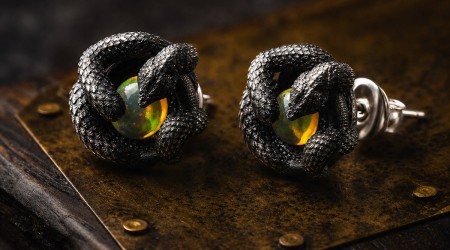
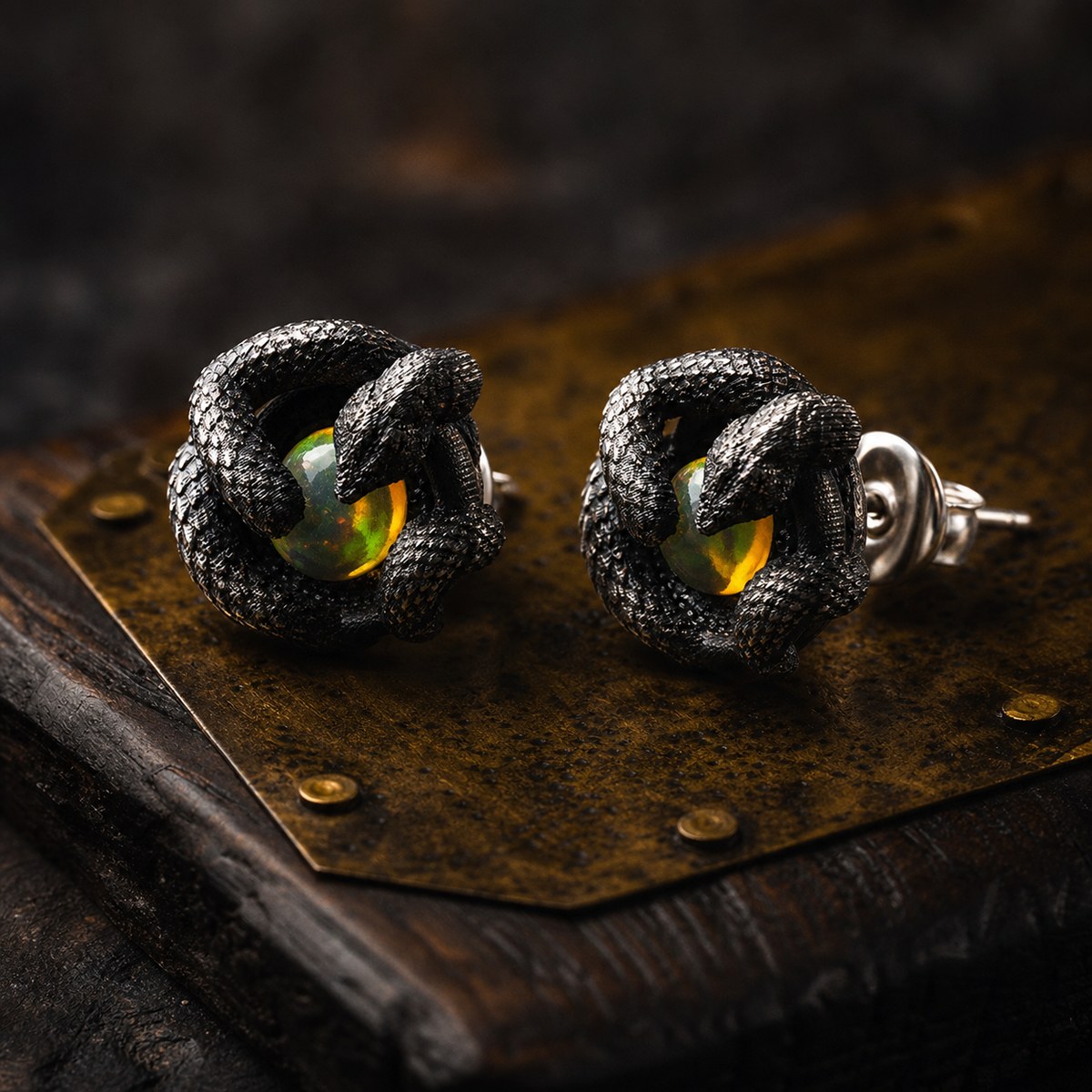
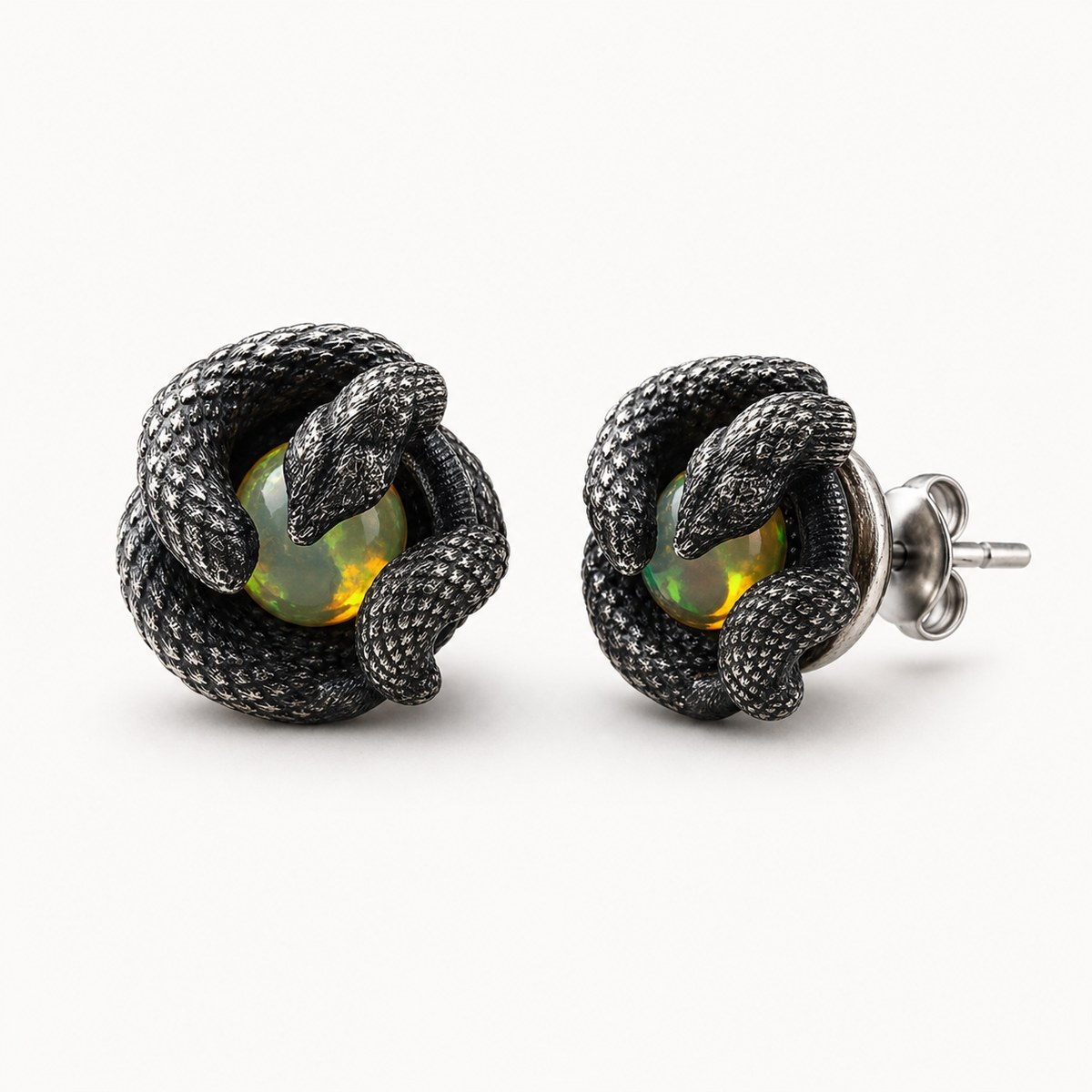
Skullearring’s natural-opal snake stud is described as natural opal in an oxidized silver design and is available as a single or pair. That wording does not, by itself, establish solid, doublet or triplet construction. We therefore use it here only to show how a dark setting can frame the visible stone and why a product description must not be expanded beyond its documented facts.
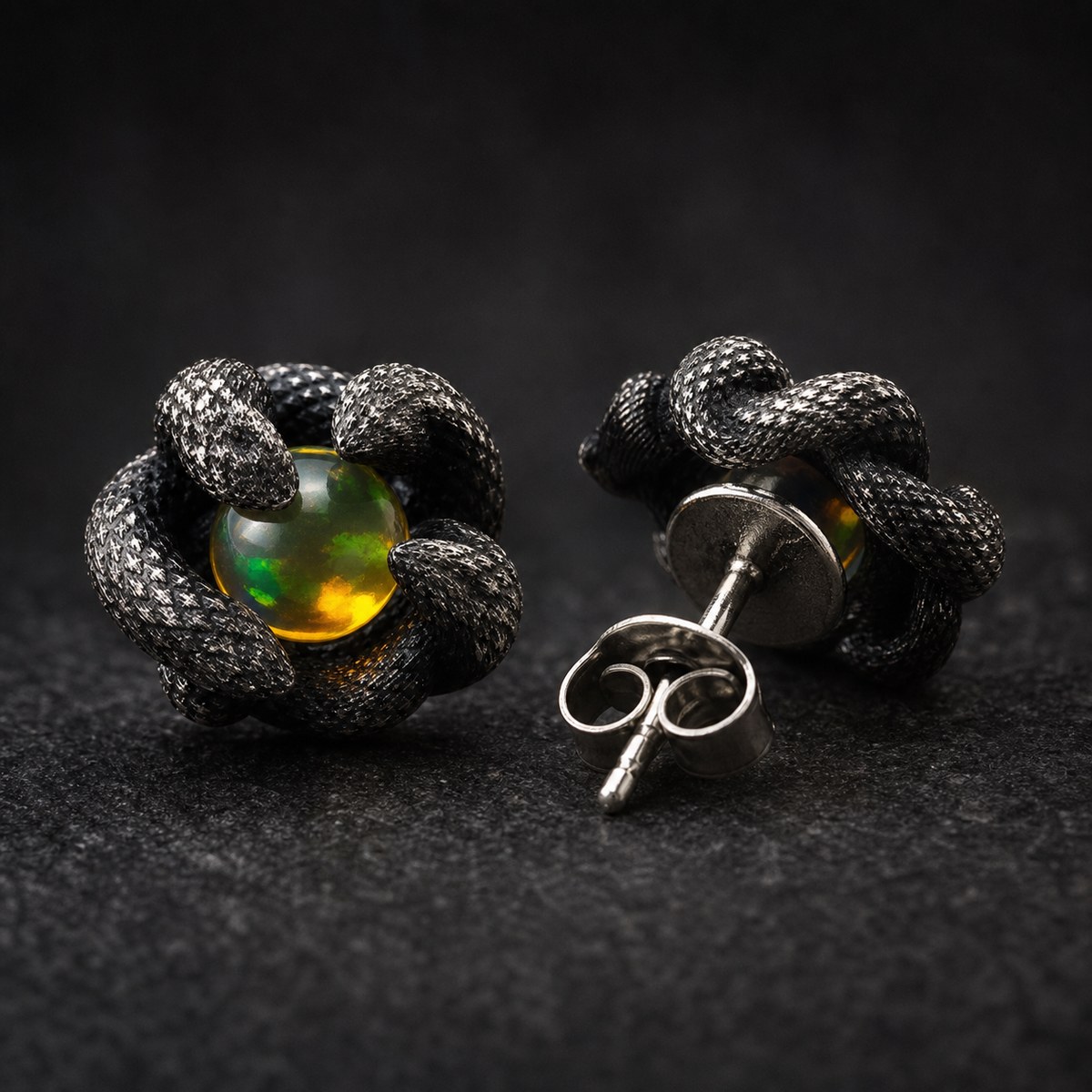
For more examples of how design language and material evidence should be separated, see the snake earrings meaning and history guide. Cultural symbolism can describe documented traditions; it cannot verify a gemstone’s construction or promise a physical or spiritual effect.
Care consequences without overclaiming
All opal earrings deserve protection from sharp impacts, high heat and aggressive cleaners. Composite construction adds bonded interfaces and potentially different cap and backing materials. That does not let us calculate a universal lifespan or failure probability. It does justify asking for construction-specific instructions and avoiding prolonged soaking when the assembly is unknown.
Do not use an ultrasonic cleaner, steam cleaner, boiling water, bleach, ammonia, silver dip or abrasive polish on an opal earring unless a qualified professional who has examined the whole piece specifies the method. If an earring has intentional dark recesses, aggressive polishing can also erase the designed contrast; our oxidized silver care guide explains that surface separately.
Stop home cleaning if the stone moves, a layer appears to lift, a cap looks cloudy, a crack grows, the bezel is distorted, or the post is loose. Cleaning cannot repair structural damage. Store each earring so the opal does not rub against another jewel, and keep the written description with the pair.
Common claims to challenge
“Doublet means fake.” Too broad. A doublet is a composite construction and may include natural opal. The correct question is what every layer is and whether the assembly was accurately disclosed.
“Natural opal means solid opal.” Not necessarily. “Natural” can describe the opal component; “solid,” “doublet” and “triplet” describe construction. Ask both questions.
“You can always identify a triplet from the front.” Not reliably. A transparent cap may create visible clues, but a photograph or mounted stone can hide interfaces. Treat visual inspection as screening, not definitive testing.
“Triplets are always more durable.” A cap may protect the thin opal surface from some contact, but the finished object also includes bonded joins, backing, setting and care history. No single construction word proves overall durability.
“Opal has healing or luck-giving power.” Cultural associations can be discussed with a specific source and context, but they are not clinical evidence and do not establish a guaranteed outcome. This guide makes no medical, emotional or supernatural claim.
FAQ
Is an opal doublet real opal?
It can contain a natural opal layer bonded to a separate backing. The complete item is a composite. Ask whether the opal component is natural or laboratory-created and what the backing and adhesive are.
Is an opal triplet a synthetic opal?
Not by definition. “Triplet” means three-part construction. The opal layer may be natural, laboratory-created or imitation, so the seller must identify both construction and material.
Can I tell a solid opal from a doublet while it is set?
Sometimes an exposed side or back shows a join, but a bezel may conceal it. A photo cannot rule out hidden layers. Ask for documentation or independent examination when the answer affects value.
Which construction is best for earrings?
There is no universal best. Choose according to disclosed materials, workmanship, price, appearance, care requirements and your willingness to protect the piece. Accurate description matters more than marketing hierarchy.
Can doublet or triplet earrings be soaked?
Avoid prolonged soaking unless the maker supplies construction-specific instructions. Bonded layers introduce uncertainties that are absent from a verified one-piece gem. Use the least aggressive cleaning method and dry the whole earring.
What should appear on an invoice?
Ideally: opal construction, natural or laboratory-created status, relevant treatments, metal identity, quantity, and any special care requirements. Keep the invoice and original listing together.
Evidence limits and review date
This guide explains published nomenclature, disclosure principles and conservative care decisions. It cannot identify an individual stone from a web image, value an earring, verify origin, or replace a laboratory report. Product observations are limited to visible features and the wording of the current product page. Claims should be revised if laboratory evidence or supplier documentation changes.
Sources reviewed: GIA opal quality factors; GIA simulants and imitation materials; Geoscience Australia opal facts; CIBJO Gemstone Blue Book; U.S. FTC gemstone advertising guidance; GIA opal care and cleaning. Last reviewed: August 1, 2026.
Leave a comment