Inlaid and engraved initial earrings describe different aspects of lettering. Engraving cuts a design into a surface; metal inlay places another metal within prepared areas in many traditional techniques. They are not necessarily alternatives: a recess can be engraved before it is filled. For a buyer, the important question is whether the visible letter is a cut mark, a separate decorative material, or a combination—not whether one word sounds more luxurious.
This guide compares construction vocabulary for personalized studs. It does not identify a workshop process from a photograph or claim that every product sold as “inlay” uses the same technique. For alphabet, case and orientation decisions, use our separate letter-selection and proofing guide.
Engraving describes how a mark is made
The Victoria and Albert Museum's metalworking guide describes engraving as cutting lettering or decoration into metal. Its explanation distinguishes this from chasing, which works the surface without removing metal. Traditional engraving uses hand tools; modern equipment can also produce lettering. Consequently, “engraved” alone does not establish that a letter was cut by hand.
A plain engraved initial can be formed from the same metal as the surrounding face. It does not automatically contain gold simply because the photograph shows a bright or warm-colored line. Ask whether a contrasting material or finish has been added to the mark.
Inlay describes added material, but the method still matters
In its account of decorative metalworking techniques, The Metropolitan Museum of Art describes channels or recesses filled with another material. It also distinguishes metal hammered into undercut cavities from foil or wire worked onto a prepared surface. These are historical descriptions of arms and armor, not manufacturing specifications for modern silver studs.
The practical lesson is narrow: a word in a listing is not a complete process record. A buyer who needs to understand attachment, repair or surface depth should ask the maker. Neither a gold-colored letter nor a visible border proves an undercut, a particular attachment method or a particular quantity of gold.
Why “engraved or inlaid?” can be a false choice
The Met's electrolytic inlay demonstration provides a useful counterexample. It shows a letter M recessed into silver and then filled with copper using an electrical process. The museum also documents historical objects combining different inlay methods. This is evidence that making a recess and adding a contrasting metal can be separate stages—not evidence that Skullearring uses copper in its gold-letter products.
Likewise, the museum's electrolytic etching explanation describes removing material with an electrical process. Etching and tool engraving can both create decoration, but their mechanisms differ. If a seller uses “etched,” “engraved” and “inlaid” interchangeably, request a plain-language account of what is actually supplied.
A buyer's comparison framework
- Plain engraved letter: ask how the mark is made and whether anything fills or coats it. The lettering method does not specify the underlying alloy.
- Metal-inlaid letter: ask which metal forms the letter, which forms the base, and how the maker describes the attachment. Do not infer those answers from color.
- Engraving with an added finish: ask what produces the contrast. A dark or gold-colored mark needs a material description separate from the word “engraved.”
- Raised lettering: ask whether the character is part of the original body or a separately attached component. Its height alone does not identify a technique.
These are purchasing questions, not a ranking of craftsmanship. There is no universal winner for durability, comfort or value without information about the actual construction, dimensions and use. This guide does not provide lifetime estimates or scratch-resistance guarantees.
Gold purity is a separate question
The U.S. Federal Trade Commission's jewelry guide explains karat as a measure of gold purity and identifies 24K as pure gold. That information concerns the stated gold material. It does not make a silver-bodied stud a solid-gold earring, tell you the letter's thickness, or establish the metal of the post and back.
Keep three fields separate in your notes: body material, lettering material and lettering process. For a broader comparison with plated silver and vermeil, read the existing gold construction comparison rather than treating this lettering guide as a replacement.
A real product example—and its evidence limits
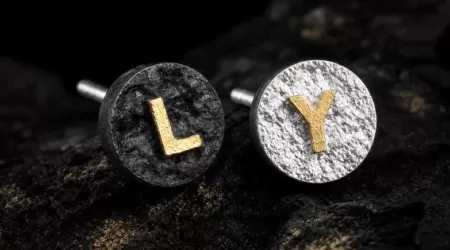
Skullearring's personalized initial stud earrings are described on their product page as a 999 fine-silver disc with an uppercase letter inlaid in 24K gold. That is the product's stated material and design description. It is not a claim that the whole stud is 24K gold, or proof that it uses any museum technique discussed above.
Use the live options to check available letters, finish and quantity. If exact letter depth, attachment method or future alteration is important to your decision, obtain confirmation before ordering. Do not assume that selecting an initial includes a separate engraving service, unlimited fonts or later re-lettering.
What to confirm before choosing
Ask: “What material forms the visible letter? Is it cut into the face, added to it, or both? Which construction details can you confirm in writing?” Then compare the answer with the actual product description. If an answer is missing, leave it unknown rather than filling the gap with a workshop story.
Bottom line: choose the documented design you want, not a supposed contest between engraving and inlay. The two terms can describe different stages of one object. For a gift, finish with the separate order-confirmation checklist so construction questions do not replace checking the recipient's letters and supplied quantity.
Sources and limits
The five linked primary sources above support terminology, process distinctions and gold-purity interpretation. Museum examples establish what those documented techniques mean; they do not certify this store's production methods. Product facts are limited to the linked live product record. The comparison questions are editorial guidance, not laboratory findings or a guarantee of wear performance.
Leave a comment