Short answer: bird earrings do not have one universal meaning. A bird may suggest flight, movement, memory, aspiration or simply a shape the wearer enjoys, but the defensible interpretation depends on the species, culture, period, maker and wearer. Museum records prove that bird forms have appeared in jewelry across many settings; they do not prove that every bird earring means “freedom,” “luck” or “protection.” For a modern purchase, separate personal symbolism from verifiable facts such as material, dimensions, weight, finish, orientation and whether the listing is for one earring or a pair.
Why “Bird Earrings Meaning” Has No One-Word Answer
“Bird” is a very broad label. A dove, peacock, crane, phoenix and unidentified small bird are not interchangeable images. Even two objects showing the same species can have different functions when they were made in different places, used in different ceremonies or chosen for different personal reasons.
A reliable interpretation therefore starts with evidence, not a symbol dictionary. Ask four questions:
- What bird is actually shown? A documented species is more informative than a generic wing shape.
- Who made or used the object? Culture, date, place and function determine context.
- What does the source record say? A museum label, maker statement or wearer account is stronger than a modern retail slogan.
- What remains personal? A wearer may give a design a private meaning without turning that meaning into a historical fact.
What Museum Records Actually Show
Authoritative collection records show variety rather than a single continuous tradition.
- The Metropolitan Museum of Art records a Phoenician gold earring, dated from the late fifth to third century B.C., with a glass pendant in the form of a bird, possibly a dove.
- Another Met collection record documents an eleventh- or twelfth-century Iranian earring whose bird body is made in gold filigree.
- A late sixth- or seventh-century Byzantine half-moon earring incorporates peacocks into a gold design.
- The Cleveland Museum of Art records a Muisca bird pendant, approximately dated 900–1550, as a cast-gold personal ornament from a different material and cultural setting.
- The Museum of Fine Arts Boston documents a marsh-bird hair ornament made by Arts and Crafts designer Charles Robert Ashbee and later converted to a brooch.
These objects differ in date, geography, construction and use. That difference is the key finding. The records demonstrate that bird imagery has been adapted repeatedly; they do not authorize us to transfer one object’s meaning to every modern earring.
Does a Bird Earring Mean Freedom?
Freedom is a common modern personal association because birds fly and move across boundaries visible to people. It can be a sincere reason for choosing a design. However, it is an interpretation, not a measurable property of the jewelry and not a meaning documented for every historical bird ornament.
The careful statement is: a wearer may use a bird earring as a personal reminder of freedom or movement. The overclaim is: bird earrings universally symbolize freedom. The museum evidence supports the first as a possible modern reading only when it is clearly labelled personal; it does not establish the second.
Do Bird Earrings Bring Luck or Protection?
No reliable source reviewed for this guide shows that wearing a bird earring changes probability, protects the body, prevents harm, improves health or creates a spiritual effect. “Lucky,” “protective” and similar words can be names, stories or wearer interpretations. They should not be presented as physical outcomes.
This boundary does not remove emotional value. Jewelry can mark a journey, person, achievement or memory. It simply keeps cultural interpretation separate from claims that would require evidence of an effect.
Why the Species Matters
| Motif | What can be said safely | What requires specific evidence |
|---|---|---|
| Generic bird | May evoke flight, movement, nature or personal memory. | A fixed cultural or religious meaning. |
| Dove | Identify it as a dove only when the design or source supports that identification. | Peace, faith or another tradition-specific reading for a particular object. |
| Peacock | Distinctive tail and eye-like feather forms can support species identification. | Royal, spiritual or protective meanings without context. |
| Crane | A long-necked bird motif can be discussed within a documented artistic tradition. | Longevity or good-fortune claims transferred to every crane design. |
| Phoenix | A mythological bird rather than a biological species. | Rebirth or renewal claims for an object whose maker did not establish that story. |
For focused examples, compare our evidence-bounded guides to crane earrings meaning and peacock feather earrings meaning. The purpose of those pages is not to create universal rules, but to show how species-specific research narrows the question.
Meaning and Product Facts Belong in Separate Columns
A product can be meaningful and still require ordinary specification checks. The Federal Trade Commission’s Jewelry Guides emphasize truthful representation of material aspects of jewelry, including type, metallic content, size and weight. Those fields are more useful for purchase evaluation than an unsupported symbolic promise.
| Question | Evidence type | How to verify |
|---|---|---|
| What does the bird mean to me? | Personal interpretation | The wearer’s own reason or a documented gift story. |
| What did it mean historically? | Object-specific interpretation | Museum record, maker documentation or reliable scholarship tied to that object. |
| What metal is it? | Product fact | Listing disclosure identifying the metal and the part it describes. |
| Will it cover my lobe? | Fit comparison | Named dimensions, fastening position and the wearer’s own measurement. |
| Will it feel light? | Individual experience | Per-earring weight plus a cautious first wear; no universal guarantee. |
| Am I buying one or two? | Purchase-unit fact | The selected single/pair option and total live price. |
A Real Product Example: Silver Bird Ear Climber
The current Silver Bird Ear Climber offers a useful example because its emotional reading and technical record can be kept separate.
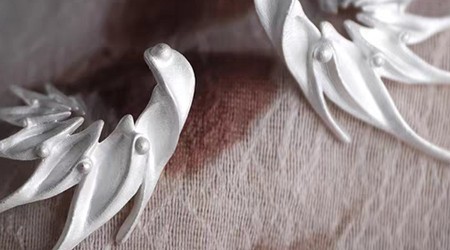
The live page verifies a multiple-bird sculptural form in 925 sterling silver with a satin white-silver finish. Each directional earring is approximately 30 mm high by 20 mm wide and about 5 g. Buyers can select a left single, right single or mirrored pair. These are catalog specifications, not promises that the design will fit every lobe or feel lightweight to every wearer.
The birds may personally suggest flight, community, motion or a remembered place. The page does not establish that the object brings freedom, luck or protection. Its strongest purchasing evidence is the narrower record: material, size, weight, finish, orientation and purchase unit.
How to Check Fit Before Buying a Bird Ear Climber
A directional climber rises along the lobe instead of hanging vertically. A mirrored pair needs one left-oriented and one right-oriented piece. Use the following checks:
- Confirm that the piercing is fully healed and comfortable.
- Measure the usable height and width from the piercing toward the outer lobe.
- Compare those measurements with the product’s named dimensions.
- Check whether weight is stated per earring or per pair.
- Select left, right or mirrored pair deliberately; do not infer orientation from a single photograph.
- Review the chosen option and live total price before checkout.
Our complete ear climber fit and orientation guide explains the measurement process and why identical jewelry can sit differently on different anatomy.
Care for Satin Sterling-Silver Bird Forms
Satin texture diffuses light and makes sculpted wing planes visible. It should not be polished automatically to a mirror finish. Wipe moisture and cosmetics away with a soft dry cloth, store the earring separately from harder jewelry, and hold the fastening or solid centre rather than pulling thin wing tips.
Sterling silver can tarnish during ordinary exposure. That does not prove that the item is fake. Use our sterling-silver tarnish and safe-care guide to distinguish surface change from material identification and to avoid overly abrasive cleaning.
Buyer Checklist
- The bird species is identified only when the design or source supports it.
- Historical meaning is tied to a specific object, culture and period.
- Personal symbolism is labelled as interpretation, not fact.
- The metal claim identifies fineness and the part it covers.
- Dimensions are stated in millimetres with named axes.
- Weight is stated per earring or per pair.
- Closure and left/right orientation are clear.
- The selected option states single or pair.
- No luck, protection, healing, allergy or spiritual-effect promise is treated as proven.
Conclusion
Bird earrings are best read in layers. The museum layer documents a particular object’s place, date, material and motif. The design layer identifies the species and construction. The personal layer belongs to the wearer. The buying layer verifies material, dimensions, weight, finish, orientation and quantity.
Keeping those layers separate produces a more accurate answer than a universal symbol list: a bird earring can carry a meaningful personal story, but the story should not replace historical context or product evidence.
Reviewed by the Skullearring Editorial Team on August 30, 2026. This article provides historical interpretation, product-selection and care information; it does not provide medical advice or promise physical or spiritual effects.
Sources
- Metropolitan Museum of Art: Phoenician gold earring with glass bird pendant
- Metropolitan Museum of Art: medieval Iranian bird-form earring
- Metropolitan Museum of Art: Byzantine half-moon earring with peacocks
- Cleveland Museum of Art: Muisca bird pendant
- Museum of Fine Arts Boston: Jewels, Gems, and Treasures
- Federal Trade Commission: Jewelry Guides
Tags: bird earrings meaning, bird jewelry history, silver bird earrings, ear climber earrings, sterling silver earrings
Related Products
Leave a comment