Short answer: star earrings can suggest guidance, hope, aspiration, remembrance or simply a love of celestial design. There is no single universal meaning. A star’s significance changes with culture, period, shape and the wearer’s own reason for choosing it. The defensible way to read a modern star earring is to separate interpretation from facts you can verify: material, size, finish, closure and whether the listing is for one earring or a pair.
What Is a Star—and What Is a Star Motif?
An astronomical star is not the pointed icon used in jewelry. NASA describes stars as giant bodies of hot gas whose energy comes from nuclear fusion. A jewelry star is a designed shape: often five, six or eight points, sometimes symmetrical and sometimes deliberately irregular.
That boundary matters. A five-point stud does not reproduce the physical form of a star, and its number of points does not automatically establish a religious, national or protective meaning. Shape can be a clue to context, but it is not proof by itself.
Why Are Stars Associated with Guidance?
Guidance is a reasonable modern interpretation because people have used celestial bodies to find direction. NOAA notes that sailors used constellations, the Sun and Moon to navigate before satellite positioning. The U.S. Naval Observatory documents how the Nautical Almanac supplied the astronomical data needed for navigation and still treats celestial navigation as an independent backup to electronic systems.
This history helps explain why a wearer may choose a star as a personal reminder to find direction, stay on course or remember a destination. It does not prove that every historical star jewel carried that message. “Guidance” is an interpretation grounded in a real human use of stars, not a universal dictionary definition.
Do Star Symbols Have One Ancient Meaning?
No. Museum records show star forms in different periods and settings, but the objects do not collapse into one story.
• The Metropolitan Museum of Art records a small gold star pendant from Egypt’s Middle Kingdom, dated approximately 1802–1640 B.C. or later.
• The Smithsonian National Museum of African Art records an Ethiopian Orthodox silver-alloy pendant cross with an eight-pointed star form and a specifically Christian wearing context.
• The British Museum records a nineteenth-century Asante gold star-shaped pendant whose curatorial notes connect stars with people in particular Akan proverbs and political relationships.
These records establish variety, not a continuous universal tradition. The Egyptian pendant, Ethiopian cross and Asante regalia differ in place, date, material, function and documented context. A modern five-point earring should not be assigned any of those specific meanings unless its maker or wearer identifies that connection.
Common Modern Meanings of Star Earrings
Modern wearers often use star jewelry in several overlapping ways:
• Guidance: a reminder of navigation, direction or staying on a chosen path.
• Aspiration: a visual shorthand for reaching higher, pursuing a goal or celebrating an achievement.
• Hope: a point of light against darkness, used as a personal rather than measurable promise.
• Memory: a small celestial marker associated with a person, date or private story.
• Style: a compact geometric form chosen with no symbolic claim at all.
None of these readings is compulsory. Jewelry can be symbolic, decorative or both. For a broader comparison of celestial motifs, see our evidence-bounded guide to sun and moon earrings meaning.
What Does a “Lucky Star” Earring Actually Promise?
A product name such as “Lucky Star” can describe a theme or intended mood. It cannot demonstrate that wearing the earring changes probability, brings good fortune, protects the wearer, improves health or produces another measurable outcome. Those effects are not supported by the astronomical, museum or product evidence reviewed here.
The safest reading is simple: “lucky” is part of the design name, while any feeling of encouragement or good fortune belongs to the wearer’s personal interpretation.
Meaning Versus Verifiable Product Facts
A Real Product Example: Fine Silver and Gold Inlay Star Stud
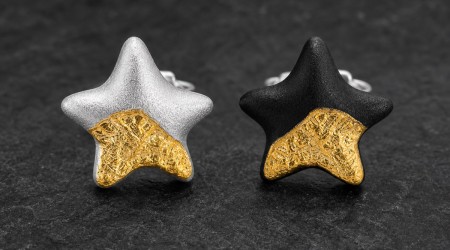
The live Lucky Star Stud Earrings record describes a softly rounded five-point face approximately 9–10 mm wide. The decorative face is identified as 999 fine silver with textured 24K gold inlay. Finish options are Natural Silver and Black Oxidized, and the listing offers a single earring or a pair. The closure is described as a straight post with push-back.
The material statement must stay component-specific. The current record does not separately state the composition of the post or push-back, so it would be inaccurate to say that every component is 999 fine silver. Likewise, 24K gold inlay describes the gold detail, not the entire earring. For construction differences, compare our guides to 24K gold inlay on silver earrings and gold inlay vs vermeil vs gold plating.
The U.S. FTC Jewelry Guides provide the regulatory framework for precious-metal representations. A product’s own verified fields remain the controlling source for its materials, dimensions and quantity. Browse the broader silver earrings collection to compare those fields across designs.
How to Choose Star Earrings
• Decide whether meaning matters. Choose a star for guidance or aspiration if that interpretation is personal to you; do not treat a retail name as an outcome guarantee.
• Check the point count and shape. A rounded five-point star reads differently from a sharp eight-point form, but shape alone does not prove cultural affiliation.
• Verify face size. Millimeter dimensions are more useful than “small” or “statement.”
• Separate face, post and back materials. One fineness claim may not cover every component.
• Confirm finish and gold technique. Oxidation is a surface treatment; inlay, vermeil and plating are not interchangeable terms.
• Confirm quantity. Check whether the live option is one earring or a pair before relying on the displayed total.
Conclusion
Star earrings do not have one fixed meaning. Guidance, hope and aspiration are plausible modern readings, especially given the long practical relationship between stars and navigation. Museum records also show that star forms have appeared in very different cultural settings, which is precisely why context matters. Treat symbolism as personal and cultural interpretation; treat material, size, finish, closure and quantity as facts that must be verified on the product page.
Sources
• NASA Science — Stars
• NOAA Ocean Service — What is GPS?
• U.S. Naval Observatory — History of The Nautical Almanac
• The Metropolitan Museum of Art — Star pendant
• Smithsonian National Museum of African Art — Pendant cross
• British Museum — Asante star-shaped pendant / soul disc
• Federal Trade Commission — Jewelry Guides
NASA — Stars — https://science.nasa.gov/universe/stars/
NOAA — Navigation before GPS — https://oceanservice.noaa.gov/facts/gps.html
U.S. Naval Observatory — Nautical Almanac history — https://aa.usno.navy.mil/publications/na_history
The Metropolitan Museum of Art — Star pendant — https://www.metmuseum.org/art/collection/search/546744
Smithsonian — Pendant cross — https://www.si.edu/object/pendant-cross%3Anmafa_71-23-1
British Museum — Asante star-shaped pendant — https://www.britishmuseum.org/collection/object/E_Af-Ash-27
Federal Trade Commission — Jewelry Guides — https://www.ftc.gov/business-guidance/resources/jewelry-guides
Related products and reading
Sun and moon earrings meaning — https://skullearring.com/silver-earring-journal/sun-moon-earrings-meaning-history-symbolism
Lucky Star stud earrings — https://skullearring.com/lucky-star-stud-earrings-999-fine-silver-24k-gold-inlay
24K gold inlay silver earrings guide — https://skullearring.com/silver-earring-journal/24k-gold-inlay-silver-earrings-guide
Gold inlay vs vermeil vs gold-plated silver — https://skullearring.com/silver-earring-journal/gold-inlay-vs-vermeil-vs-gold-plated-silver
Silver earrings collection — https://skullearring.com/silver-earrings
Related Products
Leave a comment