On an earring, “999” normally means 999 parts per thousand silver—99.9% pure silver—for the part the description or mark actually covers. It does not, by itself, say that the post, backing, solder, inlay, coating or every other component is the same metal. Read it as a fineness statement first, then check exactly which component it describes.
This guide explains how to read that statement without turning a number into a promise it cannot make. It is not an assay of an individual earring, a substitute for a seller’s current product specification, or a medical suitability claim.
What “999” and “fine silver” mean
Fineness is commonly expressed in parts per thousand. The British Hallmarking Council’s official fineness guidance lists 999/Fine Silver, 958/Britannia, 925/Sterling and 800 among accepted silver fineness descriptions in its UK context. The Gemological Institute of America likewise explains that a 999 mark means 99.9% pure silver and calls it fine silver.
That makes 999 and 925 different statements, not competing quality labels. The U.S. Federal Trade Commission explains that “sterling silver” or “925” refers to products containing 92.5% pure silver. Higher fineness does not automatically mean a better choice for every design, price point or part of an earring.
Why an earring needs a component-by-component reading
An earring is an assembly. Its face, decorative inlay, post, clutch, jump ring, stone setting and soldered joins can be different components. A description such as “999 fine-silver face” supports a claim about that named face; it does not establish the composition of a backing that the description does not identify.
This is especially important when more than one precious metal appears. A 24K gold detail and a 999 silver disc are not the same claim, and neither means the whole earring is solid gold. The British Hallmarking Council’s guidance on gold-plated silver descriptions warns that gold references can mislead where the construction is not stated clearly. For a construction comparison, use our separate guide to gold inlay, vermeil and gold-plated silver.
What a 999 mark cannot tell you
- It cannot identify every component. The mark may apply to a named part rather than the post, back or a repair.
- It cannot prove construction. It does not tell you whether a gold-coloured detail is inlay, plating, a separate component or another treatment.
- It cannot prove condition. A fineness number does not show whether a post is bent, a setting is secure or a repair has changed the piece.
- It cannot answer fit or sensitivity. Fit depends on form and dimensions; individual reactions and product-specific component information need separate assessment.
- It cannot replace seller accountability. A mark is one data point, not a complete record of origin, maker, policy or current configuration.
For the same reason, a photograph cannot authenticate purity by colour. If you need help separating visual clues from evidence, see what product photos can and cannot verify.
Fine silver, softness and design
GIA notes that 999 silver is very soft and can be susceptible to scratches and dents. That is a material property, not a verdict on every 999-silver earring. Thickness, form, texture, reinforcement, wear pattern and which component is actually fine silver all matter. The dedicated guide Why Do Fine-Silver Earrings Bend? covers that mechanical question without treating 999 as either fragile by definition or permanently damage-proof.
For a buyer, the practical response is to ask for the named dimensions, weight and component materials relevant to the design you are considering. Do not infer those values from a macro photograph or from the purity number alone.
Hallmarks, stamps and jurisdiction
A purity stamp and a complete hallmark are not synonyms. In the UK, the government’s hallmarking summary describes a complete hallmark as including a sponsor or maker’s mark, a metal-and-fineness mark, and an assay-office mark. The same guidance says some articles are exempt from compulsory UK hallmarking below stated weight thresholds, including 7.78 g for silver. Those are UK legal rules and exemptions, not a global rule or proof that an unmarked earring is or is not silver.
The FTC similarly advises U.S. buyers to look for the seller’s name or registered trademark alongside precious-metal quality descriptions. Before purchasing, check the description, seller identity, returns information and the market rules that apply to your delivery destination. An online description should state the facts a buyer needs; it should not use a number as decoration.
A real product example: personalized initial studs
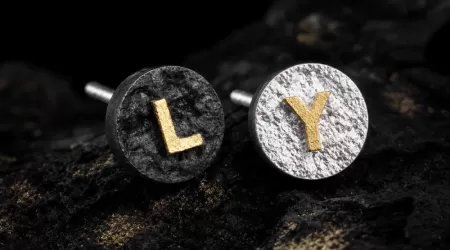
The live Personalized Initial Stud Earrings page describes a 999 fine-silver disc with an uppercase letter inlaid in 24K gold. It also identifies a straight post and butterfly backing, but the product record should be read only for the material and option fields it explicitly states. It would be inaccurate to say that every component is 999 silver, that the entire stud is 24K gold, or that the page proves an assay hallmark when those details are not stated.
For a purchase, use the listing’s live option summary to confirm the selected initial, finish and single-stud or pair choice. Then compare that order summary against the product’s stated construction. The 24K gold-inlay silver earrings collection is a useful place to compare documented designs, but each product page remains the controlling record for its own specifications.
A five-question reading checklist
- Which component does the number describe? Look for “face,” “body,” “post,” “back” or another named part.
- Is the fineness separate from the gold detail? Distinguish 999 silver from 24K gold, plating, inlay and other construction terms.
- Is it a hallmark or only a stated purity mark? Do not add an assay-office claim that the seller has not made.
- What remains unknown? Write down unspecified parts instead of filling gaps from an image.
- What decision are you making? For fit, care, repair or a purchase, request the product-specific facts that answer that exact question.
Bottom line
“999 fine silver” is a precise and useful fineness statement when it is tied to a named component. It is not a universal description of an assembled earring and does not settle construction, origin, fit or care. The most reliable listing makes the metal, component and technique legible together—then leaves anything not documented as unknown.
Evidence and limits
This guide draws on the FTC’s consumer guidance on gold and silver jewelry, the British Hallmarking Council’s official guidance on hallmarks and fineness, the Council’s guidance on gold-plated silver descriptions, and GIA’s material overview. They define terms and legal or consumer context; they do not assay a particular Skullearring item or endorse this store. Product statements above are limited to the linked live product record checked on 16 September 2026.
Leave a comment