Short answer: fine-silver earrings can bend because high-purity silver is naturally workable: it is soft, malleable and ductile. Sterling silver is alloyed partly to increase strength, but purity is only one factor. The thickness and shape of the earring, how the metal was formed, the location of joints, and the force applied all affect whether a post, hoop or decorative section changes shape.
A slight change in a deliberately adjustable part is not the same as a failing solder joint or cracked setting. Do not repeatedly bend a post back and forth. Stop wearing the earring if a post, hinge, stone setting or joined area moves unexpectedly, and ask a qualified jeweler to inspect it.
Fine silver is workable by design
The U.S. Geological Survey describes silver as malleable and ductile. Malleability means a metal can be shaped under compression; ductility describes its ability to deform under tension. Those properties help a metalsmith form silver, but they also mean a thin section can change shape when enough force is applied.
A second USGS silver study calls silver soft, malleable and ductile and notes its long use in personal adornment. These are material properties, not a prediction that every silver earring will bend during normal wear.
999 fine silver and 925 sterling are not identical
A 999 mark describes approximately 999 parts silver per thousand. A 925 or sterling mark describes 925 parts silver per thousand. The U.S. Federal Trade Commission explains that 925 is a silver-content mark. The remaining portion of a sterling alloy is made from other metal or metals.
The Gemological Institute of America explains that silver used for jewelry is often alloyed to improve strength and that 999 fine silver is especially susceptible to scratches and dents. That makes composition relevant, but it does not establish a universal hierarchy for finished earrings. A thick, compact fine-silver form may resist an everyday load better than a very thin sterling component. Manufacturing, heat treatment, work hardening and design still matter.
For a fuller purity comparison, read 925 sterling silver versus 999 fine silver earrings.
Six factors that determine whether an earring bends
| Factor | Why it matters | What a buyer can verify |
|---|---|---|
| Silver fineness | Higher-purity silver generally contains less strengthening alloy, but fineness alone does not define the finished part. | The stated 999, 925 or other composition and whether it applies to the whole earring or only one component. |
| Section thickness | A slender post or thin open hoop can flex more readily than a compact, thicker section made from the same alloy. | Face width, wire or post dimensions when the seller publishes them. |
| Geometry and leverage | Force applied far from a joint creates more leverage than the same force near the supported area. | Overall dimensions, moving parts and where the earring is held during use. |
| Manufacturing history | Hammering, rolling, forming and heating can change the local response of metal. | Only documented processes; do not infer an exact hardness value from appearance. |
| Joints and mixed components | A post, hinge, solder seam, stone setting and removable back can use different constructions or alloys. | Which part moved and whether the movement occurs at a joint. |
| Loading history | Snags, drops, squeezing and repeated adjustment can accumulate damage. | A recent event, new misalignment, rough closure or visible crease. |
A bend is an observation, not a diagnosis
First identify exactly what changed. A straight post that now points sideways, a hoop that no longer closes, and a decorative leaf designed to be gently posed are three different situations. Compare both earrings, current product photographs and any maker instructions. Do not assume that a visible difference proves a metal-composition problem.
The FTC's Jewelry Guides require truthful descriptions of metallic content, durability, size and weight. A fineness claim describes content; it is not a laboratory certificate for every mechanical property of a finished design.
Inspect before you try to reshape anything
- Remove the earring without pulling the decorative face. Support the post or closure as the maker intends.
- Work in bright light. Look for a crack, crease, lifting inlay, loose stone, opened solder seam or rough hinge.
- Separate the components mentally. The decorative body, post, hinge and back may not use the same alloy.
- Compare alignment without forcing it. Check a matching earring or verified listing photograph.
- Stop if the change is at a joint. A moving joint requires inspection, not repeated home adjustment.
The Canadian Conservation Institute recommends examining silver construction, including solder joins, hollow sections, gilding, inlays and plating, before treatment. Its guidance concerns collection objects, but the inspection principle is useful for jewelry: do not apply one remedy to an object made from several materials and joints.
Why repeated bending is a poor test
Bending a post back once may seem to restore its appearance, but moving it repeatedly in opposite directions is not a harmless way to test quality. It places additional strain on the same small area, while the wearer cannot see what is happening inside the metal or joint.
The U.S. National Park Service Museum Handbook warns that careless handling can dent, bend or break metal objects and that their strength should not be overestimated. Jewelry is made to be worn rather than archived, but the mechanical caution still applies: use the closure as designed and let a jeweler assess structural correction.
Care habits that reduce accidental deformation
- Put earrings on after clothing, scarves and headphones to reduce snagging.
- Remove them before sleep, sport or any activity where the earring can be compressed.
- Open a hinged hoop at its closure; do not pull the whole circle sideways.
- Press a push-back along the post axis instead of levering the decorative face.
- Store each earring in a separate soft compartment so heavier pieces cannot crush thin parts.
- Do not polish a bent area aggressively. CCI notes that abrasive polishing removes underlying silver as well as surface material.
If fit or leverage is the concern, use the earring-weight and comfort guide and the guide to reading earring dimensions online. Weight, diameter and closure geometry answer different questions.
A verified product example
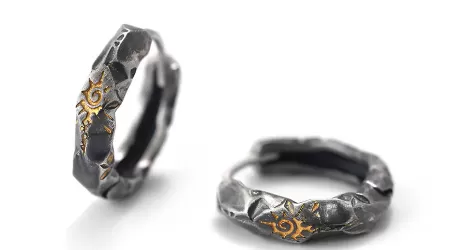
The Faceted Fine-Silver Small Hoop is listed as 999 fine silver with 24K gold inlay, approximately 2.2 g per earring and a 4.5 mm face. Its separate push-back is listed as S925. This is a useful construction example because the decorative body, straight post and removable backing should be checked as separate parts.
Those facts do not publish a hardness value, a bend threshold or a promise that a thin component cannot deform. They help a buyer ask the right follow-up questions: which part is 999, which part is 925, which area moved, and did the movement occur at a joint?
When to stop wearing the earring
- The post has a sharp crease, crack or rough edge.
- A soldered connection moves relative to the decorative body.
- A hinge no longer closes securely or aligns with its catch.
- A stone or inlay is loose, lifted or newly rattling.
- The back slips off, jams or requires force.
- The earring presses, pinches or changes angle in a way it did not before.
A care article cannot certify a damaged earring as safe. For surface cleaning after the construction has been checked, follow the finish-specific guidance in how to clean oxidized silver earrings. Cleaning does not repair a crack or moving joint.
Buying checklist for fine-silver earrings
| Ask | Why the answer helps |
|---|---|
| Is the fineness stated for every component? | A body, post and backing may differ. |
| Are dimensions and per-ear weight published? | They help assess scale, leverage and fit without inventing a durability guarantee. |
| How does the closure operate? | Correct operation reduces unintended sideways force. |
| Are stones, inlays, plating or oxidized areas present? | Mixed materials change cleaning, handling and repair decisions. |
| What should happen if alignment changes? | A maker-specific inspection or repair path is safer than repeated home bending. |
Bottom line
Fine silver can bend because workability is part of the material, not automatically evidence of poor workmanship. Sterling alloying can improve strength, but no purity mark by itself predicts the behavior of every finished earring. Judge the exact component, geometry, joint and loading event. Avoid repeated reshaping, stop wearing a piece with a damaged post, hinge, setting or seam, and use a qualified jeweler for structural inspection.
Browse the silver earrings collection to compare verified material, size, closure and per-ear weight details before choosing a design.
Sources
- U.S. Geological Survey: Mineral Resource of the Month — Silver
- U.S. Geological Survey: Silver — A Materials Flow Study
- Gemological Institute of America: White Gold vs. Silver
- Federal Trade Commission: Buying Platinum, Gold, and Silver Jewelry
- Federal Trade Commission: Jewelry Guides
- Canadian Conservation Institute: Silver — Care and Tarnish Removal
- U.S. National Park Service: Curatorial Care of Metal Objects
Leave a comment