Direct answer: bamboo earrings can carry meanings associated with integrity, constancy, resilience, and cultivated character—but only when the object’s cultural and historical context supports that reading. In Chinese literati art, ink bamboo became closely tied to the ideal of the principled scholar. Korean scholar-painters used the motif within related Confucian traditions. In Japanese art, bamboo may signal strength of purpose, fidelity, purity, good fortune in a specific “Three Friends of Winter” setting, or simply a long-established material and visual subject. A bamboo-shaped earring does not automatically promise luck, health, prosperity, or spiritual protection.
This guide separates documented art-historical associations from modern styling language. Its purpose is not to assign one universal meaning to every bamboo design, but to show how a careful interpretation can be built from evidence.
Why bamboo does not have one universal jewelry meaning
“Bamboo meaning” is often compressed into a list of attractive words: luck, strength, wealth, flexibility, longevity. That approach removes the object from the culture, period, medium, and companion motifs that gave it meaning. A Yuan-dynasty Chinese ink painting, a Joseon Korean scholar painting, a Japanese bamboo basket, and a modern silver ear climber are not interchangeable evidence.
The safest method is to ask five questions: What exactly is depicted? Where and when does the interpretation come from? Is bamboo shown alone or with pine and plum? Is the object made from bamboo or merely shaped like it? Does a museum or scholarly source connect that particular context to the claimed idea?
Evidence map: what authoritative collections actually support
| Context | What the evidence supports | What it does not prove |
|---|---|---|
| Chinese literati ink bamboo | Links to the ideal gentleman, moral integrity, upright principle, and endurance under pressure. | That every bamboo ornament is a talisman or creates those qualities in its wearer. |
| Korean Joseon scholar painting | Integrity, nobility, resilience, and fortitude within a Confucian painting tradition. | One fixed meaning across all Korean objects or all periods. |
| Japanese bamboo in painting and decorative art | Strength of purpose, fidelity, purity, long use as a subject, and context-specific auspicious associations. | That bamboo always means “good luck” when shown alone. |
| Three Friends of Winter | Bamboo read together with pine and plum as enduring winter plants and an established East Asian art theme. | That a lone bamboo leaf must carry the complete meaning of the trio. |
| Modern bamboo-shaped jewelry | A contemporary design may reference leaf structure, growth, flexibility, or the histories above. | Medical, spiritual, financial, or relationship effects. |
Chinese art: the principled scholar and the bending stalk
The clearest documented symbolism appears in Chinese literati culture. The Metropolitan Museum of Art’s exhibition Noble Virtues: Nature as Symbol in Chinese Art explains that bamboo’s ability to bend in cold wind without breaking made it an image of a virtuous person who withstands hardship. The comparison concerns character under pressure; it is a metaphor created through observation and cultivated through painting and poetry.
The Kyoto National Museum’s study of Chinese ink bamboo paintings places this tradition within the history of brush painting associated with figures such as Wen Tong and Su Shi. It connects bamboo’s upright sections and nodes with the ideal gentleman, virtue, and an unyielding moral principle. Ink bamboo also became a way for painters to express mind and character through disciplined brushwork rather than a botanical illustration alone.
A Smithsonian National Museum of Asian Art publication offers a complementary object-level example. In its discussion of a Chinese garden scene, bamboo is identified as a “gentleman” and symbol of moral integrity because the stalk returns upright after bending in wind. The physical behavior is the basis of the metaphor; it is not evidence that wearing a bamboo motif changes a person’s character.
Princeton University Art Museum also shows why context matters. Its exhibition essay New on View: In the Garden describes Chinese garden plants as components of deliberately encoded symbolic programs. In that setting, bamboo could represent gentlemanly humility and constancy, with longevity also appearing in the garden’s larger symbolic language. This is stronger evidence than a generic online claim because it specifies both setting and interpretive tradition.
Korean art: integrity and resilience in a scholar-painter tradition
The Korean evidence is related to, but should not be collapsed into, the Chinese examples. The Met’s Joseon-dynasty work Bamboo in the Wind by Yi Jeong explains that bamboo carried Confucian and Daoist associations with integrity and nobility. The plant’s ability to bend without breaking embodied resilience and fortitude. The work belonged to a learned painting culture in which brush control, personal cultivation, and the chosen motif interacted.
That evidence supports a historically grounded reading of resilience. It does not justify saying that all bamboo jewelry is “Korean,” that the motif has one meaning throughout Korean history, or that a modern wearer receives a guaranteed psychological benefit. A contemporary earring can be inspired by the idea without becoming equivalent to a Joseon ink painting.
Japanese art: a motif, a material, and several context-dependent readings
Japanese bamboo history is broader than a single symbol. The Met’s catalogue Japanese Bamboo Art: The Abbey Collection documents bamboo’s long presence in everyday life and sophisticated art practice. In basketry, bamboo is not merely pictured; it is the structural material shaped through specialized craft knowledge. That material history should not be confused with a silver object that depicts bamboo leaves.
Painting offers another layer. A British Museum screen of bamboo standing upright in snow records long associations with strength of purpose, fidelity, and purity, while noting bamboo’s place beside pine and plum in winter imagery. The museum’s object history situates these associations in Japanese painting traditions rather than presenting them as universal definitions.
The Kyoto National Museum’s “Three Friends of Winter” exhibition further demonstrates how bamboo’s meaning changes when it appears with pine and plum. The three plants remain visually alive through winter and became a shared theme across Chinese and Japanese art. On Japanese mirrors and other decorative objects, the combination can function as a celebratory motif. A lone leaf-shaped earring, however, should not automatically inherit every association of the full group.
A practical five-step interpretation framework
- Identify the form. Is it a stalk, a jointed cane, a leaf, an ink-brush cluster, or an abstract openwork shape? A leaf silhouette may emphasize growth and direction more than the bending-stalk metaphor.
- Name the cultural source. “East Asian” is too broad when a specific Chinese, Korean, or Japanese work is available. Use the narrowest supported description.
- Check period and medium. Literati painting, garden design, basketry, mirrors, and modern jewelry create meaning in different ways.
- Look for companion motifs. Pine and plum materially change the interpretation by placing bamboo within the Three Friends of Winter. Birds, rocks, calligraphy, and snow can also guide the reading.
- Separate interpretation from outcome. A motif can remind a wearer of constancy or resilience. It cannot prove that wearing it creates health, wealth, luck, protection, or moral virtue.
Which common bamboo-jewelry claims are well supported?
“Bamboo represents resilience.” Strongly supported when tied to the documented metaphor of bending without breaking in Chinese and Korean scholar art, and to context-specific Japanese works.
“Bamboo represents integrity or constancy.” Supported in Chinese literati and Korean Joseon contexts, and in some Japanese painting interpretations. State the context rather than treating it as a global dictionary definition.
“Bamboo means good luck.” Sometimes supported when bamboo appears in an auspicious ensemble such as pine-bamboo-plum. Too broad as a claim about every bamboo object.
“Bamboo brings wealth, healing, or protection.” Not established by the museum and scholarly evidence reviewed here. A retail product should not turn symbolic language into a promise of material or medical results.
“Bamboo jewelry is sustainable.” Not true merely because the design looks botanical. A silver bamboo motif is still a metal object; sustainability would require separate evidence about sourcing, manufacture, packaging, durability, and end-of-life handling.
How the current Skullearring bamboo design should be described
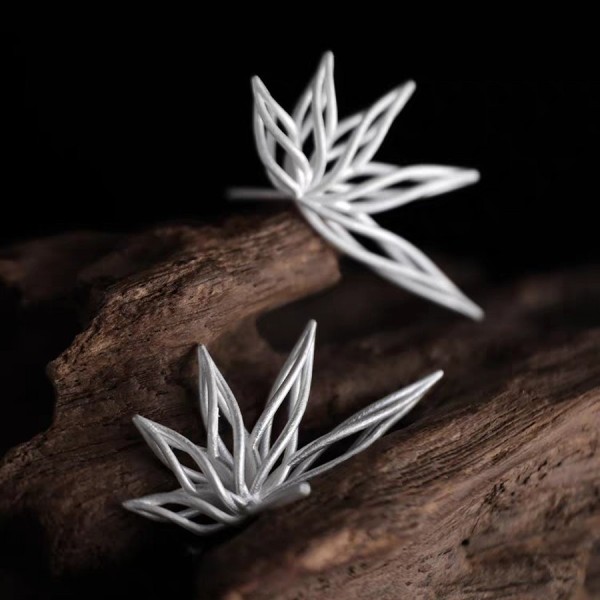
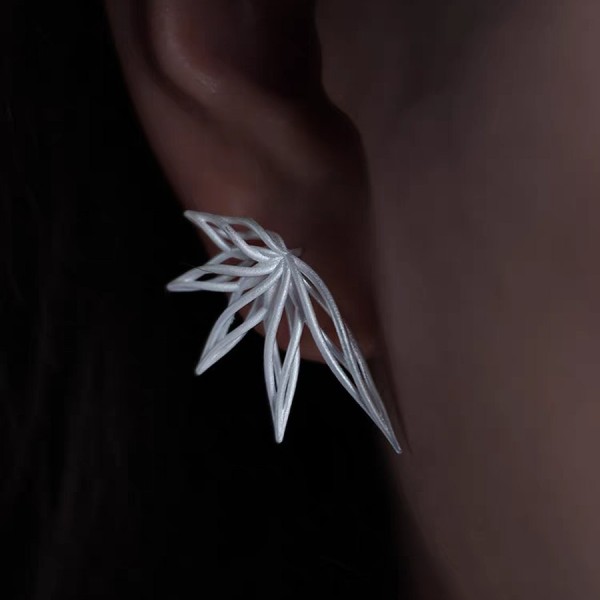
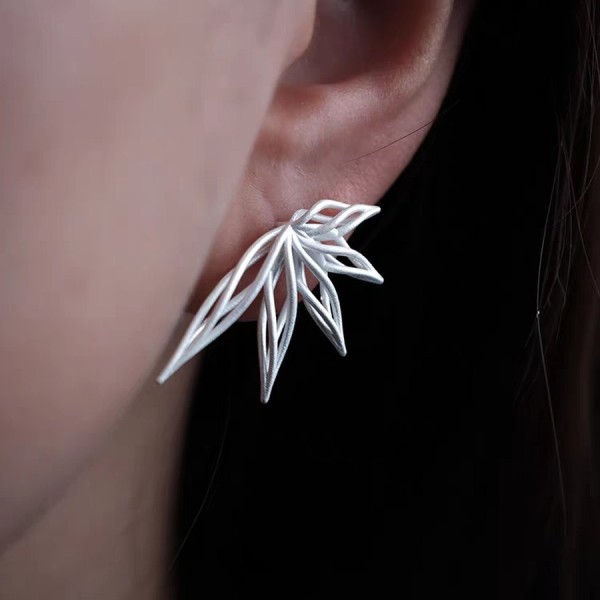
The live Bamboo Leaf Ear Climber is a contemporary openwork bamboo-leaf design in 925 sterling silver with a satin white-silver surface. The verified product record lists an approximate height of 30 mm, width of 15 mm, and weight of about 3 g per earring. It is directional, with separate left-ear and right-ear singles plus a mirrored-pair option.
Those facts support a visual reading of upward movement, branching, and light passing through the leaf framework. They do not establish a traditional date, ritual use, or guaranteed symbolic effect. For fitting guidance, use the left/right ear-climber fit guide; for purchase-language clarification, see the single-earring versus pair guide.
How to choose and wear a bamboo motif respectfully
- Describe the piece first: material, shape, finish, size, and orientation.
- If you mention symbolism, cite the relevant culture and art context.
- Use phrases such as “can evoke” or “has been associated with” instead of “will bring.”
- Do not label a modern design as an ancient amulet without provenance.
- Do not combine unrelated Chinese, Korean, and Japanese meanings into a single exotic story.
- Let the wearer choose a personal association while keeping the historical evidence visible.
Readers comparing silver fineness can consult 925 versus 999 silver for earrings. For another evidence-bounded motif study, compare the crane earrings art-context guide and the lotus earrings meaning guide. The full collection is available through Silver Earrings, and related research appears in the Silver Earring Journal guides.
Limitations and uncertainty
This article reviews selected museum and scholarly sources, not every regional bamboo tradition. Meanings change across time, medium, religious setting, social class, and individual maker. Museum interpretation can also be revised as scholarship develops. The evidence supports historically bounded associations; it does not prove a universal code, a wearer’s intention, or any physical or spiritual effect.
FAQ
Do bamboo earrings mean resilience?
They can. The bending-without-breaking metaphor is well documented in Chinese and Korean scholar art, and related associations appear in Japanese works. The strongest wording is that a bamboo motif can evoke resilience—not that it produces resilience.
Are bamboo earrings lucky?
“Lucky” is too broad without context. Bamboo can participate in auspicious combinations, especially with pine and plum, but a standalone modern bamboo earring is not evidence of a guaranteed fortune effect.
Is the meaning Chinese or Japanese?
Both Chinese and Japanese art histories contain important bamboo traditions, and Korean scholar painting does as well. The interpretations overlap but are not identical. Identify the specific source, period, and medium whenever possible.
Does a silver bamboo earring have the same meaning as a bamboo basket?
No. A silver earring depicts the plant; a bamboo basket is made from the plant and belongs to a material craft tradition. The two can be discussed together only after that difference is made explicit.
Can bamboo earrings improve health or attract wealth?
No reliable evidence reviewed here establishes those effects. Historical symbolism and personal reminders should not be converted into medical or financial claims.
Sources and review date
Evidence reviewed 15 August 2026. Core references: The Metropolitan Museum of Art; Kyoto National Museum; Smithsonian National Museum of Asian Art; Princeton University Art Museum; British Museum; and the Met’s Joseon and Japanese bamboo collections. Links appear beside the claims they support.